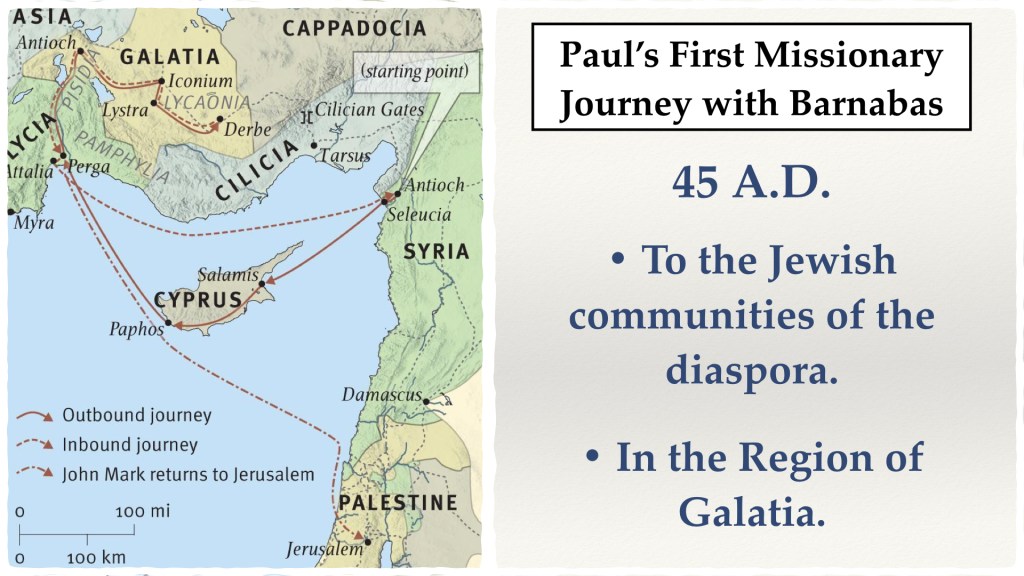
Opening: The book of Galatians is a letter sent to a region of churches in an area known as Galatia (thus the title of the book). This area of Galatia is the area that Paul planted churches in during that first missionary journey with Barnabas (Acts 13 and 14). The book of Acts records two journeys for Paul before his arrest in Jerusalem (Acts 21). His first journey, the one with Barnabas, is done among the Jewish population dispersed within in the old empires of the Babylonians or Assyrians. Paul and Barnabas would find the local synagogue and preach the gospel. (Note: Paul’s second missionary journey was into modern day Greece, an area that was not a part of the pre-Roman Empires of Babylon or Assyria / Persia and thus was a radically different cultural context for Paul to proclaim the Gospel in). Since there was a such strong traditional Jewish context among those first churches that Paul and Barnabas planted a natural question that arose was what does it mean to be a Christian in context to the law of Moses? This question was especially important for those who were never Jewish (i.e. gentiles). Paul and Barnabas traveled to Jerusalem to meet with Peter and other people who knew Jesus to ask this question about the law. This meeting is called the Jerusalem Council and can be found in Acts 15 (We will talk more about this gathering when we get to Galatians 2). The point is that Peter, an apostle or Jesus, affirmed the very same gospel that was given to Paul through revelation in Jesus. Here is a part of Peter’s speech at the council; “9 and he made no distinction between us and them, having cleansed their hearts by faith. 10 Now, therefore, why are you putting God to the test by placing a yoke on the neck of the disciples that neither our fathers nor we have been able to bear? 11 But we believe that we will be saved through the grace of the Lord Jesus, just as they will (Acts 15:9–11 ESV).”
It would seem that the Jerusalem Council answered the question about the law, but it did not solve the problem, for people still went to the churches in Galatia insisting that in order to be a Christian, to be saved, one must follow the law. This means that the grace of God no longer was grace, a gift. Thus, the good news (Gospel) ceased to be good and became just another ma- made religion of works.

Thus, the purpose of this letter to the churches of Galatia – Paul is fighting for the gospel. In this post we will look at just the first 5 verses of Galatians 1. These verses represent Paul’s salutation where he communicates who he is, who this letter is to, and a great summary of the gospel itself. Galatians 1:1-5 reads; “1 Paul, an apostle—not from men nor through man, but through Jesus Christ and God the Father, who raised him from the dead— 2 and all the brothers who are with me, To the churches of Galatia: 3 Grace to you and peace from God our Father and the Lord Jesus Christ, 4 who gave himself for our sins to deliver us from the present evil age, according to the will of our God and Father, 5 to whom be the glory forever and ever. Amen (Galatians 1:1–5 ESV).”
1. Paul, an Apostle
Paul is fighting for the gospel. One of the ways that the gospel was attacked was to attack Paul. I am sure these false teachers were saying things like “Who is this Paul guy, who gives him any authority to tell us what Jesus said and did?”
Thus, the very first thing that Paul does is to establish his authority. Paul says about himself that he is an Apostle, and this is a big deal.
- The word apostle in Greek literally means one who is sent. And thus, one could argue that all people are apostles, meaning, that all people are called and sent by God according to his purposes
- But in the early church, the word apostle had a very special meaning. It referred back to the original 12 disciples of Jesus, those what he called out of the multitude for special fellowship and teaching from him. They were unique and they carried a unique authority in the church.
As you can imagine, there were many people who had all kinds of things to say about Jesus and his teachings. I can picture peopled healed by Jesus describing the miracle, and those who sat and heard his teaching probably retold the experience over and over again. Also, knowing how easy it is for people to exacerbate or to make up stories to make themselves look more important there was probably a lot of false things being said about Jesus as well. How does one know what is true and what is false? The answer of the early church was if the teaching came from an apostle, one of the twelve chosen disciples of Jesus (minus Judas of course).
An apostle was the voice commissioned and authorized by God – selected by Jesus – to reveal the works, words and meanings of Jesus. The voice of the apostle was authoritative and the church itself was built upon the witness of these apostles. Not only was the church built upon the witness of the apostles, but the New Testament itself is the apostolic witness of Jesus Christ. Their witness is how we has the New Testament.
A church like us (New Baptist Church), even though there have been a tremendous amount of historical forces over these past 2000 years that have shaped our practice, I count ourselves as being an apostolic church in so much that we are faithful to the teachings of scripture that have been given to us through the Apostles. For it is their teaching that defines what is orthodoxy (right doctrine).
Therefore, when Paul says – Paul, an apostle—not from men nor through man, but through Jesus Christ and God the Father, who raised him from the dead— It is a bomb shell. Paul is calming an authority that is equal to Peter’s and the rest of the Apostles. It is not hard to imagine what people are saying about Paul.
- Paul was never a follower of Jesus.
- He did not even meet him.
- In fact, he was a chief persecutor of the church and actually killing Christians.
- Paul is crazy. You cannot trust anything he says.
How can this man – Paul – claim such an authority? This is how – Paul will be saying about himself “Because I encountered the resurrected Lord and was called by him and sent by him for the purpose of the gospel, I am an apostle – an authoritative voice of who Jesus is, of what he has done, and what it means to follow him.” And – by the very fact that we have this book of Galatians and other letters of Paul, shows that the other Apostles – Peter, James and John – accepted Paul as an apostle, as being authoritative in what he taught.
Before moving on a very important note needs to be made. There are no living apostles today in the same way that Paul and Peter were apostles. The ministry of the apostles ended with the apostles. There is no one alive today who has the authority that the apostles had. The authority to add to the New Testament, the authority to define orthodoxy (right doctrine) and orthopraxy (right practice). God still works, God is active, God sends people, but the work and authority of the apostles was limited to the life of those apostles. Therefore, if you ever come across a preacher who claims the same type of authority that Paul claims, the authority of an apostle, my advice to you is to run away.
2. Grace and Peace
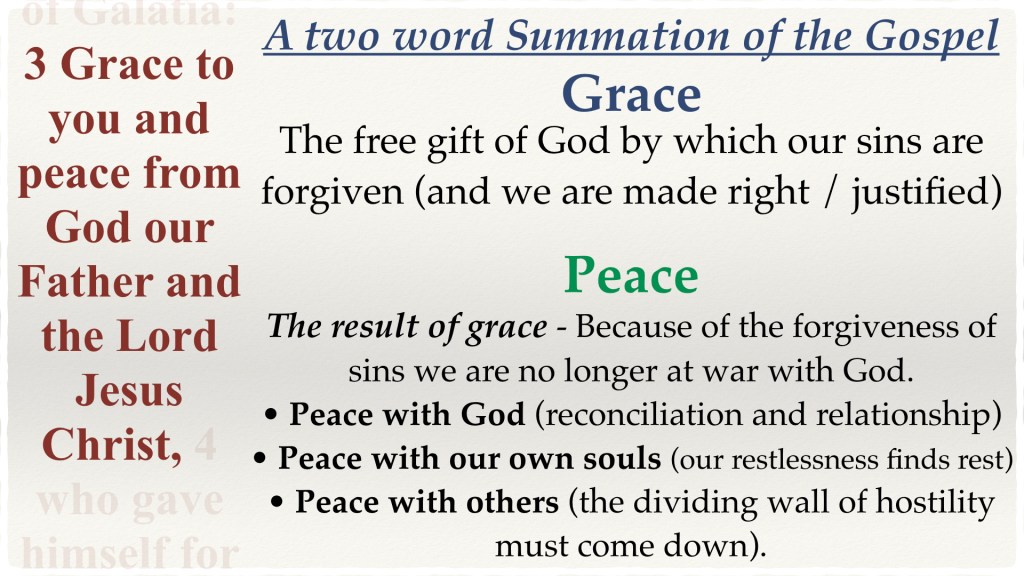
Moving on in the opeing verses, after tells us who this letter is directed towards, he says in vs 3 “Grace to you and peace from God our Father and the Lord Jesus Christ.”
These two words – Grace and Peace – are the summary of the entire gospel. Simply put:
- Grace is the free gift of God by which our sins are forgiven.
- Peace is the result of this free gift of grace given to us. Peace with God – because of grace (the forgiveness of sins) we are no longer at war with him, the rebellion is over. And because of that peace with him
- – we begin to experience peace with ourselves (our conscious is quieted, our restlessness finds rest and our life finds life).
- – we begin to experience peace with others. This is one of the big topics that Paul will be talking about in Galatians as a consequence of the gospel. The dividing walls of hostility must come down – because of this peace (See Ephesians 2).
Notice what Paul says about this Grace and this peace – It is from God our Father AND the Lord Jesus Christ.
I know that it is hard to understand the nature of our God when we talk about God being triune – God the Father, Son and Spirit all one. But regardless of how difficult that is – to be clear – Jesus is God and we read it right here (for grace and peace is from God the Father AND from Jesus). This gift of grace being given from God our Father AND the Lord Jesus declares the Jesus is God is a declaration of his divinity.
Grace: So, what is this grace, what is this free gift of God by which our sins are forgiven. We are told in vs 4 what this gift is – “who gave himself for our sins.” He gave what? Did he give gold? Silver? A Stimulus Check? No! What did he give? He gave himself!! That is the gift. He gave himself for what though? Did he give himself for gold? For a Kingdom? For Gold? For praise and worship? No! He gave himself for our sins!!
I am haunted by this. When I consider that he gave himself for my sins my heart is devastated by two things.
- First, his gift of himself for my sin speaks to the seriousness of my sin. Possibly one of the greatest lies that we are told by our world and we often tell ourselves is that our sin is small, that it is insignificant, that it is no big deal. But if my sin is no big deal, why did he give himself for it? Sin is serious, it is damaging, it is enslaving, it is damning. We are destroyed by our sin, we are held captive by our sin, we hurt ourselves by our sin, we hurt others by our sin, we dishonor God by our sin, and we blind by our sin. And ultimately, we die by our sin. But thanks be to God, “he gave himself for our sin!!”
- The second thing that haunts me when I read that who gave himself for our sins is how much I am loved. My heart is devastated by this love. Another lie of the world says is that you are alone, that no one will love you like you love you, that no one cares for you like you care for yourself, but here we have the Lord giving himself for our sins, and when we consider the seriousness of sin we must also recognize in that gift the depth of his love. You are loved more deeply than you know.

I am moved by this and ask you to think about it. There is a connection here, the more you recognize the horrific nature of your sin, the more you are overwhelmed by shame and guilt, but in God’s grace (the gift of himself) the more you will know that you are loved. And this love is for you! Paul does not say that he give himself for the apostles sins, or good peoples sins, or the sins for the such and such.. he says he gave himself for OUR sins. That includes me, that includes you. This is the grace, the gift of God by which we are forgiven. Now the Peace.
Peace: The peace that we have received because of the grace is expressed in the second part of vs 4 which reads “…to deliver us from the present evil age.” What is this present evil age? I think this present evil age is literally the evils of the world that we live in. We live in a world that is terrifying. Right now, because of the Covid-19, the country and nearly the whole world is shut down. Millions upon millions have lost their jobs. People are shunning friends and neighbors. There are people who are seeking to make a profit from the suffering of others through hording and then black-market sales. A deadly disease has become a political – we are living in chaos, our liberties are limited. I grieve for people in college, that generation, how do they flourish, how do they move forward in the world today? Watching the news, I hear stories of people talking about the death of loved ones, or not being able to see them, or being isolated, or those working in the hospitals and waking up to death each day. And I have not even begun to start to talk about racism, and injustice, and greed and materialism – and the sexualization of our culture – the list goes on and on and on. This present evil age includes the sins of the world that destroy us and hold us captive and hurt us and others, and dishonor God, and ultimately subject everything to death. This evil age represents our bondage to sin, leading to our bondage to death and decay.
How shall one escape this evil age and be delivered from it? We do so through the gospel of Jesus Christ. His grace and peace. The Peace of God is experiencing his grace that has delivered us from the bondage of sin and death and given us victory over the world.
3. His Will
Finally, Jesus says, that this Grace (He gave himself for our sins) and this peace (to deliver us from the present evil age) was all done “according to the will of our God and Father, to whom be the glory forever and ever. Amen.” Which means that this (the gospel) is how the God has chosen to work. The gospel is not an option among many, but is the way (only way) that we are saved from the bondage of sin and death. The gospel of grace and peace is how God has chosen to do his work of love. And since it is his idea, his will, and his work – all glory belongs to him forever and ever.
What more could we say but to join with Paul and say “Amen!!” Truly!! Can you say amen to the gospel? Have you been delivered from this present evil age and know His peace because of his grace? Can you say Amen? If so, say “Amen!!!” and give all thanks and glory to God for what he has done and how he has loved.
If you cannot say “amen” to the gospel, why not? What is holding you back, what is keeping you from knowing his love, from receiving his forgiveness, and having his peace? I encourage you today to believe upon him and know the riches of his Grace and Peace!!
Preached by Pastor Trent Eastman
April 19, 2020 – New Baptist Church
 Concerning the Word of Life