David is on the run. Saul, the king, is out to kill him. The First place he runs to is the old prophet Samuel, but Samuel himself is afraid of Saul and David is unable to stay there. He runs next to the priests, hoping that he may find shelter and sanctuary there with them, but he is not able to stay. But, from the priests he receives aid. He is given the sword of Goliath that was kept there among the priests, and 5 loaves of bread for David and the men that are with him. You can read about this in 1 Samuel 21.

The Five loaves of bread that was given David was the bread of the presence, the bread that was placed in the tent of meeting, the tabernacle, the house of God. This tent of meeting was the place where the people, represented in the High Priest, would approach God. The tent was constructed first with an outer courtyard, where the alter and sacrifices took place, and then in the inner part of the tent only the priests ministered before the Lord. In this inner part there would be the lampstand, the incense altar, and a table from which the bread given to David was taken from. Going further into the tent would lead you to the Holy of Holies, where the Ark of the Covenant sat. Everything in this tent had a symbolic meaning :

- The Tabernacle -God lives among us
- The Altar – God Saves us
- The Laver (Basin) – God cleanses us
- The Lamp-stand – God gives us light
- The incense – God hears us
- The Ark – God is present among us and in relationship.
- The showbread – God has fellowship with us
It is this bread that the Priest, out of mercy, gives to David. In 1 Samuel 21:7 we are told that when the priests gave David this bread a certain Edomite named Doeg saw what they did. In 1 Samuel 22 Doeg the Edomite reports back to King Saul of the priests’ aid to David. What did King Saul do? He traveled to Nob (the place where the priests lived and where the tent of the Lord was set up) and killed 85 consecrated, ordained priests. Scripture also tells us that Saul, through the hand of Do’eg the Edomite, also killed other men, women, children and infants as well as all their livestock. Long before Jezebel and King Ahab inflicted their war against the priests of the Lord, King Saul carries out an unholy war upon the priests of Israel. This is how it reads in 1 Samuel 22:18 – “Then the king said to Doeg, “You turn and strike the priests.” And Doeg the Edomite turned and struck down the priests, and he killed on that day eighty-five persons who wore the linen ephod. And Nob, the city of the priests, he put to the sword; both man and woman, child and infant, ox, donkey and sheep, he put to the sword.”
Reading on from 1 Samuel 22 we see that there was one young boy named Abiathar, the grandson of the slain high priest, who escaped and fled to David. Abiathar tells the fugitive David what King Saul had done and how the whole city or priests was slaughtered. Upon hearing this David grieves and turns to this young man Abiathar and says to him (1 Samuel 22:22)… “I have occasioned the death of all the persons of your father’s house.”
A Theologian named Walter Brueggemann wrote a book called Power, Providence, and Persononality – about the life of David. Throughout the book he describes David as winning, winning, winning – for the Lord was with Him. While King Saul was always loosing, loosing, loosing. I am sure, that at this moment, at this juncture in time David did not feel like he was winning.
- He has had to flee his home.
- The most powerful man in the land is hunting him down
- Soon his wife, Michal, will be given to another man.
- There is no one – not Samuel the prophet, or the priests – who can protect him.
- There is no law or authority that he can appeal to
- He is having to beg for bread
- Trying to find a safe place to land he actually goes over the Philistines but barley escapes them by acting insane.
- He is hiding in a cave
- And now, laid upon his shoulders – is the weight of 85 priest slain, and the town of NOB destroyed including its women and children.
I doubt David felt like he was winning. I think that he probably felt a little bit like Job – another person who had lost everything – wondering WHY? Where are you God? Why do the innocent suffer? Why do the wicked succeed in their plans of violence and oppression and lies, such as Do’eg the Edomite? Why do you allow these things to happen?
At some level, in some way, this is a question that I think every person who has ever lived has asked. Maybe with one’s own suffering like the loss of a job, after a devastating accident, suffering a betrayal, becoming sick, being cheated, robbed or abused. Why Lord? Why do you allow these things to happen? Maybe you have asked this question not for yourself, but for the hurt and pain that others are suffering. Maybe you have asked this question as you wake in the morning and read the news and see all the conflict and pain that seems to fill every headline. Why Lord? Why do you allow these things to happen?
Our Psalm tonight is Psalm 52. It is a Psalm that David writes in the context of all of this evil and suffering happening to David. In this Psalm David does not give answer to this question of why. Rather what David does instead is simply trust the Lord in his time of pain and confusion. Psalm 52 describes what trusting the Lord looks like as well as what it does not look like. Let us now look at the Psalm.
The Psalm begins with an introduction – “TO THE CHOIRMASTER. A MASKIL OF DAVID, WHEN DOEG, THE EDOMITE, CAME AND TOLD SAUL, “DAVID HAS COME TO THE HOUSE OF AHIMELECH.” That title is how we know of the Psalm’s context.
“1 Why do you boast of evil, O mighty man?…” You can hear the sarcasm in David’s voice. You Do’eg – great warrior, slayer of priest, women, children, cows, donkeys and sheep. What a mighty man you are.
Now Notice now what David hangs onto, he says next – “…The steadfast love of God endures all the day.” This is the truth that David grasps, it is his life line, and he plants himself in this truth. Despite hiding in a cave, being hunted, carrying the weight of the slaughter of these priests and their families… David is hanging onto God’s love. Despite the evil, all the pain, and all the hardship in this world David is saying God’s love is greater! That is what he grasps – “The steadfast love of God endures all the day.”
David has a choice. In the midst of his personal failure and suffering that comes with hearing the news of having caused the death or many, he could become bitter, hateful, and hopeless. I am sure he was tempted to respond in such a way. Or, David could choose to trust God and hang onto the truth of God’s great and mighty love. Those are his options. David can plant himself in the tent of the wicked drawing from its soil anger and bitterness and hurt, or he could plant himself in the tent of God, drawing from its soil life, allowing the love and holiness of God to make him whole.

This choice is yours as well. Either you allow the brokenness of this world to overwhelm and break you, or you allow the love and holiness of God to make you whole by trusting in him. That is the choice. Psalm 52 describes these two choices using the image of a tree. Do you plant yourself in the tent of the wicked or do you plant yourself in the house (tent) of God?
The Tent of the wicked is where Doeg has planted himself in and its soil has shaped Doeg’s soul. It is a soil of falsehood. “2 Your tongue plots destruction, like a sharp razor, you worker of deceit. 3 You love evil more than good, and lying more than speaking what is right. Selah 4 You love all words that devour, O deceitful tongue (Psalm 52:2-3).”
And David tells us what will happen to those who plant themselves in this tent. “5 But God will break you down forever; he will snatch and tear you from your tent; he will uproot you from the land of the living. Selah The soil of the tent of evil has no depth our nourishment and are easily removed.” The Old Testament does not mention hell – at all. It will talk about the grave, and death… but not hell. Our understanding of hell comes from the New Testament, mostly from Jesus. BUT – in the Old Testament there are many clues and hints that will lead us to an understanding of hell. Look at vs 5 again – But God will break you down forever. This suggests an eternal destruction for those planted in the house of the wicked.
People who put roots into the soil of this world and nourish themselves on deceit, lies, and untruth will be uprooted. People who love what is evil, who plot harm and put their trust in material things will find that which they trust in will be destroyed. “6 The righteous shall see and fear, and shall laugh at him, saying, 7 “See the man who would not make God his refuge, but trusted in the abundance of his riches and sought refuge in his own destruction!” Wow, “sought refuge in his own destruction!” What a thought to ponder. This is tent of the wicked.
But there is another tent – it is called in the Psalm – the House of God. “8 But I am like a green olive tree in the house of God. I trust in the steadfast love of God forever and ever.” When David is talking about the house of God I think he has in mind the tabernacle. Remember what the tabernacle represents?

- God’s living presence – The Tabernacle
- God’s salvation – The Altar –
- God’s cleansing – The Laver (Basin) God cleanses us
- God’s light / truth – The Lampstand – God gives us light
- God’s hearing us – The incense – God hears us
- The Ark – God is present among us.
- God’s fellowship with us – The showbread – God has fellowship with us
The Tabernacle is the visible place of God’s steadfast love. David describes himself as a green olive tree and I love that image. An olive tree in good soil will have roots that go down 20 feet!! Its wood is hard and solid and able to live for a long time. If you travel to Jerusalem today you will find trees that are 2000 years old trees that have survived invasions, wars, famines, droughts, as well as other forms of disasters. This is the point that David is making, if you want to survive, be whole – to live well in this world – then plant yourself into the rich deep soil of God.
- Plant yourself in His word, in His truth, in His people, in His power, in His work, in His salvation, and in His presence. This is what David means when he says “But I am like a green olive tree in the house of God. I trust in the steadfast love of God forever and ever.”
The steadfast love of God is what we would call God’s Covenantal love. David is not talking about love in general, or love as a feeling, or love as a kind thought. David is talking about the love of God by which he has already taken action for you. That is why it is Covenantal love. In the context of David, God had already chosen and called and anointed David as the future king. God – entered into a Covenantal with David – promising David to be king despite David in the moment being hunted and hiding in a cave. We can see David trusting in God’s faithful covenantal promises in the last verse of the Psalm. “9 I will thank you forever, because you have done it. I will wait for your name, for it is good, in the presence of the godly.” In other words, even though things look bleak right now, I trust you – because of who you are and what you have done.
The same is for you and me. God has already done the work for you and me to be planted in the house of God forever. He has already given to us a new covenant by which we enter his presence and are grown by God having lives that are whole and holy. This new covenant of God’s steadfast love is the work of Jesus Christ upon the cross. Without his work, there is no option, we would live, be shaped by, and perish as people planted in the tent of the wicked. BUT through the cross of Christ God has made it possible for us to be brought into his tent and into his presence.
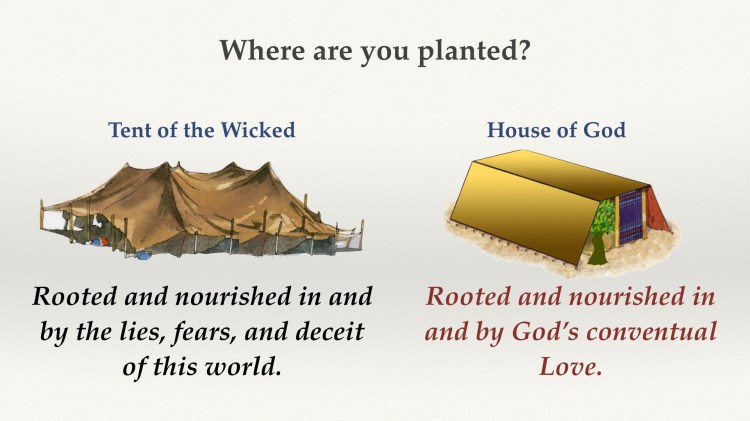
Where are you planted? What type of soil is feeding your soul? Is it the toxins of this world, the lies, the fears, the half-backed truths, and the hate? Are you trusting in the things of your own destruction? Or is your life planted in the house of God? Are you finding nourishment from the deep soil of his love, his truth, his people, and his fellowship?
This is what it means to be a Christian. Through the work of Jesus Christ already accomplished by God, you have been planted into his presence. And through this trust in His steadfast love your soul is nurtured by Him.
Preached by Pastor Trent Eastman
May 13, 2020 – Wednesday Evening Live Stream
New Baptist Church of Huntington WV
 Concerning the Word of Life