
Paul confronts Peter in Antioch. That is the context of Galatians 2:11-14. Last week we looked at Galatians 2:1-10, where Paul travels to Jerusalem in defense of the gospel, the free gift of God given to both Jew and Gentile – achieved, worked for and given through the Lord, Jesus Christ. Jesus gave himself for us, for our forgiveness of sins so that we may be delivered from evil. Saved from the bondage of sin and death. And one of the images of the New Testament that warms my heart is Galatians 2:9 – where it reads “ “9 and when James and Cephas and John, who seemed to be pillars, perceived the grace that was given to me, they gave the right hand of fellowship to Barnabas and me, that we should go to the Gentiles and they to the circumcised. 10 Only, they asked us to remember the poor, the very thing I was eager to do.” (Galatians 2:9–10 ESV). Right there – In this meeting of these Four people – Paul, James, Cephas (Peter) and John – we have the entire New Testament except for the books of Matthew and possibly Hebrews (we do not know who wrote Hebrews, the author’s name is not given). There are more authors then these four – but the Gospel of Mark is written by Mark who followed Peter on his journeys, and the Gospel of Luke and Acts (written by Luke) was the travel companion of Paul, and the short book of Jude is connected to James. So here we have nearly the entire NT sitting at the table together praising the Lord and affirming the truth of the Gospel and a reminder to remember the poor. I love that image.
This story is also in Acts 15. And we read there that Paul and Barnabas left Jerusalem with a letter from all the writers of the New Testament and travel back to Antioch. And we read – “30 So when they were sent off, they went down to Antioch, and having gathered the congregation together, they delivered the letter. 31 And when they had read it, they rejoiced because of its encouragement (Acts 15:30–31 ESV)”. Now, at this point in the history of the church, one may think, “Problem solved.” The false gospel of works has been nipped in the bud. Halted. But reading our scripture today we see that it was not halted, but in fact had gotten worse, for this false gospel had infected Peter himself and Barnabas, the pastor of the church of Antioch.

Let us read our scripture today. “11 But when Cephas came to Antioch, I opposed him to his face, because he stood condemned. 12 For before certain men came from James, he was eating with the Gentiles; but when they came he drew back and separated himself, fearing the circumcision party. 13 And the rest of the Jews acted hypocritically along with him, so that even Barnabas was led astray by their hypocrisy. 14 But when I saw that their conduct was not in step with the truth of the gospel, I said to Cephas before them all, “If you, though a Jew, live like a Gentile and not like a Jew, how can you force the Gentiles to live like Jews?” (Galatians 2:11–14 ESV).” Amen.
In the Book of Acts, we read that 50 days after the resurrection was the day of Pentecost. The day that the Holy Spirit came down upon those meeting in the upper room and went out and preached the gospel, resulting in thousands becoming believers and followers of Jesus. This was the birth of the church. The church grew tremendously fast. In order to handle the growth, there was a calling of 7 deacons. One of them, Stephen begins to preach, this is Acts chapter 7. And Stephen, because of his preaching is killed. And after the death of Stephen, on that very day scripture says, the Jerusalem church is persecuted, and it scatters into the world. At this point in time the gospel was preached only among Jews, but when the church was persecuted and scattered many gentiles (non-Jews) began to hear the gospel message and began to be saved. It is here in acts that we have the stories of the Ethiopian and the house of Cornelius. Peter goes and investigates and witness the Holy Spirit being poured out upon Gentiles and he recognizes that the gospel is for all people. In Acts chapter 11 we read – ““20 But there were some of them, men of Cyprus and Cyrene, who on coming to Antioch spoke to the Hellenists also, preaching the Lord Jesus. 21 And the hand of the Lord was with them, and a great number who believed turned to the Lord. 22 The report of this came to the ears of the church in Jerusalem, and they sent Barnabas to Antioch.” (Acts 11:20–22 ESV)

The disciples in Jerusalem hear about more non-Jews coming to the faith and so they send out a trusted follower of Jesus, Barnabas – to see what is happening. He arrives in Antioch, and witness a mighty movement of God he realizes that he needs help. He then does something that was questioned by many, but was clearly led by God and changes the course of history. He contacts this man named Saul of Tarsus (Paul) who was one of the primary persecutors of the church, yet claims that Jesus had appeared to him. Paul was held at arm’s length by all the other Christians, not welcomed into ministry, but it is Barnabas who goes to Paul and says to him, I need you help in Antioch. He invites Paul into ministry. Here it is in Acts – “25 So Barnabas went to Tarsus to look for Saul, 26 and when he had found him, he brought him to Antioch. For a whole year they met with the church and taught a great many people. And in Antioch the disciples were first called Christians. (Acts 11:25-26).
- The Church of Antioch was pastored by Barnabas
- The Church of Antioch was the first church for non-Jews, Gentiles to be a part of it.
- The Church of Antioch was the first church where Jews and Gentiles were together.
- And thus it is not surprising that it is there, at Antioch that followers of Jesus were first called Christians.
Can you now hear the shock and anger, and bewilderment of what happened when Peter came to Antioch? But when Cephas came to Antioch .. he drew back and separated himself, fearing the circumcision party. 13 And the rest of the Jews acted hypocritically along with him, so that even Barnabas (Tender hearted Barnabas, the son of encouragement, the one who risked himself to welcome Paul into the ministry, the one who welcomed non-Jews to the table) even Barnabas was led astray by their hypocrisy.” We are told that both Peter and Barnabas, as well as many others, are led into sin out of fear of the circumcision party. Before moving on I need to make one thing clear. Paul says that these men came from James. (vs 12). I do not think or believe that James sent these men, nor was responsible for these men, nor did these accursed preachers of a false gospel speak for James. I think when it says that they came from James in vs 12, it simply means that they are using James name as a means to claim authority for themselves. They are name dropping in such a way that James would be horrified. They are preaching a false gospel – that in order to be saved you need not only Jesus, but to follow the law of Moses as well. But the question remains, “Why do these men have such power that even Peter and Barnabas are afraid of them?”
Here is what I think. In Acts 15:5 we read “But some believers who belonged to the party of the Pharisees rose up and said, “It is necessary to circumcise them and to order them to keep the law of Moses.”” I think these are the same men that are now in Antioch and the key in understanding the fear is that they belonged to the party of the Pharisees. In terms of Judaism of the day. Pharisees were the movie stars, the rock stars, the sports stars. Their opinion mattered. Thus, when the pharisees became a part of the church it brought to the church both wealth and prestige. Imagine what it would be like if a movie star like Brad Pitt, or George Clooney, or Rock Star like Lady Gaga became a Christian, and decided to attend and become a member of New Baptist Church. Our Church. Imagine what would happen. Our attendance would triple in weeks. The church’s income would skyrocket, reporters would be here, and people would hang on every word that that person says regardless of how well they know the gospel. Their word, their presence, their opinion, their influence, would carry so much weight that any preacher that disagreed with them, or told them maybe you should not be teaching Sunday school would be risking everything. I think that this is the fear that has corrupted Peter and Barnabas. We, human beings,
- we long to be accepted.
- We long to be loved
- We long to be affirmed and praised
- We long to be seen as beautiful
- We long to be valued
The voices of the world says, “you will be loved, and valued, and affirmed and seen as beautiful if you do certain things, buy certain products, support certain causes, and in this case, follow certain customs or laws.”
The fear that Peter and Barnabas suffer under is the fear of not being accepted, not being liked, not being a part of the in-crowd of the popular people. It is the fear of being judged, the fear of what of others think. They want to be seen as beautiful, and respectable and important – so much so, that these longings of the soul to be praised and affirmed and liked becomes a type of guiding principle that directs their life. And unfortunately, it has led them down the road into racism.
What is the guiding principle of your life? What determines how you live your life, the actions you take, and the road that you are on? How much of your life is directed by a fear of others? (Many will say, “I am afraid of no one.”)But, how much do the opinions of others determine what you do? How worried are you about what others may think about you? How important is it to you that what you put on social media is affirmed, and liked, and commented on? How do you respond when you are rejected and not accepted? How much of your life is directed by a fear of others?
It is a powerful fear that even the greats, Peter and even Barnabas, can cause to be led astray. We all struggle with this, and this is why what Paul says next is so important. If you have your Bible, I would highlight this verse because it is so critical. Galatians 2:14 “But when I saw that their conduct was not in step with the truth of the gospel…” Paul is expressing the guiding principle for the Christian life, and notice what it is not. It is not the law nor is it a fear of others. Those are lines, guiding directions that we are not to walk on.

The guiding principle for the Christian life is to live in step with the truth of the gospel. It is the truth of the gospel that determines how life is to be lived. The language that Paul uses is very helpful here. The word he uses is ὀρθοποδοῦσιν (orthopodusin) which is to walk in a straight (ortho) line. Imagine a police officer pulls over a drunk driver and asks him to walk in a straight line. The person who is drunk cannot. They fall off the line. Thus, in the same way there is a line that the gospel lays down – that you and I are to walk on. This line laid down is the truth of the gospel which is the reality and consequences of what Jesus has done for you and me. This is something that is worthy to pondering, it is worthy of much study and reflection.
Paul is not holding up the law and saying, “this is what you need to follow.” He is not holding up a culture, “this is what you need to conform your life to.” He is holding up the gospel and saying, “the way that you are to walk and live your life must be in accordance to the gospel.” And the gospel is what? In the simplest terms, it is what Jesus has done for you, he gave himself for your sins so that you may be delivered from bondage. That action of God sends a line out into your life that you are to walk.
With what time I have left I want to highlight just a few of things as to what it means to walk in step with the truth of the Gospel. The First is how you view yourself, and the second is how you view others seen in the question he asks peter. “If you, though a Jew, live like a Gentile and not like a Jew, how can you force the Gentiles to live like Jews?” In our day, this can be said in different ways –
- “If you a sinner saved by grace how is it that you cannot give grace to others but judge others, are critical, and look down at people.”
- If you are so forgiven by the Lord how is it that you cannot forgive others?
- If you are welcomed into the heavenly courts of the most high, how is it that you can’t welcome people into your own life and be kind and patient with people?
- If you are saved by grace, why do you struggle to live by it and keep trying to justify yourself?

It has been said – that a person’s problem with sanctification (living a life that is holy and pleasing to God) begins as a problem of justification (which is recognizing that accepted by God because of who Jesus is and what he has done). How you act, how you live, how you treat others and how you see others is a reflection of how deeply the gospel has worked its way into your life. Those longings of the soul,
- How we long to be accepted.
- How we long to be loved
- How we long to be affirmed and praised
- How we long to be seen as beautiful
- How we long to be valued
Are all met, are all satisfied in the Gospel. We do not have to make ourselves acceptable to God. We don’t have to do epic things to get God’s attention. The gospel itself is God speaking to you – you are loved, you are valued, you are accepted, and you are a child of God.
But, like Peter and Barnabas, it is possible for the voice of the gospel to be drowned-out by all the other voices and noises of this world, causing a person (us, you, me) to trust in our own strength and our own goodness and our own wisdom, and like Peter and Barnabas, to be led astray into hypocrisy.
I love the quote from Martin Luther on this very text about being a person of the gospel, it reads; “The law is divine and holy. Let the law have his glory, but yet no law, be it never so divine and holy, ought to teach me that I am justified, and shall live through it. I grant it may teach me that I ought to love God and my neighbor; also, to live in chastity, soberness, patience, etc., but it ought not to show me, how I should be delivered from sin, the devil, death, and hell. Here I must take counsel of the gospel. I must hearken to the gospel, which teacheth me, not what I ought to do, (for that is the proper office of the law,) but what Jesus Christ the Son of God hath done for me : to wit, that He suffered and died to deliver me from sin and death. The gospel willeth me to receive this, and to believe it. And this is the truth of the gospel. It is also the principal article of all Christian doctrine, wherein the knowledge of all godliness consisteth. Most necessary it is, therefore, that we should know this article well, teach it unto others, and beat it into their heads continually. (Martin Luther, St. Paul’s Epistle to the Galatians)”
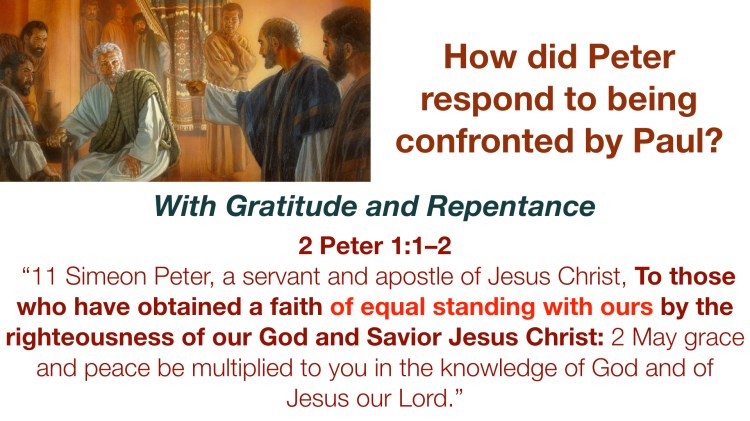
We are to be gospel people. Before closing I want to close the loop on Paul confronting Peter. How do you think Peter responded to Paul? I think Peter received Paul’s words with gratitude and that he was led to a right repentance. I base this on what Peter says in the opening of his letter, 2nd Peter. Notice how Peter begins his letter. Peter, the Jew, the great apostle of Jesus, writing to these churches full of gentile believers says; (2 Peter 1:1–2 ESV) “1 Simeon Peter, a servant and apostle of Jesus Christ, To those who have obtained a faith of equal standing with ours by the righteousness of our God and Savior Jesus Christ: 2 May grace and peace be multiplied to you in the knowledge of God and of Jesus our Lord.” Your faith is of equal standing to that of Peter’s by the righteousness of our God and Savior Jesus Christ. How is that possible, it is because we have the same gospel. Amen
 Concerning the Word of Life