“1 I mean that the heir, as long as he is a child, is no different from a slave, though he is the owner of everything, 2 but he is under guardians and managers until the date set by his father. 3 In the same way we also, when we were children, were enslaved to the elementary principles of the world. 4 But when the fullness of time had come, God sent forth his Son, born of woman, born under the law, 5 to redeem those who were under the law, so that we might receive adoption as sons. 6 And because you are sons, God has sent the Spirit of his Son into our hearts, crying, “Abba! Father!” 7 So you are no longer a slave, but a son, and if a son, then an heir through God (Galatians 4:1-7).”
In the book of Galatians, Paul is fighting for the gospel. People have come into the church and have brought a distorted doctrine of works and legalism. One of Paul’s arguments is that this distorted gospel does not free people, but instead keeps them in bondage to what Paul calls in verse 3 of our text today “the elementary principles of the world.” In verses 4 and 5, we read the redemptive story that is in Christ. “But when the fullness of time had come, God sent forth his Son, born of woman, born under the law, 5 to redeem those who were under the law, so that we might receive adoption as sons.” These verses describe the redemptive story of the gospel for which Paul has been fighting. God has sent the Son into the world to redeem us. This word redeem is significant. It is a word that carries two foundational functional meanings.
- First, the word redeem means to save something or someone (literally to purchase). Thus, when we talk about being redeemed, it is done synonymously used to talk about our salvation, our being saved. What are we saved from? What are we redeemed from? We are saved from the penalty of sin and bondage of sin. We are saved from the elementary principles of this world that hold us in bondage, and we are saved from death itself.
- The second functional meaning of the word redeemed looks at what one is saved TO. Being saved not only is about being saved FROM something but also being saved TO something. Being saved or redeemed means a new change of status. We are saved TO something. For example;
- In the gospel, slaves become free. This is a changed status.
- In the gospel, those separated from God become reconciled to God. This is a changed status.
- In the gospel, those who are unrighteous are declared righteous. This is a changed status.
Notice how Paul describes the changed status or our redemption in verse 5, “to redeem those who were under the law so that we might receive adoption as sons.” The status change that our redemption brings to us is those in Christ being adopted as sons and daughters of God. When Paul talks about adoption, what he has in his mind is different than what we have in our minds. To us, adoption refers to a child, boy, or girl, who does not have a parent that can raise him or her. Thus, the child is given up for adoption, and hopefully, a kind and loving mother and father will adopt that child and bring him or her into their home and make that child a part of their family. The purpose of adoption in our day is to provide a place for that child to grow up in and call home until adulthood.
In the ancient world, the use and understanding of adoption were different. What is in Paul’s mind when he talks about adoption is different. The classical understanding of adopting includes how we understand it, but there is a whole other layer to it. The purpose of adoption in the Roman World was too legally change the status of a person. That is what adoption did, and that is the primary reason people were adopted. When a wealthy and powerful person adopts a young man or young woman, it was not to provide that young person a family that they needed to be raised correctly. Instead, it was to give to that young man or woman the inheritance, the power, the name, the prestige, the position of the one doing the adopting. It changed the very status of the person adopted.
- If a person were a slave and adopted by a free man, that slave would instantly become free. His status would be changed.
- If a person had a huge debt, that debt would be erased upon adoption because that person adopted is now a different person. The debt belonged to the previous person. When a person is adopted, he or she is now a new person, will have a different name, and have different standing in society.
At the time that Paul was writing this letter to Galatians, the normative for a person to become Emperor of Rome was through adoption. Julius Caesar adopted a teenage boy that he met one time named Gaius Octavius. In fact, Gaius Octavius was not adopted by Julius Caesar until Julius Caesar died, and the will was read where Julius adopts Gaius as his son, thus transferring to this newly minted son all his authority, power and wealth. Gaius Octavius is renamed as Caesar Augustus and rules Rome. Through adoption, he goes from a teenage boy to the ruler of Rome. Talk about a status change. Ceaser Augustus adopts Tiberius, who becomes the next ruler. Tiberius adopts Caligula, who is the next Emperor. Caligula is killed by his army, and the military puts Claudius on the throne. In 54 AD, Claudius adopts Nero to be his son, thus making Nero now the Emperor. The adoption of Nero may be the date that Paul is writing this letter to the churches of Galatia. You can imagine the political talk that is going on down at the city square. When Claudius adopted Nero, not only did Nero inherit wealth and power, but he also inherited the Roman Empire as well. I am sure people joking said, “I wish someone would adopt me. I wish some great king would adopt me and give me all his wealth and power.”
Well, guess what? Paul comes along and says that there is a great king. The King of Kings, a king that is much greater than Caesar, and he has adopted you. “God sent forth his Son, born of woman, born under the law, to redeem those who were under the law, so that we might receive adoption as sons.” What a remarkable status change. Nothing compares to it. You are a son of the most high God. The maker and creator of heaven and earth. Your inheritance, your status, your position is higher than the angels of heaven itself. Wow. That is what it means to be redeemed. You are saved from sin and its effect, and your status changes from being enslaved to the elementary principles of this world to a being child of God.
But that is not the end of God’s work in your life. God does something more. Listen again to the words of scripture. 6 And because you are sons, God has sent the Spirit of his Son into our hearts, crying, “Abba! Father!”
Notice how the structure of verse 6 compares to verses 4 and 5. In verses 4 and 5, we read that God sends the Son into the world to redeem those in the world. Looking at verse 6, we see that Paul uses the same structure as verses 4 and 5, but something different is happening.
- In verse 6, God is still the one who sends but notice it is the Spirit now sent. Where is the Spirit sent? The Spirit is sent not into the world, but our heats. Why is the Spirit sent into our hearts, for what purpose? The Spirit is sent not to redeem us or change our status (that was the work of the Son), but rather the Spirit is sent in our hearts crying “Abba! Father!” The Spirit is sent to you for you to experience intimacy with God. The Spirit is sent so that we, who are redeemed and adopted by God through Christ, not just know the change of our status, but that we experience real fellowship, kinship, intimacy with the Father. This experience of intimacy with God through the Spirit is the cry of “Abba! Father!”
An excellent way to describe this visually is through the story that Jesus tells in Luke 15:11-32. The story is about a son, known as the prodigal son, who dishonors and deserts his father. You probably know the story. The story is about a man who has two sons, and one of his sons asks for his share of the property. This younger son takes his inheritance and squanders it. By demanding his inheritance and leaving and leaving as he does, he dishonors his parents in such a way that his actions, under the law, no longer make him a son of the father.
Therefore, when he comes to his senses, as it reads in Luke 15:17, he decides to go back home, but not as a son, but as a hired servant. He is dead to the family, but maybe his father will have mercy on him and give him food to eat and a place to sleep. Before he sees his father, he plans what he will say to him, “18 I will arise and go to my father, and I will say to him, “Father, I have sinned against heaven and before you. 19 I am no longer worthy to be called your son. Treat me as one of your hired servants.”’” (Luke 15:18–19 ESV). This son knows that his father is good and is counting on the Father’s mercy, but due to what he has done, he feels unworthy to be called his son. The prodigal son has no idea as to how much the father loves him.
There are so many Christians today who are like this prodigal son when he has come to his senses. They know of God’s mercy and grace, they go to him because they have nowhere else to go, but they do not know how much God loves them. They may know it in their head, but they do not know it here in the heart. They have not experienced the love of God. Thus, the purpose of God sending the Spirit is to bring the experience and reality of God’s love.
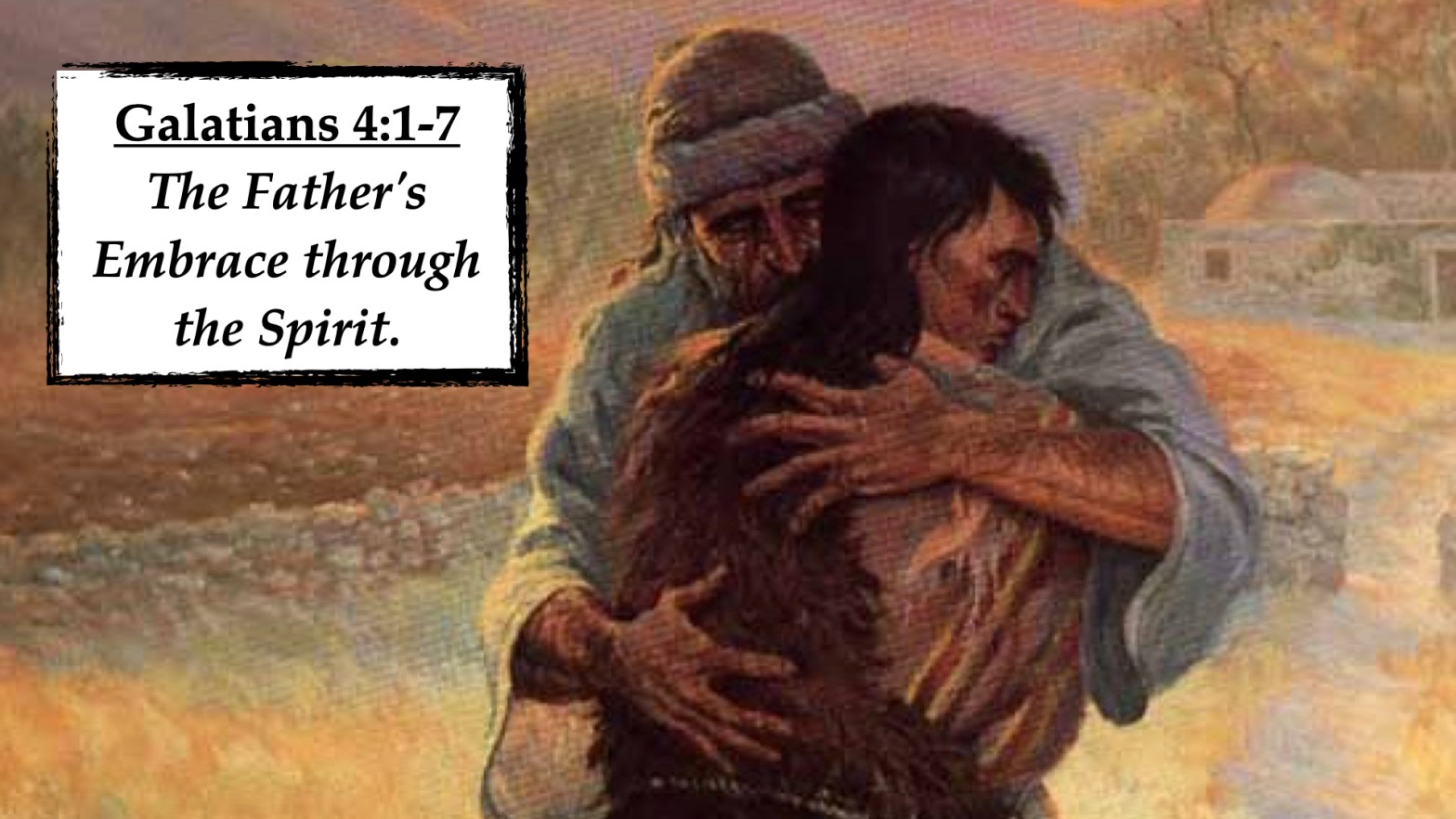
In the story that Jesus tells, the father sees the son when the son is yet a long way off. He hikes up his dress, runs to him and wraps his arms around him, and kisses him. My son has returned. The son tries to tell his father how he is unworthy to be called his son, but the Father does not let him get very far because he is too busy loving him.
The father embracing the son is an image of the Spirit being poured out into the hearts of sons and daughters of God. The father could have stood off and been very stoic and say to the son, “I love you, welcome home.” The son would have been pleased, I am sure, but he would not of experienced that love. Instead, the father runs to the son, embraces him, and kisses him. The son experiences the depth of the Father’s love. The father’s embrace and kiss are felt when the Spirit is sent into your heart.
Many people describe the role of the Holy Spirit is to be a comforter or the giver of talents and gifts, our text today simply tells us that God sends the Spirit into your life for you to experience his love, to feel his embrace and his kiss. “To cry, Abba, Father.” “Behold, what manner of love the Father hath bestowed upon us, that we should be called the sons of God (1 John 3:1 KJV).”
Have you experienced the Father’s kiss? Do you know how much you are loved, not just intellectually, but experientially in your heart? Has your heart cried out, Abba, Father? I thought a lot this week of what it feels like to cry, “Abba, Father.” What does it feel like to have intimacy with God? How would you answer that question? For me, after pondering this question, I describe my own experience of the Father’s love in two ways.
1. First, I experience the father’s love in the feeling of assurance. Yes, I do believe intellectually in the assurance of salvation, but it is the Spirit that makes this knowledge become something felt. This feeling of assurance is what keeps me from lapsing into legalism, or into fear, or into the need to judge or criticize others to make myself look good. The feeling of assurance is this sense that it is going to be ok even if there is a pandemic, and the whole world feels like it is in chaos. There is peace in the storm. Also, wrapped in this feeling of assurance is a sense that my life has significance, purpose, and meaning. This feeling is essential to me. I think a lot of people, and I include myself, long for some measure of significance, purpose, and meaning. Unfortunately, when there is not a sense of assurance, people (like the prodigal son when he leaves his family) seek to find significance in the things of this world like power, popularity, importance, influence, and wealth. Having though, this feeling of assurance that comes from the Spirit of God involves confidence that my life matters, that it is significant, even if what I am doing is not seen as worldly necessary, or maybe not seen at all. This feeling of assurance and significance leads me to be faithful to where God has placed me to do what God has given me to do. That is number one; “what does it feel like to have intimacy with God?” For me, it is a feeling of assurance, peace, and confidence.
2. Second, the experience of intimacy with God causes a feeling of pleasure. There are two ways that I encounter this pleasure and joy. First, I experience the intimacy of happiness when I observe and meditate upon the beauty of Jesus. This joy is kind of like the pleasure felt when seeing a beautiful sky, or a sunset, or even the playfulness of puppies. There is pleasure in beauty, and likewise, there is a pleasure that comes from gazing upon the grace of God. Also, this pleasure felt found in the intimacy of God happens when God is pleased. When I ask the Lord, “what is your will, am I in your will, am I doing your will?” I find that there is a great pleasure that comes from being obedient to the will of God. The encounter of joy through obedience is not legalism, but rather it is a pleasure found in God being pleased, like a son finding comfort in his father.
That is what intimacy with God feels like to me. These are the times when my heart cries, “Abba, Father,” and through the Spirit, I experience the feelings of assurance, trust, pleasure, and joy. These feelings that I have tried to describe are mine. It is how I experience the Spirit in my heart crying Abba, Father.
Some of you here today may be thinking to yourself, “I do not have any of these feelings or experiences, does that mean that I am not saved?” I don’t think so. To be very clear, if you do not have any feelings of intimacy with God and your heart does not cry out Abba Father, it does not mean that you are not saved. Think back to our scripture this morning. This cry of the heart is not the means of salvation but is something that God does after salvation has taken place. (verse 6 comes after verse 4 and 5). Which means, technically speaking, that it is possible to be saved, redeemed by Christ, adopted by God as a child of God, a full heir to the throne, and have no feelings of intimacy with God. If this is you, I do not think God will leave you this way, because he promises the Spirit. But it is crucial to be precise; your salvation is not contingent upon your feelings. Your salvation is contingent upon what Jesus has done. This experience and feeling of intimacy are given to you through the Spirit after you are saved.
So how do you get it? How do you have this experience of intimacy with God that is given to you through the Spirit? Since God is the sender of the Spirit, He does what He does, and we have no control over Him or his Spirit. We do not do anything to get God to do anything. But, there are things we can do to hold our hands out to God, to seek his presence. I believe that a primary way that we hold our hands out to God, seeking his Spirit to be active and alive in our hearts, is through looking at and meditating upon the work of Christ. I say that because, according to our text today, the sending of the Spirit follows the sending of the Son. The Spirit follows the work of Christ in you. Thus as you meditate upon Christ’s work, the beauty of that work, the holiness of that work, as you look to him, and ponder him and explore his grace, I believe that it is then that the Spirit cries out in your heat Abba Father! Let us do that now as we come to the table of communion.
This message was preached at New Baptist Church by Pastor Trent Eastman on July 5, 2020.
 Concerning the Word of Life