
Introduction: The Scripture today is Galatians 4:8-11. The reason I am focusing on just a few verses this morning is that in these verses, Paul is making a connection between legalism (adding to the work of Jesus) and idolatry. It is a profound connection that needs to be heard today. Idolatry is not an ancient religion or a problem of the past but is at the heart of the things that enslave and divide us today. My purpose is to expose this problem and to proclaim the Gospel that delivers us from idolatry.
(Galatians 4:8–20 ESV) “8 Formerly, when you did not know God, you were enslaved to those that by nature are not gods. 9 But now that you have come to know God, or rather to be known by God, how can you turn back again to the weak and worthless elementary principles of the world, whose slaves you want to be once more? 10 You observe days and months and seasons and years! 11 I am afraid I may have labored over you in vain.
Prayer
“8 Formerly, when you did not know God, you were enslaved to those that by nature are not gods.” Paul is speaking about the enslavement that happens under idolatry. The bondage of idolatry is a crucial understanding found in all of scripture. God forbids idolatry not only because it is wrong, a sin of failing to give God what is God’s. God forbids idolatry because it demeans, it destroys, and it enslaves people.
We don’t hear or feel this danger of idolatry because, in our minds, idolatry is just some little statue that serves as a good luck charm. How in the world do you get from a small icon to slavery? Part of my goal this morning is to answer the question of how idolatry enslaves. To do this task, I will start at one of my most favorite books of the Bible, Exodus.
The book of Exodus is fantastic, for it is a story that sets a type of template for God’s redemptive work in this world. You know the story of Exodus; the people of Israel are slaves in Egypt. God hears their cry and sends to them Moses, the man who will come and draw them up out of Egypt. But, before the people were brought up out of bondage, a battle is fought between the Lord High God, Yahweh, and idolatry represented by the gods of Egypt. This confrontation between God and the idols of Egypt is a common understanding of the ten plagues. Each of the nine plagues represents a confrontation with an Egyptian false god or goddess, with the 10th plague being a form of judgment. Idolatry is complex and must be understood as more than the simple worship of a statue. Idolatry is the worship of what that statue represents, which is usually something that is longed for or needed for life, health, and happiness. After each of these plagues, God says, “I am doing this so that you will know that I am God (Exodus 7:5).” The plagues are a battle between the one true God and the false idols or gods of the land. Finally, the last plague is a judgment upon all the people, including the Israelites. The Israelites escape that judgment by taking shelter under the blood of the lamb, a magnificent foreshadowing of Christ.
The story of Exodus continues, at this point, the Israelites flee Egypt, cross the red sea, travel to Mt Sinai where they enter a covenant with the Lord, and the Lord Himself, true God, draws near to them with his glory filling the tabernacle. They are new and free people, spiritually and socially. Soon after departing from Mt Sinai, though, in Numbers 14, there is an unfortunate event where the people of Israel stand on the edge of entering the promised land and are afraid of moving forward because they do not trust the presence and leading of the Lord. They say to Moses, “we want to go back to Egypt.” We want to back to our enslavement, and Moses goes head slap (what?!?!).

Our scripture today is Paul is doing the same head slap regarding the churches of Galatia. What, you want to go back to slavery, to those that by nature are not god? The people in the churches of Galatia came to Christ as gentiles, pagans, people who were once held in bondage to idols. Again, idolatry is not just the worship of a figurine but is what that figure represents.
- Zeus, the god of the sky.
- Hera, the goddess of marriage and families.
- Poseidon, the god of the sea.
- Areas, the god of war.
- Artemis, goddess of the hunt.
- Aphrodite, the goddess of love and beauty.
- Bacchus, the god of wine, and having a good time.
Behind every element of creation and every human need for happiness and life, there was a god. A person would worship that god, depending upon what was his or her needs.
- If you are a soldier, you will worship the god of war, Ares.
- If you were a sailor, you would worship the god Poseidon.
- If you were an athlete, you would worship the god Nike
- If you were angry or bitter and wanted revenge, you would worship the goddess Nemesis.
- If you are into money and fortune, you will worship the goddess Tikee (or Fortuna), who carries the cornucopia
This is paganism. This is idolatry. This is how people thought and lived. Every created thing was either a god or had a god behind it. Every aspect of life, like falling in love, getting married, raising a family, owning a business, or plowing a field is either a god or is controlled by a god. Thus, to have success in life, in whatever area of life that maybe, a person had to figure out and do the religious ritual necessary to get whatever god he or she needed to give a blessing. This was idolatry on a personal level.

There was also idolatry on a social level. In verse 9, Paul asks the question, 9 But now that you have come to know God, or rather to be known by God, how can you turn back again to the weak and worthless elementary principles of the world, whose slaves you want to be once more?” The elementary principles of the world are a description of how people understood the ordering of life. Idolatry was not just a personal faith, but a represented the whole nation functioned. For God to bless this nation, think Rome here, the people of that nation had to perform the right ritual to the gods. And proper ritual included the ordering of society. Slaves had to be kept slaves; women had to be kept in their place; those of noble birth must be kept clean of those of ignoble birth. Idolatry shaped all of society and held people in bondage by a system of castes. A caste system is the natural result of national idolatry. People who worship idols believed that for gods to bless a nation right ritual included a caste system. The elementary principles of the world that not only controlled personal and private life but also controlled the very nature and fabric of society.

The Gospel: Thus, you can imagine how powerful the Gospel must have been when preached to people who were enslaved, literally, and spiritual, into this system of idolatry. Here is the Gospel. There is only one God, he is the maker of heaven and earth, and you do not have to do anything to get his attention, he knows you, and he loves you. He has sent the Son, Jesus Christ, to provide a way for you to know him and to enjoy him. And all that God requires of you is for you to bring him your failures and guilt and sin and trust him. Many people, men and women, rich and poor, slaves and free, did that very thing, they trusted God and put their faith in Jesus Christ. When they did this (responded to the Gospel by faith), their lives changed. No longer were they under the bondage of heart and mind, but they were also freed from the caste system created by idolatry. We see this freedom in the words of Paul at the end of chapter 3. “There is neither Jew nor Greek, there is neither slave nor free, there is no male and female, for you are all one in Christ Jesus.” (Galatians 3:28 ESV). When people stopped worshiping idols, it was not just a personal liberation but also a social one as well.
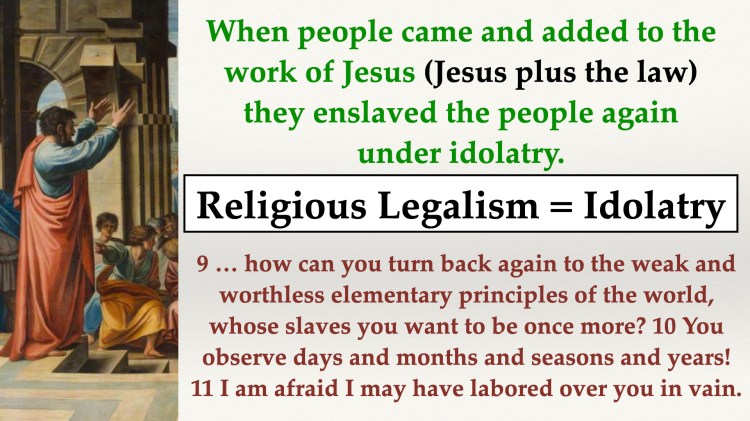
But something happened among these early churches freed by the Gospel. People came after Paul had left and told these people that faith is not enough. That for God to know you and bless you and save you, you need to start performing certain rituals and follow specific laws. And one of the consequences of this legalism was the reinstatement of a caste system. We can see this caste system in how Jews no longer ate with Gentiles. The wealthy Christians would eat the Lord’s supper first and give the leftovers to the more impoverished Christians (1 Corinthians 11). Those who had certain spiritual gifts kept themselves apart from those that could not speak in tongues (also 1 Corinthians). These divisions are why Paul is showing that the legalism that has come into the church is just another form of idolatry seen in how it causes divisions and enslavement. Adding to the work of Jesus, turning faith into legalism is idolatry. 9 But now that you have come to know God, or rather to be known by God, how can you turn back again to the weak and worthless elementary principles of the world, whose slaves you want to be once more? 10 You observe days and months and seasons and years! Paul is giving them an example of how their legalism has turned into a system of idolatry. “I am afraid I may have labored over you in vain (verse 11)”. In other words, Paul is wondering, were you ever really free of idols?
There are only two alternatives in life for all people, you either worship the true God, or you are enslaved to the worthless elementary principles of this world. You either worship the true God, or you are enslaved to something that is not a god.
One of my favorite New Testament books is the book of 1 John. The three big themes of 1 John are living in light (holiness), living in love, and living in God. 1 John is about these three themes. The very last verse of 1 John (1 John 5:21) is a verse that feels like it comes out of nowhere. I am reading the last two verses of the book. “And we know that the Son of God has come and has given us understanding, so that we may know him who is true; and we are in him who is true, in His Son Jesus Christ. He is the true God and eternal life. 21 Little children, keep yourselves from idols.” (1 John 5:1–21 ESV)
What? Why did John end this amazing letter where he never once mentions idolatry with a warning about idols? The answer is that John is summarizing his entire book. If you fail to live in the light, if you fail to live in love, if you fail to live in God, the cause of that failure is idolatry, enslaved to the worthless elementary principles of this world. John is teaching us that the greatest danger that confronts us is not wrong deeds or actions but is idolatry. WHY? Because deeds and actions are always the outcomes of the idols that we worship.
What reasons do you give when you sin or when you are angry, prideful, selfish, bitter, or jealous? What reason do you provide when you lie, when you lust, when you cheat? What reason do you give to yourself or others when you fail to live like Jesus, to love like Jesus, to be patient like Jesus, to have compassion like Jesus? Most people would answer these questions by saying, I am must be a sinner. That is who I am. I am wired this way. I cannot do it differently. I have no power to change. A sinner is who I am; it is the sinful nature in me.
Yes, we are sinners, but the reason why we do the things that we should not do and do not do the things that we should is that something else has taken the place of God in our hearts. Idolatry is the root and heart of sin. Idolatry is when something besides God has become your highest beauty, your highest good, your primary purpose, and that which you must have to be happy, satisfied, or content. When something has taken this place in you that belongs only to God, this thing has also taken control of your life and you are enslaved to it.
To be clear, as created beings, we have needs, desires, and wants that are not wrong or bad. This creation is good, and we are to enjoy the beauty of the sun and the moon, the sky and trees, and family and friends. It is good to enjoy and desire these things. But when something, anything, turns from a good desire that I trust God with, into something that I must have to be happy and to be at peace, I have taken something good and turned it into an idol. When the heart turns something into an idol, it enslaves and demands sacrifice. It requires money, attention, time. It controls how I feel and what I do and who is welcomed and who is acceptable. Idolatry turns normal and good desires into enslaving masters or demons that always creates divisions.
Therefore, if you want to know what your idols are, look at two things.

- 1. Look at the things that enslave you. Generally, the things that have become idols are the things that you must have (or think you must have) to be happy or content. What must you have to be happy? Answer that, and you may find an idol.
- 2. Look at things in your life that bring conflict and division. When people argue or fight over something, there is probably an idol in that conflict somewhere.
Here are some examples of what I mean. What is the idol of the person who goes around always angry or bitter or hurt at a wrong done to him or her? The wrong is real, something (physical or material, a divorce, or robbery, a rape) was taken from that person. Yes, it is right for justice to happen, but there is no healing, anger is still felt, hurt, and bitterness keep churning, all of which indicates an idol is present. What is the idol? It is that thing that was taken because that person has made that thing essential for his or her happiness.
What is the idol of people who are insecure and struggle with low self-esteem or guilt? They can forgive others, but they cannot forgive themselves, and thus go around with a hanging head and low self-esteem while at the same time, they do things to garner attention. Generally, it is the idol of low self-esteem wrapped in guilt, and shame is the need for other people’s approval. That is the idol that the heart has created. I cannot be happy until I am liked or praised, and thus when I do something wrong, who will love me or praise me?
Idols can be anything. Jobs, families, a person, a cause, a goal, a position, or standing in life. Anything. The idol could be money; it could be the color of the carpet; it could be how fast the traffic is moving. Something happens in the heart that looks to that thing or person or desire and says I must have you to be happy and content.
The idol that Paul identifies at work in the churches of Galatia is the idol of religion. The type of religion that demands specific laws and rituals to be followed if God is going to save or bless. He gives an example of this religion in vs. 10, “ You observe days and months and seasons and years!” Religion, with its legalism, is an idol that has destroyed churches and homes and lives. The idolatry or religion happens when a person believes that God’s love for him or her is contingent upon following some rule or law. The idolatry of religion also describes God’s will as obedience towards a law. The truth is that God loved us while we were yet sinners (Romans 5:8), and that His will for our lives is to enjoy Him. God has set us free in the Son. You and I are viewed by God through the righteousness of Jesus, and in so doing, we have Him, the source of real joy, of genuine contentment, of real peace.
In the book of Exodus (I am going back to where I started), God enters a conventual relationship with the people of Israel, a relationship so intimate that God’s very glory will dwell in their midst at the tabernacle. When the covenant was made, a law was given that defines how God and the people of Israel will dwell together. This law is summed up in what we call the ten commandments, and the ten commandments are summed up in the first two commandments.
- You Shall have no other gods before me.
- You shall not make yourself an idol.
How do you love and please God, how do you live in relationship with him? The answer is that you do so when he is your first love when he is your primary desire, the source of your beauty, and your joy. Thus, how much truer this is this for us, in the New Covenant made through the Son, Jesus Christ? The New Covenant is so much better than the Old for the glory of God does not dwell in some tent hidden away; the glory of God dwells in our hearts through the very Spirit of God. You were made by him, and were made for him; thus, he alone satisfies the real desires of your heart and soul. He alone is the source of our joy and peace. 21 Little children, keep yourselves from idols.” Amen
Preached on July 12, 2020. Pastor Trent Eastman.
 Concerning the Word of Life