

What does it mean to love? This is one of the questions that I ask a bride and groom who come to me and ask me to perform their wedding ceremony. Other questions include, “why do you desire to get married when in today’s world, the norm is not to marry?” And, “why do you seek to be married in a church by a Christian pastor? Why do you seek a Christian wedding?” These questions are essential because it helps them understand not only their motives in becoming wedded but also what exactly marriage is. On the last night that I meet with the soon to be husband and wife, I have them read through the promises (wedding vows) that they will be making to each other. After they read the vows, I then ask them, “what does it all mean?” What does it mean to love? What does it mean to honor? What does it mean to cherish? Usually, I receive excellent answers to these questions that reveal a solid understanding of what marriage is and a knowledge of the promises that will be made that are necessary for that marriage to thrive. Occasionally though, from a young couple more influenced by the world than the Bible, the answers that they speak are erroneous and indicate to me that their future together will be filled with heartache.
What does it mean to love? The incorrect answer that the world gives to this question is that to love someone is to accept that person as he or she is without trying to change that person. And, the world also says that love is a marvelous experience or a powerful feeling that must be obeyed. These are wrong answers, and if attempted to be lived out will always result in either a disillusionment with love or grand hypocrisy.

What does it mean to love? There are a couple of passages in the Bible that provide very poetic definitions of love. 1 Corinthians 13 says that love is patient and kind, filled with humility, often makes sacrifices, and surrendering one’s own will. Love is forgiving and seeks to serve the other, celebrates and holds fast to what is good, and is always faithful. To quote, “love bears all things, believes all things, hopes all things, endures all things. Love never ends. (1 Corinthians 13:7-8a).” Romans 12 adds to this definition of love when it says, “Let love be genuine. Abhor what is evil; hold fast to what is good (Romans 12:9).” “Rejoice in hope, be patient in tribulation, be constant in prayer (Romans 12:12).” What does it mean to love?
The Bible’s definition and description of love are very different from our world’s definition and description of love. Can you see the difference? In the Bible’s definition of love, love is not a feeling, it is not an emotion, but love is a choice. Love is a choice TO BE faithful and kind, seeking good for that person despite whatever is unacceptable in that person. Do you see the difference? In the context of personal sin and failure again hear what love is, “Love bears all things,” which means that love is long-suffering. “Love believes all things, hopes all things, endures all things,” which means that no matter how bad a situation may be and how far a person has sunk, love always holds onto a real hope for that better day and endures the suffering of the moment. That is what love is. Love never ends. Love abhors what is evil; it does not accept evil. And in this hope, and this enduring, love never stops praying. To love someone means that you never give up hope, practice faithful patience, and never stop praying. This is love. Love seeks good for the person, which means it seeks change for that person when life is wrong.
I share all of this because, in the context of our passage today, Paul is asking the people in the churches of Galatia to change. In our world, asking a person to change is highly offensive. When people are asked to change or told that a particular way of life is wrong, the response is, “How dare you impose your morality on me and ask me to change. How dare you stick your nose in my business and tell me that my life is not right or good. How dare you tell me how to live my life.” If you love me, you will accept me. The world’s way of love is the gateway for a person to become an enabler of evil or a codependent to human suffering and bondage. Real love, as defined by scripture, always seeks good for the person, which means it seeks change for that person when life is wrong.
Yet, not all changes sought in the other person are necessarily the actions of love. Most often, it seems to me that people seek to change other people according to their agendas, or out of pride or arrogance. This is not love. It is not love that aims to improve the other to support or accept my sin. It is not love to seek change in the other to support my causes and do what is important to me. It is not love to manipulate the other so that I now have control over the thoughts and emotions and actions of that person. Yes, love seeks change, but if the wrong change is sought, it is not love at work but abuse. That distinction needs to be clear.

This abuse is what has been happening to the people of Galatia. People, false teachers, have come to the churches of Galatia not to love them, but to abuse them. The change that these false teachers seek in the people is for them to return once again to enslavement to the elementary principles of this world. Paul says further that they are seeking this change for their selfish agendas, verse 17, “They make much of you, but for no good purpose. They want to shut you out, that you may make much of them.” It grieves me to say that I know of some pastors that do this very thing. They hold up their theology or their church as being the only God-ordained church, and all other churches and preachers are heretical. If anyone visits another church or is engaged with other Christians, individual members of that church would go to that person and tell them all the ways that those other Christians are heretical, wrong, and how you need to keep away. Doing precisely what Paul is describing here, “They make much of you, but for no good purpose. They want to shut you out, that you may make much of them.” That is not love.
This is not only a church problem but happens everywhere. In your place of work, if you have a lot of staff, I am sure that you have some staff who seek to control people according to their agendas or ego. It is how politics work. Politicians make much of people when they want their vote, and then seek to hold you through political division. One of the scare trends today is “cancel culture,” which is a way of seeking and forcing an agenda or change upon people through destroying people. This is not love.
So, how do you love? How do you rightly love a person, not just in the context of marriage or family, but in the context of life? How do you love your neighbor, the stranger, and those who are different from you in terms of race, status, or age? If love is abhorring what is evil, holding fast to what is good, rejoicing in hope, being patient in tribulation, and constant in prayer, seeking good for that person despite whatever is unacceptable in that person, then how do you do it? How do you love?

Our scripture today provides what I consider to be the answers to the two most important questions about love. Here are the questions.
- Question 1 is philosophical – “What type of change does love seek?” If the wrong type of change is sought, turning love into abuse, what then is the right type of change for love to seek?
- Question 2 is technical – “How does love carry out the desired change?” If love is seeking good for that person and helping bring that person into that good, how do you do it?
These are two critical questions that you do need to get right if you are to love well. Our text today provides answers to both questions.
Question 1, “What type of change does love seek?” What is the good that love seeks for the other? As human beings, one of our sinful habits that are extremely hard to break is this need or desire to change other people to suit our own needs and wants. That is why people seek power, influence, and popularity. As said earlier, if the wrong change is sought it is not love at work but abuse.
So, what is exactly the type of change that love seeks? The answer to this question is in verse 19. The verse reads, “my little children, for whom I am again in the anguish of childbirth until Christ is formed in you!” The change (the good) that love seeks is Christ formed in you. To love someone and to seek good for that person, that good is Christ formed in that person. The change that love seeks is Christ formed in you. How do you love a neighbor, how do you love a friend, how do you love your spouse, and how do you love your children? You seek in them Christ formed, which is the highest good to rejoice in. This is a significant thought, much larger than we can unpack today; thus, I ask that you meditate on what it means to seek Christ Formed in others as the primary action of love. Think about how “Christ formed in you” impacts how you love your children, love your friends, love your spouse, and even love strangers. “Christ formed in you” means to know the Lord, to experience the Lord, to grow in the Lord, to enjoy the Lord, and to follow the Lord. Christ formed in you is the highest good and the greatest beauty that your life will ever know. Christ formed in people is also the greatest good and highest beauty that we can lead others into experiencing. Christ formed in you is the change that love seeks. This change of Christ formed in you is not the selfish demands of personal needs that are usually the changes that people seek in others but is life-giving. Notice again how Paul says it “I am again in the anguish of childbirth until Christ is formed in you.”
Answering the first question of what change is sought brings us to our second question. Question 2, “How does love bring change?” “How does love carry out the desired change of “Christ formed in you”? Just as there is a right goal, the right purpose of love, so also is there a right way of action of love towards that goal. Also, there is going to be a spectrum of action towards that person in how love is done dependent upon who that person is, the nature of that relationship, and the struggles or evils that hold dominion over that person. With this said, in our scripture today, Paul does show five ways that love brings change.
The way that love brings change is very different from how the world brings change. The world’s method of bringing change to others is described in Saul Alinsky’s book “Rule for Radicals.” He says that change is brought by hurting people. To quote, if you want change, “go after people” because “people hurt faster than institutions.” The way to change something or someone one, says Alinsky, is to “pick a target, freeze it, personalize it, and polarize it.” I believe that what he described as “Rules for Radicals” is just a very clear-eyed description of how the world seeks to bring change through power, pressure, force, and threats. This is not love, and it is not how you and I are to be about seeking change in people. So how does love bring change?
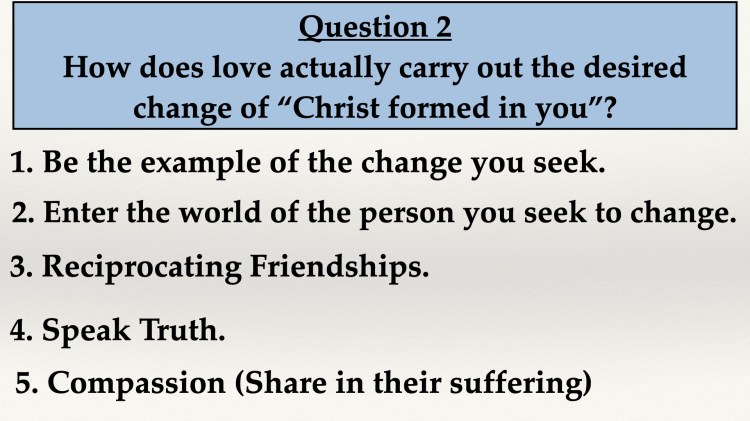
1. Be the example of the change you seek. To seek Christ formed in others, your own life must reflect the Lord. We see this in verse 12, “Brothers, I entreat you, become as I am.” In Philippians 3:17, Paul repeats it, “Brothers, join in imitating me, and keep your eyes on those who walk according to the example you have in us.” In this book of Galatians, some of the things that Paul wants the people to imamate is;
- Loyalty and passion to the truth of the gospel (2:5,14).
- Welcoming all people into the family of God as brother and sister regardless of Jew or Gentile, slave or free, man or woman (3:28).
- To die to the law so that they might live for God (2:19-20).
- To enjoy God through the gift of the Spirit. (3:6-4:7).
To ask a person to change, you must be an example of that change.
2. Enter the world of the person you seek to change. Again verse 12, “Brothers, I entreat you, become as I am, for I also have become as you are. “ Entering the world of others does not mean that Paul loses his identity, but instead meets people and engages with people where they are. This movement towards entering the world of others means to seek to understand how they view the world. Paul did not come with criticism or condemnation but instead sought to connect with them in such a way that he can speak into their world. Several examples come to my mind as to what it looks like to enter someone else world. My best example that I can think of is that of parents and children. Occasionally, Parents at wit’s end, have come to me asking for any advice with a problemed young son or daughter. And note, every situation is different and complex, and I am no expert. But a question I often ask is, “do you enter their world?” How do you engage with them on their level, know who they are, understand their desires or needs? Do you enter that child’s play? Do you allow the teenager to pick the activities you that you do together? How do you enter his or her world? As the saying goes, they don’t care how much you know until they know how much you care. People know you care when you meet them where they are, engage them in their world an,d context.
3. Reciprocating Friendships. I struggled to give a name to what I see in scripture, and reciprocating friendships is the best description I found. Reciprocating Friendship is seeing real value, purpose, and meaning in that other person. Often, the one that seeks to change the other person, the one who seeks the change holds him or herself off as the expert; “I don’t need to change; you are the one that needs to.” Teachers are often like this to their students; Preachers are often like this to their churches. Parents are often like this to their children. These types of one-way relationships are transactional, where it is one person that seeks change in the other, while that other person adds nothing to the one that seeks to bring change. People who seek only one-way change are the type of people who find it easy to give help but find it hard to either ask or receive help. A Reciprocating Friendship, though, is a relationship where every life adds to my life. In the context of mentoring, teaching, or leading those that are mentored or taught adds immeasurable value and meaning to life. My life is better because of him or her. My life is better because of you. We see reciprocating friendship in our scripture today when Paul says “13 You know it was because of a bodily ailment that I preached the gospel to you at first, 14 and though my condition was a trial to you, you did not scorn or despise me, but received me as an angel of God, as Christ Jesus. 15 What then has become of your blessedness? For I testify to you that, if possible, you would have gouged out your eyes and given them to me.” Paul arrived there not as if he needs nothing from them; rather, he was entirely dependent upon them. This reciprocating friendship, as I am calling it, is also expressed in 1 John 1:3-4, “that which we have seen and heard we proclaim also to you, so that you too may have fellowship with us; and indeed our fellowship is with the Father and with his Son Jesus Christ. 4 And we are writing these things so that our joy may be complete.” I seek your good not as charity, but because you add value to my life and you make me better, this is reciprocating friendship.
4. How do you change people so that Christ is formed in them? The answer, Speak truth. We see this in verse 16. “Have I then become your enemy by telling you the truth?” Speak Truth. Spoken words are necessary to love. There is an old saying about preaching the gospel attributed to St. Francis of Assisi. “Be prepared at all times to preach the gospel, and when necessary, use words.” It is an excellent saying in terms of the importance of being an example. What we do does speak volumes, but words are always necessary for preaching the gospel. To tell people that God loves them, they need to be told God loves them. The change that love seeks is brought through the Word being taught and proclaimed.
And now, number 5. How do you change people? The last answer seen in our text is compassion. Compassion not only in terms of empathy but also, and I think, more importantly, sharing in the suffering of people. Paul says, vs. 19, “My little children, for whom I am again in the anguish of childbirth.” What an interesting image Paul is using when he describes the suffering necessary to bring about “Christ formed in you” as childbirth. He is saying, “I am sharing in your suffering until Christ is formed in you.” The underlying meaning of the word compassion is shared suffering. To love someone, not only do you enter their world, you enter their suffering.
This is how love is done. We are commanded by the Lord to love one another and our neighbor. How are we to love? The highest love is to seek Christ formed in one another. How do we do that? According to our scripture today, we do that by;
- Be the example of the change you seek.
- Enter the world of the person you seek to change.
- Reciprocating Friendships
- Speak Truth.
- Compassion, share in their suffering.

This is a good list, and I know it is a good list because all these five points of bringing change reflect Jesus. This is how he changed us; it is how he changed me.
- Jesus was perfect; he showed not only the life that we ought to live but the life that is possible when lived in the reality of the Kingdom of heaven. His life is the best example of what it means to live well.
- He entered our world, became flesh, and dwelt among us. Not as a Stanger, or in disguise, but as one of us, fully human. At the start of his ministry, he was baptized, identifying with us in our condition of sin and our need for change. He knows every struggle we have and every temptation we face. He wept and laughed and listened. He entered our world, becoming man, yet never ceasing to be God.
- And he did so to bring us into a relationship with him, even friendship. One of the deadliest forms of theology today is a one-way transactional theology that sees God far off trying to get an excel spreadsheet to balance. Jesus says to his disciples, and he says to us, you are my friends (John 15:14). I know I cannot add anything to God, but somehow in God’s love for me, he says to me through Christ, “you are important to me, I value you.” One of the greatest blessings that God gives to me is the things that willfully receives back from me. Think of the kings on the throne tossing their crowns. His love for us allows us to give to him.
- And Jesus spoke truth. That is kind of what got him killed. He spoke truth to everyone always. Truth with love, truth with the purpose of Christ being real in them. That is my view of everything that Jesus says to every person. I don’t see Jesus’ words to the Pharisees and Sadducees and other religious leaders as being purposefully antagonistic, or demeaning, or trying to make fun of them. I think everything he said was to help them see who he was – the son of God – and to see the sin that kept them blind. He spoke truth to open the eyes of the blind.
- And finally, Jesus not only shared our suffering, but he also took it upon himself. As it reads in Isaiah 53, “Surely he has borne our griefs and carried our sorrows; … he was pierced for our transgressions; he was crushed for our iniquities; upon him was the chastisement that brought us peace, and with his wounds we are healed.” (Isaiah 53:4–5 ESV). That is the genuine compassion of the Lord.
Scripture commands us to love. We are commanded to love with a love that seeks Christ formed in people. The way of love is the way of Christ. May the Lord strengthen you in His Spirit to be the vessel of love needed today.
 Concerning the Word of Life