
In Galatians 4:21-5:1, Paul does something that he very rarely does; he uses allegory. Allegorical interpretation of scripture is not normative for Paul, and for that matter, should not be normative for us. An allegorical interpretation is when a story becomes a symbol that represents something else. The Lion, the Witch, and the Wardrobe is an allegory by C.S. Lewis about the gospel. Pilgrim’s Progress, written by John Bunyan, is an allegory of the Christian journey in this life and learning what it means to trust in God’s grace and not in our own efforts. Those allegories are good, and they work. It is different, though, to take an event in scripture and turn it into symbols that represent something different. The human mind can produce some really wired teachings through an allegorical interpretation of scripture.
There are places in scripture though that allegory is used. Our scripture today is one of those places. Paul takes a story found in Genesis, a literal historical story, and says to us, “I want to interpret this as an allegory for us today.” Thus, for us to understand this passage of scripture and apply it to our lives, we must understand the story of Genesis and then the allegory that Paul creates using it. Here is our passage today. (Galatians 4:21–5:1 ESV) 21 Tell me, you who desire to be under the law, do you not listen to the law? 22 For it is written that Abraham had two sons, one by a slave woman and one by a free woman. 23 But the son of the slave was born according to the flesh, while the son of the free woman was born through promise. 24 Now this may be interpreted allegorically: these women are two covenants. One is from Mount Sinai, bearing children for slavery; she is Hagar. 25 Now Hagar is Mount Sinai in Arabia; she corresponds to the present Jerusalem, for she is in slavery with her children. 26 But the Jerusalem above is free, and she is our mother. 27 For it is written, “Rejoice, O barren one who does not bear; break forth and cry aloud, you who are not in labor! For the children of the desolate one will be more than those of the one who has a husband.” 28 Now you, brothers, like Isaac, are children of promise. 29 But just as at that time he who was born according to the flesh persecuted him who was born according to the Spirit, so also it is now. 30 But what does the scripture say? “Cast out the slave woman and her son, for the son of the slave woman shall not inherit with the son of the free woman.” 31 So, brothers, we are not children of the slave but of the free woman. 1 For freedom Christ has set us free; stand firm therefore, and do not submit again to a yoke of slavery.” Prayer
I am sure that any Jewish person who heard Paul repeat this allegory or read this letter just might have wanted Paul dead. They would exclaim, “Fake News!! Hagar is an Egyptian, not an Arab. Mt. Sinai is where the covenant with the descendants of Sarah was made, not the descendants of Hagar. The descendants of Hagar are the Nabateans; their city is Petra, not Jerusalem. Paul, you are crazy. Jerusalem is the city of the descendants of Sarah. How dare you Paul say that we Jews from Jerusalem are descendants of Hagar the slave and her son Ishmael.” To these historical inaccuracies, Paul would again say, “This is an allegory, I am not treating the text as literal, but listen closely so you may understand the meaning of the allegory.”
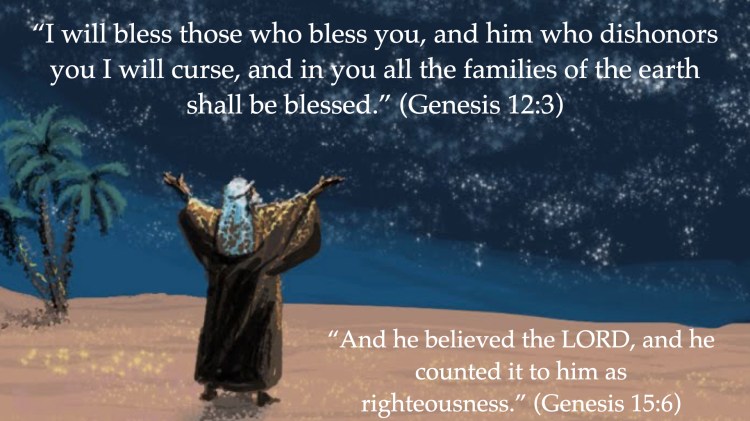
The historical story that Paul interprets as an allegory is found in the book of Genesis. It begins when God calls Abraham to go to a new land and promised him that he would be a great nation. A nation, God promises, through which all the families of the world will be blessed. We read this in Genesis 12:3, “I will bless those who bless you, and him who dishonors you I will curse, and in you, all the families of the earth shall be blessed.” After this promise is given, Abraham goes through a series of adventures. He goes to Egypt; he rescues his nephew Lot and even meets the great priestly king named Melchizedek. After these many adventures, a day comes when Abraham says to God, “How will I be a great nation when I have no children?” God responds to Abraham by telling him to go outside and look up into the night sky and count the stars. “Your offspring will be like the stars of heaven.” It is here that we read, 15:6, that “And he believed the LORD, and he counted it to him as righteousness.” It is at this time that a formal covenant between the Lord and Abraham is made. This is one of the covenants that Paul is talking about in the text.

The making of the Abrahamic Covenant is unique, though, because God alone walks the path between the slaughtered animals. You can read about it in Genesis 15:12-21. The image that scripture gives us is that of God walking that path between the sacrificed animals alone. The meaning of God doing this alone is that he, the Lord himself, takes on all of the responsibilities and all the penalties of the covenant. The other party, Abraham, will be a recipient of the covenant through no effort of his own. It would be like going to buy a house, and as you sat down to sign all the mortgage papers for the loan, another person steps in and signs them all for you, and says, “The house is yours; I will take care of everything.” When God makes this covenant with Abraham in Genesis 15:12-21, that is what is happening. God takes full responsibility for the keeping of the covenant as well as all the penalties if the covenant is broken.
That is not the end of the story. Some time goes by, and Abraham still does not have a son, and so he and Sarah think that they are responsible for doing what God said he would do. So they plan a way to bring about God’s promises. Hagar, the handmaiden of Sarah, is brought in, and Abraham beds her, from which a son is born, who is named Ishmael. At this point in time, all seems well to Abraham, for he now has a son, but God returns to Abraham and says to him that Ishmael is not the son of the promise. Sarah, your 90-year-old wife, will have a child, and I will establish a covenant with him. Hearing this, Abraham and Sarah laugh. “Come on, God, that is impossible.” And God says, “Exactly, that is the point, and that is why I am the one who is doing it.” And so, a year later, Sarah has a child. God tells Abraham and Sarah to name the child Isaac, which means laughter to remember that they laughed at his promise of Sarah’s having a child, thinking it was impossible.

That is the first half of the story that Paul turns into an allegory. The second story that Paul adds to his allegory is the covenant that God makes at Mount Sinai with the people of Israel, often called the Mosaic Covenant. The covenant at Mount Sinai, the story of Moses, and the people of Israel, and the giving of the law, is made differently than the covenant with Abraham. Remember, in the covenant with Abraham, God alone takes full responsibility for fulfilling the covenant and any penalties if the covenant is not fulfilled, not so at Mount Sinai. In Exodus 24, the covenant is made. Animals are sacrificed, and Moses takes half of the blood from these sacrifices and throws it against the altar. This is a way to signify God’s signing the covenant, so to say, “Yes, I promise to be with you, and go before you, and to protect you, and to bring you into the land of milk and honey.” The blood thrown on the altar is his signature. Then Moses turns to the people saying, “You all need to sign it too.” Reading this in Exodus 24:6-8, “And Moses took half of the blood and put it in basins, and half of the blood he threw against the altar. (That was God’s signature) 7 Then he took the Book of the Covenant and read it in the hearing of the people (which was the law). And they said, “All that the LORD has spoken we will do, and we will be obedient.” 8 And Moses took the blood and threw it on the people and said, ‘Behold the blood of the covenant that the LORD has made with you in accordance with all these words.’” By the blood thrown on them, the people sign the covenant promising that they agree to keep the law and accept all the curses outlined in the law if they do not. Which promise, as we all know, lasted for about a week, but that is another story. Let us stick to the allegory given to us.
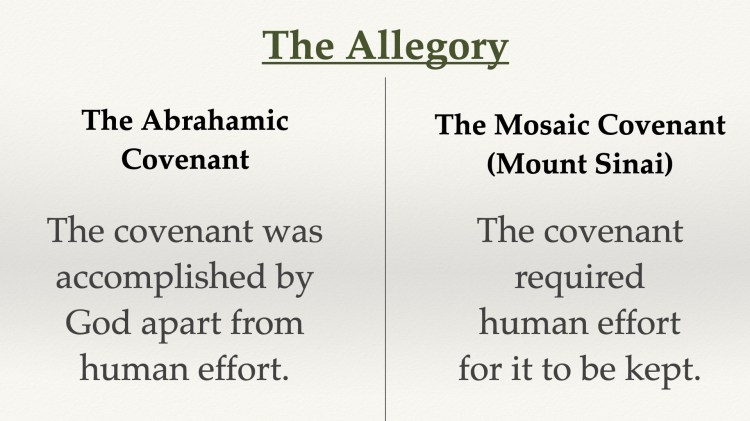
How these two different covenants were made is a major factor in understanding the allegory. The first covenant, the covenant of promise where God pinned Abraham to the ground, was a covenant accomplished by God apart from human effort. The second covenant at Mount Sinai, where blood is thrown on the people, is the covenant that required human effort to keep, something that human effort could not do.
Paul treats these events as an allegory for the people. Those false teachers coming from Jerusalem want you to be under the second covenant, the covenant made at Mount Sinai, where human effort was required but unable to keep. They are trying to get you to bring about the promises of God through human effort in the same way that Abraham and Sarah tried to produce the promises of God through Hagar, the handmaiden. The result of human effort trying to produce the promises of God is slavery. That is what those false teachers are doing to you.

That is not the covenant we have received in Jesus Christ. The covenant we have received in Christ is like the covenant made with Abraham, where the responsibility and the penalty fall upon God alone. It is here that Paul quotes Isaiah 54, tying this ancient promise given to Abraham and Sarah to the fulfillment of God’s promises found in Christ. Galatians 4:27 “For it is written, “Rejoice, O barren one who does not bear; break forth and cry aloud, you who are not in labor! For the children of the desolate one will be more than those of the one who has a husband.” 28 Now you, brothers, like Isaac, are children of promise.” This passage of Isaiah that he quotes points us to a whole section of scripture that is all about the new covenant in Jesus Christ, the suffering servant who takes the sins of the world upon Himself. You, Paul says, are like Isaac, children of God made so through the promise and work of God. Not through human effort. “31 So, brothers, we are not children of the slave but of the free woman. 1 For freedom Christ has set us free; stand firm therefore, and do not submit again to a yoke of slavery.”

How does this allegory apply to us? First, the simplest and clearest application of this allegory is that salvation is received as a work of God given to us as a gift apart from human effort. This gift from God is called grace. We are saved not by our works, not by our efforts, but by grace through faith apart from human effort. Salvation does not come from our own doing, but it a gift from God. And because it is a gift from God and not of our works, salvation as a gift brings freedom.
This is the second point. Salvation as a gift brings freedom. Thus Paul ends his allegory, “For freedom Christ has set us free; stand firm therefore, and do not submit again to a yoke of slavery.” (Galatians 5:1 ESV)
Here is how I understand this freedom that Paul is talking about in the context of receiving God’s promises apart from (or minus) human effort. I am enslaved when I, by my own effort, seek to achieve the things (to do, to be, or to have) that my heart desires. Things like my own salvation, the fulfillment of God’s promises, a joy and peace found only in relationship with God, being righteous and blessed by God. I am enslaved when I try, by my own efforts, to garner these things that are impossible for me to grasp.
Why? Why does adding human effort to accomplishing the promises of God bring bondage and enslavement? I thought a lot about this, and I think there are a lot of answers, much more than I am giving here, but I am preaching to myself, and this is what I need to hear, and thus I am sharing it with you.

The things that 100 % come from God are the very things that I (we) most long for, and thus they are also the things I (we) most fear not having. It is this fear of not having that, I think, is the root of our enslavement to human effort. Just like what Abraham and Sarah did when they took Hagar as the means to accomplish God’s promises: the enslavement of the human heart is the fear and false belief that God is not going to deliver; therefore, I need to act. I need to take matters into my own hands.
- God is not going to save me; I need to save myself.
- God is not going to bless me; I need to bless myself through my hard work.
- God is not going to give me joy or peace; I need to find them for myself.
- God is not going to really forgive me and declare me righteous; thus, I need to practice self-righteousness and do my best to deny, deny, deny any wrongdoing. And if that does not work, I blame, blame, blame.
The enslavement of human effort is manifested in our fears. We see it in;
- the fear of making a mistake
- the fear of not being good enough
- the fear of being judged by others
- the fear of being rejected
- the fear of not having friends
- the fear of what others think
- the fear of not being respected, or not being liked
- the fear of not getting my fair share
- the fear of not being in control
- the fear of what happens if I do not get my way
- the fear of being alone
- the fear of being judged unrighteous
And so, because of these fears, we fight and scratch and posture and give excuses and pretend to be people we are not, and say “Yes,” when we really want to say “No,” and are easily influenced by what the crowds think, and so on, and so on and so on. This slave master of fear has control of our lives. This is the covenant of Sinai when the people stood before God and were sprinkled with blood and told that if you fail to keep this covenant all these curses will come upon you. It is the covenant of fear. This covenant of fear is a symbol of how life is lived by all people in this world.

The Promises of God and the Freedom brought by Grace: But there is a different covenant seen in God’s covenant with Abraham. When it came time for that blood to be sprinkled upon those entering the covenant, God literally holds Abraham to the ground, and He, the Lord, alone walked down that path between the sacrificed animals representing the keeping of the covenant. By walking this path alone, God is saying to Abraham, my promises to you are fulfilled by me alone, not by your effort. Therefore, since it is a covenant that is kept and fulfilled by God, not by your efforts, it is thus the covenant that brings freedom. Here is the freedom.
- I do not have to worry about failing because it is not on me.
- I don’t have to be afraid about being alone, because he will never leave me.
- I don’t have to be afraid about being good enough, because he is my righteousness.
- I don’t have to worry about getting my fair share because I inherit the kingdom.
- I don’t have to be afraid about not being in control, because I am not in control; he is, and the Lord does a much better job with my life than I do.
- I don’t have to worry about not being happy, not finding joy, because he is my joy, and he is my peace.
- I don’t even have to fear or worry about dying, for even in death, he has me.
This is the freedom that we have in Jesus Christ. When Paul says in our text today, 30 But what does the scripture say? “Cast out the slave woman and her son, for the son of the slave woman shall not inherit with the son of the free woman,” he is talking about dealing with false teachers, but I think he is also talking about casting out these fears that so easily cause us to rely on our own efforts.

So how do you do that? How do you cast out that slave driver of fear and walk in the freedom for which Christ has set you free? To answer this question, I am going to turn to the end of the book of Hebrews, where the writer is using the same allegory that Paul is using here in Galatians.
1. Remember that you belong to the New Covenant in Jesus Christ, which is a covenant of grace that trusts God to keep his promises. Paul says there are two covenants, thus know to which one you belong. Are you under the covenant of fear and human effort, or are under the covenant that trusts God to keep his promises? In order to cast out this slave-driver of fear, you need to keep locked in your mind, through the everyday disciplines of prayer and scripture and faith, the truth and reality of the covenant you are under. Here is the scripture from Hebrews 12 that speaks of these two covenants and reminds those in Christ exactly which covenant they are under. Reading Hebrews 12:18-21, “18 For you have not come to what may be touched, a blazing fire and darkness and gloom and a tempest 19 and the sound of a trumpet and a voice whose words made the hearers beg that no further messages be spoken to them. 20 For they could not endure the order that was given, “If even a beast touches the mountain, it shall be stoned.” 21 Indeed, so terrifying was the sight that Moses said, “I tremble with fear.” This is the covenant of fear and human effort. But there are two covenants; reading on, we come to the second one. Verse 22, “ But you have come to Mount Zion and to the city of the living God, the heavenly Jerusalem, and to innumerable angels in festal gathering, 23 and to the assembly of the firstborn who are enrolled in heaven, and to God, the judge of all, and to the spirits of the righteous made perfect, 24 and to Jesus, the mediator of a new covenant, and to the sprinkled blood that speaks a better word than the blood of Abel.”
In Genesis 4, the blood of Abel cries out, “Murder, murder, I demand justice.” The blood of Jesus cries out, “Forgiveness, forgiveness; justice is rendered; it is finished.” The writer of Hebrews is doing the exact same thing Paul is doing in Galatians. He is reminding them of the covenant they are under. You have not come to this mountain of smoke, and fear and trembling, but instead you have come to Mount Zion, the city of the living God. Our assurance, as Paul says in Galatians. 26…But the Jerusalem above is free, and she is our mother… 28 Now you, brothers, like Isaac, are children of promise. Paul is reminding them who they are and the covenant to which they belong.
The same is for you and me: to live in the freedom of Christ, and to cast out this slave-driver of fear, you must know and keep reminding yourself of the covenant you are under. We do this daily, repetitively, through the disciplines of prayer, scripture, and faith.
2. Listen to Jesus. That is what Hebrews says, vs. 25, “See that you do not refuse him who is speaking.” In other words, trust the promises of God. Rely on the promises of scripture. Look forward to the unshakeable reality of the kingdom of God. If you place yourself through faith and trust in that unshakeable kingdom, you will not be shaken. Listen to Jesus.
3. Practice gratefulness and give God all praise and glory. Hebrew says, 28 Therefore let us be grateful for receiving a kingdom that cannot be shaken, and thus let us offer to God acceptable worship, with reverence and awe, (Hebrews 12:28ESV). This is the way of life that is free. It is the heart that is grateful to the God of the unshakeable kingdom.
Close: We are living in a day of great fear. Fear of the virus, fear of the political chaos, fear over what this next year will bring, and fear of the future. I think that the deep source of our fears come from the thought that somehow what I truly need and what I truly desire to be happy or joyful will be taken from me. God has promised you in Jesus Christ, that . . .
- He has promised you that he is with you to the end of the age. You are not forgotten; you are not alone.
- He has promised you that your sins are forgiven and that your goodness is his righteousness. You do not have to worry about what God thinks about you. He loves you and sees you not through your sin, but through Christ’s righteousness.
- He has promised you real joy and happiness. I do believe this. The joy of the Lord is my strength. Blessed are the poor, those who mourn, the meek, the hungry. The word blessed means happy. We are blessed not because of human efforts, but because the Kingdom of God in Christ is breaking in. Knowing him does change lives and change hearts.
- He has promised you abundant and eternal life. There is nothing in this world that can take that away from you.
These are just some of the promises that God has made to you. Living in these promises as gifts of grace provides a freedom that this world cannot give. Live in that freedom. Amen.
Preached on July 26, 2020 at New Baptist Church by Pastor Trent Eastman. Proof reading and editing of the sermon manuscript by Lois Merritt.
 Concerning the Word of Life