
Galatians 5:1–6. “1 For freedom Christ has set us free; stand firm therefore, and do not submit again to a yoke of slavery. 2 Look: I, Paul, say to you that if you accept circumcision, Christ will be of no advantage to you. 3 I testify again to every man who accepts circumcision that he is obligated to keep the whole law. 4 You are severed from Christ, you who would be justified by the law; you have fallen away from grace. 5 For through the Spirit, by faith, we ourselves eagerly wait for the hope of righteousness. 6 For in Christ Jesus neither circumcision nor uncircumcision counts for anything, but only faith working through love.
False teachers have come to these churches in Galatia, telling them that to be saved they need more than Jesus. They need Jesus plus the law. Thus, Paul is fighting for the gospel. He is fighting for the truth that our salvation is won by what Christ has done for us, not by what we have done for ourselves. In this fight for the gospel, Paul has already said some very strong things about these false teachers as well as anyone who seeks to prove themselves to God through their works. He says, regarding such people;
- They are “not in step with the gospel.” (Galatians 2:14)
- They who “rely on works of the law are under a curse.” (Galatians 3:10)
- They are enslaved to the weak and worthless elementary principles of the world. (Galatians 4:9)
- They are held in bondage, living in fear. (Galatians 4:24-25)
And if this is not enough, in our scripture today, Paul even goes further to say that if a person tries to justify themselves by the law, that person is damned; they are not saved. Look at verse 2 and verse 4. “Look: I, Paul, say to you that if you accept circumcision, Christ will be of no advantage to you… You are severed from Christ, you who would be justified by the law; you have fallen away from grace.” I do not know of any harsher, stronger words that can be used. Paul is saying that if a person seeks to win their salvation, or even keep their salvation through works, that person will lose their salvation. Legalism damns people.
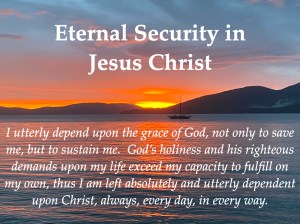
I believe in what is often called eternal security. Eternal security is the belief that no sin can remove from me the abundance of God’s grace upon my life. I believe that I do not lose my salvation if I fall into sin. I believe this not only because I think this is what the Bible teaches, but also because it is logical. The person who believes that a person’s salvation can be lost by falling into sin does not recognize that gap that exists between us and God’s holiness.
I am saved. I believe upon Jesus Christ. He is my savior, and the Spirit of God is in me and has been at work in my life for a very long time. And I can testify today that the Spirit of God has a lot more work yet to do in me. I am not there yet. If I, in any way, lose my salvation because of sin in my life, then I am not saved. I utterly depend upon the grace of God, not only to save me but to sustain me. God’s holiness and his righteous demands upon my life exceed my capacity to fulfill on my own; thus, I am left absolutely and utterly dependent upon Christ, always, every day, in every way. To suggest that a person can reach a level of personal holiness that somehow can be lost through falling into sin is utter hubris, the highest form of human arrogance. The only way a person can have such an elevated view of their self-righteous works is if they have an extremely low view of God. There is no sin that you have ever committed that is greater than God’s grace to cover it. You cannot out sin the grace and forgiveness found in Jesus Christ. This is why I believe in eternal security.
Thus, when I come to passages like ours today, I get theological heartburn. Verse 2 and verse 4 give an unambiguous warning that if I pursue the law to gain any form of justification or personal righteousness, I am cut off from Christ, which to me, means I lose my salvation. This is what makes what Paul is saying so strong. Not only does following the law enslave you, it is also another form of idolatry, and is not in step with the gospel; it also damns you. Legalism sends you to hell. According to these verses, I can lose my salvation, not because of any sin I commit, but by trying to be righteous on my own. Spiritually speaking, it is more dangerous for me to follow the law than it is for me when I sin. (Did I just say that? What just came out of my mouth?) Aren’t we supposed to be telling people how to live the good life and the rules that everyone needs to follow to be a Christian? Is that not what Jesus wants us to do? What would Jesus say?
Well, this is what Jesus says to those who require personal righteousness gained through the law. “But woe to you, scribes and Pharisees, hypocrites! For you shut the kingdom of heaven in people’s faces. For you neither enter yourselves nor allow those who would enter to go in.” “Woe to you, scribes and Pharisees, hypocrites! For you travel across sea and land to make a single proselyte, and when he becomes a proselyte, you make him twice as much a child of hell as yourselves (Matthew 23:13, 15).”
I do believe in eternal security, but heed the grave warning that Paul is giving. Whenever a person tries to accomplish a self-righteousness by their work, they are in effect refusing, rejecting, the work of Jesus in their life; therefore, Christ will be of no advantage to them. And, if a person refuses the work of Jesus, they have rejected the grace of God necessary for salvation. Paul is perfectly logical. It makes sense. Yes, the Father, through the Son in the power of the Spirit, has provided what is necessary for our salvation regardless of the sin; but, the Lord has not provided a salvation that does not need him, that is absent his glory, absent his work, absent his being Lord, and that is what legalism does. This is why Jesus says to the scribes and Pharisees, “Truly, I say to you, the tax collectors and the prostitutes go into the kingdom of God before you (Matthew 21:31).”
We are utterly dependent upon His grace. Grace shapes us; Grace defines us and gives us life. This freedom in Grace raises a very important question. Paul voices it in Romans. If the law is not needed, how then are we to live? “Are we to continue in sin so that grace may abound (Romans 6:1)?” Of course not, that is absurd. How can we who died to sin still live in it (paraphrase of Romans 6:2)?” Then, how are we to live, what is the Christian ethic? What does the Christian life look like that has died to sin if it is not the law? Paul summarizes the answer to this question with three words; Faith, Hope, and Love.
Verse 5 and 6, “For through the Spirit, by faith, we ourselves eagerly wait for the hope of righteousness.For in Christ Jesus neither circumcision nor uncircumcision counts for anything, but only faith working through love (Galatians 5:5-6).” Faith, hope, and love define the life that knows God’s grace. Each one of these words is worthy of a more significant study then I am doing in this message. I hope you ponder and think about these words so that they will define you.

Verse 5 begins by saying, “For through the Spirit.” If you go back through Galatians, you will see that everything is done through the Spirit.
- Galatians 5:16, we walk by the Spirit.
- Galatians 5:18, we are led by the Spirit.
- Galatians 5:25, we live by the Spirit and keep in step with the Spirit.
- Galatians 4:6 we are children of God and cry out Abba Father by the Spirit.
- Galatians 5:22-23 the Fruit of the Spirit is grown in us.
- And, Galatians 3:2, the Spirit of God is received by faith.
Through the Spirit of God, life is lived in relationship with God. Faith, hope, and love are not new forms of the law but define how we live in relationship with Him through His Spirit.
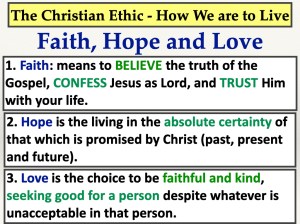
1. Faith, very simply, means to believe, confess, and trust the Lord. To me, these are the three necessary ingredients of faith to be a saving faith and is how we love God. The Great Commandment, which is to love the Lord your God with all your heart, all your soul, with all your strength and with all your mind, is faith. Belief is loving the Lord with your mind. Confession and Acceptance are loving Him with your heart and soul, and trusting the Lord daily is loving the Lord with all your strength. Thus, I define faith as to believe upon Jesus Christ, to accept Him as your Lord and Savior through confession, and to trust him with all your heart.
2. Hope. For through the Spirit, by faith, we ourselves eagerly wait for the hope of righteousness. Hope is living in the absolute certainty of that which is promised by Christ (past, present, and future). In Greek, this word hope is not how we understand the word hope. In English, we use hope to mean something like wishful desire. In Greek, the word hope implies certitude. Absolute certainty about something that is going to happen. Paul says this certainty we have is righteousness, “We ourselves eagerly wait for the hope of righteousness.” I understand his use of the word righteousness here to be a type of summary word for everything that is gained in Christ, not only in the present but also in the future.
- I have the certitude that everything in my life that is broken or wrong is, and will be, made right and transformed. (Hope of Personal Sanctification and Glorification).
- I am confident that all that is evil and broken in this world will either be healed, judged and done away. The injustices that we see now, and there are many, will come to an end. (Hope of the return of Christ).
- I am certain that there shall be a new creation where I will live eternally in the full presence of God. (Hope of Eternal Life)
- I am confident that God loves me, and that nothing will remove me from his grip. I am certain that he hears my prayers and forgives my sins. (Hope of Personal relationship with God)
These things are the hope of righteousness. Hope is the living in the absolute certainty of that which is promised by Christ, and our faith proclaims. Having this hope shapes a type of identity in the Christian.
- The material things of this world reduce in value.
- Our relationships with people go up in value.
- Our experience with suffering changes because we know it is momentary.
- Our experience when people do us wrong changes because we have been forgiven, so we forgive. And so on.
This is how hope, the certitude of Christ’s promises, shapes our lives today, and defines a part of the Christian Ethic.
3. Love. “6 For in Christ Jesus neither circumcision nor uncircumcision counts for anything, but only faith working through love.” I have defined love as “Love is a choice TO BE faithful and kind, seeking good for that person despite whatever is unacceptable in that person.” Paul will say in just a few verses from here. “For the whole law is fulfilled in one word: “You shall love your neighbor as yourself (Galatians 5:14).” And he will say again in Romans 13:9, “the one who loves another has fulfilled the law.”
If you were here a few Sundays ago when we looked at Galatians 4:12-20, we saw in Paul’s action towards the people of Galatia what it looks like to love. Love is patient and kind, filled with humility, often makes sacrifices, and surrenders one’s own will. Love is forgiving and seeks to serve the other, celebrates and holds fast to what is good, and is always faithful. To quote, “Love bears all things, believes all things, hopes all things, endures all things. Love never ends. (1 Corinthians 13:7-8a).” Love Abhors what is evil; holds fast to what is good (Romans 12:9).” Love“Rejoices in hope, is patient in tribulation, is constant in prayer (Romans 12:12).”
Love is a choice TO BE faithful and kind, seeking good for that person despite whatever is unacceptable in that person. This understanding of love means that no matter how bad a situation may be and how far a person has sunk, love always holds onto a real hope for that better day and endures the suffering of the moment. That is what love is. Love never ends. Love abhors what is evil, and it does not accept evil. And in this enduring hope, love never stops praying. To love someone means that you never give up hope, practice faithful patience, and never stop praying. This is love.
During the last week of Jesus’ life, knowing what would happen to him, he loved. Knowing that he would be betrayed, handed over, beaten, and killed, Jesus loved. During that last week of his life, he is asked by those who will do evil to him, “What is the greatest commandment in the law?” Jesus responded, “You shall love the Lord your God with all your heart and with all your soul and with all your mind. This is the great and first commandment. And a second is like it: You shall love your neighbor as yourself. On these two commandments depend all the Law and the Prophets” (Matthew 22:37-40). How are we to live? We are to live in love. That is our Christian ethic. Faith working through love.
There is no way to love with this type of love unless you have faith and hope. They all go together; faith, hope, and love. This Christian Ethic is our identity.
- Is our world scary today? Absolutely it is, but we have a hope that is certain that looks towards a world yet to come.
- Do we ourselves mess up, drop the ball, act on the old habits of sin? Yes, we do, all the time, but by our faith in the risen one who died, we confess our sin and are forgiven of all unrighteousness.
- Are there some mean and confused people doing hurtful things? Yes, there are, but by the Spirit of God, we have a love that is greater than any evil that this world can offer.
- Are there times that we suffer, and hurt, and experience pain in this life? Yes, we do and we shall suffer. But we know that this suffering is only momentary “preparing for us an eternal weight of glory beyond all comparison (2 Corinthians 4:17).” “For I consider that the sufferings of this present time are not worth comparing with the glory that is to be revealed to us (Romans 8:18).”
Faith, hope, and love are how we are to live in this world because it is how Jesus lived. How do I know? I know it because of the cross. The cross is the highest expression of Jesus’ love. Jesus chose the cross because he trusted the Father. And, we are told in Hebrews 12:2, that Jesus had such a sure conviction of joy that he was willing to endure the cross. Let us respond in kind through to him with faith, hope, and love.
This message was delivered by Pastor Trent Eastman on August 2, 2020 at New Baptist Church, Huntington WV.
 Concerning the Word of Life