
This morning, the passage that we come to in our study of Galatians is chapter 5, verses 7-12. Throughout the letter to the Galatians, Paul has talked about the false teachers who have come preaching a false gospel, a gospel that is Jesus plus. Jesus plus the law. Jesus plus your own righteousness. Jesus plus all the things you need to do if you are to be saved. Because of this false gospel, Paul has been fighting for the truly good news that our salvation is in Christ alone. What makes our passage interesting this morning is that in these six verses, Paul talks about false teachers, and in doing so, gives us certain marks or indicators that help identify a false teacher. How do you know if a teacher is false, someone you should not follow? I suspect that each of us thinks to ourselves that we have the capability to recognize a false teacher when we see one. I hope that is true. From our scripture today though, I want to highlight six marks of a false teacher that you can use to evaluate pastors, teachers, preachers, me, and I hope, yourself as well. Also, this morning, I don’t want to just talk about false teachers; I think it is equally if not more helpful to talk about faithful teachers as well. Using the opposite of each mark of a false teacher, we will then look at six marks of a faithful teacher. Looking at both false and faithful teachers means that this is a 12-point sermon, therefore I am going to move quickly from point to point. Many of these marks of false or faithful teachers are worthy of greater study, which I leave to you.
Our Scripture is Galatians 5:7-12. Let’s read. “7 You were running well. Who hindered you from obeying the truth? 8 This persuasion is not from him who calls you. 9 A little leaven leavens the whole lump. 10 I have confidence in the Lord that you will take no other view, and the one who is troubling you will bear the penalty, whoever he is. 11 But if I, brothers, still preach circumcision, why am I still being persecuted? In that case the offense of the cross has been removed. 12 I wish those who unsettle you would emasculate themselves!” This is God’s Word.
The proper application of this text is to take what Paul is saying and use it as a tool to evaluate teachers and preachers; people like me. So yes, I am on the hot seat today. But I would also like you to use our scripture today to evaluate yourself. No one wakes up in the morning and says, “I think I will be a false teacher.” No one sets becoming a false teacher as a career goal, and no teacher would ever believe that he or she is a false teacher. That is part of the problem. People become false teachers through unrecognized or unrepentant sin in their lives. The sins of pride, self-importance, and ego are the seeds most likely to grow in false teachers. Over time, these sins, if unchecked, become demons that demand to be fed and served. Thus, as I walk through these six marks of false teachers, I ask you in your own heart and mind to recognize any sins that may produce these marks of a false teacher in you. Do not just evaluate me; evaluate yourself as well. With that said, let us begin.
The 6 Marks of a False Teacher
1. A False Teacher distracts you from obeying the truth of the gospel. Verse 7, “You were running well. Who hindered you from obeying the truth?” Reading this verse I am reminded of Hebrews 12:1 which reads “Therefore, since we are surrounded by so great a cloud of witnesses, let us also lay aside every weight, and sin which clings so closely, and let us run with endurance the race that is set before us, looking to Jesus, the founder and perfecter of our faith.” False teachers are people who cause you to become entangled, weighed down, and distracted to the point that you lose your focus on Jesus. There are many examples of this mark of a false teacher and what it looks like in action. One common example is when there is a person, and it may not be the preacher, who says, “Here is a ministry or here is a cause that we all need to get behind.” Then, in the excitement about the ministry (which may be very good), all focus of the church or group of people move from being focused on the gospel to an event, or to a cause, or a wonderful ministry that becomes all-consuming. Videos are played in church, speakers come and give passionate speeches, all the energy of the church is given over to something else other than the gospel, causing the gospel and the truth of God’s Word to become secondary or pushed out altogether. There are many good ministries and causes that are worthy of your support and involvement and we have many here at church. A false teacher though turns these things that are good into idols that demand your constant focus and attention and service on them and not on Jesus. That is one example of how a False Teacher distracts you from obeying the truth of the gospel.
2. A False Teacher is more concerned about your hearing their voice than hearing God’s voice. Verse 8, “This persuasion is not from him who calls you.” The false teachers that Paul is talking about are persuading the people to do something that is not from God, which means that these false teachers want people to listen to them and not to God. They want to be in control of what God is saying to you. Again, many examples of what this would look like in practice, but I think one of the best examples of this mark of a false teacher is seen in a person who is never wrong and does not allow any correction. This mark is seen when a teacher or pastor demands to be heard, followed, and obeyed, and you cannot question him. I also think the mark of a false teacher is evident when a preacher preaches more about himself than about God’s word. A False teacher is more concerned about your hearing their voice than hearing God’s voice.
3. A False Teacher seeks to control everything and everyone. Verse 9, “A little leaven leavens the whole lump.” The image here is just one tiny piece of leaven that mixes in and disrupts everything. In the same way, a false teacher is involved with everything and must be in charge of everything. In the church, examples of this would be people who micromanage everyone and every ministry; people who demand to get their way.
4. A False Teacher leads through fear, which causes confusion and discouragement.
Verse 10, “I have confidence in the Lord that you will take no other view, and the one who is troubling you will bear the penalty, whoever he is.” When the Galatians became followers of Jesus, they related to God in the joyful confidence of children crying “Abba Father” through the Spirit. But their confidence in God’s grace became shaken by the false teachers who came to town and threatened them with the judgment of God if they did not keep the law of God. This is why I say here, “False teachers lead through fear.” The people are troubled, discouraged, and afraid because of their lost confidence in God’s grace caused by the false teachers. False teachers are always going to be twisting your arm, telling you what you need to do or else. False teachers lead through fear.
5. A False Teacher lies about other people to make him or herself look good. Verse 11, “But if I, brothers, still preach circumcision, why am I still being persecuted? In that case the offense of the cross has been removed.” What seems to have happened is that these false teachers have lied about what Paul taught as a way to make themselves look good, and to get people to accept their teaching. Maybe they pointed to Timothy, “See, he was circumcised.” Maybe they twisted Paul’s teaching that what matters is the heart being circumcised. We do not know, but what we do know is that they gave a false report about Paul so that they would look good to the people. I think this happens all the time. Preachers often speak ill of and tear down other teachers to lift up themselves. And preachers or teachers use quotes from spiritual giants as a way to make themselves look better by association. False teachers misuse other people to their advantage.
6. A False teacher is more concerned about rules, rituals, or events than about people genuinely knowing God. Verse 12, “I wish those who unsettle you would emasculate themselves!” I bet you are wondering how in the world did I get this mark of a false teacher from that verse. Here is how.
It is possible that verse 12 is not Paul just speaking out of anger but that he is making a significant connection to pagan culture. The Greco-Roman world had all kinds of gods and goddesses, like Zeus, Apollo, Athena, and so forth. These gods and goddesses were worshiped in various ways all across that ancient world. But certain areas in the ancient world were home to a specific god or goddess. We have one example in our Bible. It is found in Acts 19 when the people talk about Ephesus as the home for Artemis. Thus, as you look at the ancient world, certain geographical areas become homes or centers of cultic activity around a particular god or goddess. One of the problems that Paul had in many of these early churches is that the Gentile converts to Christianity carried with them into the church practices of worship from pagan rituals. The best example in the Bible of this, I think, is seen in Paul’s letter to the Corinthians who seem to be mimicking the worship styles of the oracle of Delphi seen in gatherings of confusion where everyone was speaking in a different tongue.

In Galatia, the people who are receiving this letter of Galatians from Paul, the central religious cultic activity was around the goddess Cybele. Like Artemis in Ephesus, the worship of Cybele in Galatia was ancient and was known throughout the Roman world as Magna Mater, the great mother of all gods. In the cult of Cybele, during each spring, there would be days of festivals. On the day known as the day of blood, the high holy day of the festival, all of the men chosen to be priests to Cybele were emasculated. The same word that Paul is using here in verse 12. These priests, called Galli, once emasculated, would dress like women, wear makeup and jewelry, go and dance in the streets and receive alms from the people who believed that these priests of Cybele now held special prophetic power. That is part of the context of these new Christians in Galatia. It is possible that what Paul is saying in vs. 12 is that if you feel that you need a special religious ceremony to make you a Christian, you may as well go to the temple of Cybele and get it done right. These false teachers only care about an event or a ritual being performed more than a person’s relationship with God. Paul is fighting against a religion based on ritual versus the Christian faith, which is based on relationship.
In churches today, I think an example of this mark of a false teacher is seen when people become so numbers-driven or event focused that what happens after the event, or after the baptism, or after the believer’s prayer does not matter to them. To be clear, I want people to know Jesus, and if you do not know the Lord, I would like to help you to understand how to know Jesus today. BUT – BUT – a false teacher is only concerned about a ritual taking place, and once that person has done that ritual – like saying a believer’s prayer or being baptized, that teacher moves on to the next person. A False teacher is more concerned about rules, ritual or events than about people truly knowing God
These are the 6 Marks of False Teachers gleaned from these six verses.

- A False Teacher distracts you from obeying the truth of the gospel.
- A False Teacher is more concerned about your hearing their voice than by your hearing God’s voice.
- A False Teacher seeks to control everything and everyone.
- A False Teacher leads through fear, which causes confusion and discouragement.
- A False Teacher lies about other people to make him or herself look good.
- A False teacher is more concerned about rules, rituals, or events than about people genuinely knowing God.
Evaluate me by this list, evaluate others by it, and evaluate yourself. How do you lead, how do you teach, how do you engage with other people? Now, let’s flip these marks of a false teacher and look at them in opposite as a way to identify the marks of faithful teachers, teachers who are true to God’s word and the gospel. Please remember that when I say, “Faithful Teacher,” I am referring to anyone with spiritual influence or authority. A faithful teacher can be a spiritual mentor, a small group leader, a Sunday school teacher, a parent, a person who leads a ministry or board in the church. All of these roles are all included in the term “Faithful Teacher.” Here are 6 Marks of a faithful teacher. If you seek to be useful in leading others in following Jesus, these are traits that you need to develop.
6 Marks of a Faithful Teacher
(1) If a False Teacher distracts a person from obeying the truth of the gospel, then, that would mean;
1. A Faithful Teacher directs and encourages you towards obeying and living in the Truth of the Gospel. A faithful teacher is not going to use his or her position of trust to get you to support their agendas. A faithful teacher is not going to rally you around a cause that is larger than, more important than, the gospel. A faithful teacher is going to disciple people. This is what this first mark of a faithful teacher is talking about, discipleship. A faithful teacher is going to walk beside you with instruction and encouragement to help you better know how to live in the reality of the Kingdom of God as a follower of Jesus.
(2) If a False Teacher is more concerned about your hearing their voice than hearing God’s voice, then, that would mean;
2. A faithful teacher helps you hear God’s voice in your life. This mark is different than discipleship. I would call this mark of a faithful teacher, spiritual mentorship. Spiritual mentorship is different from discipleship in that mentoring a person is not to teach the person about God but to help that person hear God. Both roles are very important. A spiritual mentor is not passing on knowledge or instruction but is helping that other person to hear and respond to God’s voice. Some of the tools of a spiritual mentor include God’s word, the using of tough probing questions, and sometimes confronting sin that is causing deafness to the Spirit of God. The point is that a faithful teacher is a spiritual mentor who is helping you discern the will of God in your life as opposed to trying to get you to be a part of what he or she is doing.
(3) If a False Teachers seeks to control over everything and everyone, then that would mean;
3. A Faithful Teacher gets out of the way for the Holy Spirit to work in your life. I think that we sinful human beings often get in God’s way. When we are impatient or have anxiety that things are not how we want them, or fearful that we may not be needed, we tend to get in God’s way and insert ourselves in areas where the Holy Spirit can work much more effectively without us. I think God sometimes thinks, “Why are you making it so hard?” A faithful teacher recognizes that the real work that needs to happen in a person’s life is done by God’s Spirit, not by him or herself. But often the teacher gets in the way by making everything about him or herself, needing to be in control, or the center of attention. Getting out of the way means for the faithful teacher to trust the Lord in every situation or problem. A faithful teacher lets God be the fixer. I think this is one of the reasons that people gravitate towards false teachers. They want a person to be the fixer of their problems. But a faithful teacher will say, “I cannot solve your problems, but I can point you to Jesus.”
(4)If a False Teachers leads through fear that causes confusion and discouragement, then that would mean;
4. A Faithful Teacher keeps encouraging and reminding people of the Good News of Jesus Christ.
- When people are crushed by sin and shame, faithful teachers tell them of God’s forgiveness.
- When people feel alone, faithful teachers remind them that the Lord is present.
- When people feel small, meaningless, or left out, faithful teachers remind them that they are loved by God.
I love the passage in John 12:32 when Jesus says, “When I am lifted up from the earth, I will draw all people to myself.” Fear drives people; love draws people. Faithful teachers draw people to Christ through love and by holding up the beauty of the Gospel.
(5) If a False Teacher lies about other people to make him or herself look good, then that would mean;
5. A Faithful Teachers practices humility. Lying about others to make oneself look good is a product of pride and an insecure ego that needs to be liked or approved by other people. Thus I think that the opposite of this mark of a false teacher who misuses people is humility. Now humility is one of those words hard to define and, therefore, often misunderstood. In this context of false and faithful teachers I define humility in the faithful teacher as;
- Not needing to look good
- Not needing to be first
- Not needing to be liked by everyone
- Not needing to tear other people down in order to look good
- Not needing to pretend through false association
But rather, the humility of a faithful teacher is seen in their
- Being authentic and genuine
- Being aware and reflective of his or her own sins and weaknesses
- And possibly most important, having joy in the contentment of being the Lord’s servant, no matter where the Lord has placed him or her.
(6) If a False Teacher is more concerned about rules, ritual or events than about people genuinely knowing God, then that would mean;
6. A Faithful teacher journeys with you as you grow in the Lord. (The faithful teacher wants you to know God).
A faithful teacher’s goal for you is not for you to perform some ritual that allows them to boast about how many people did this wonderful thing. Instead, a faithful teacher’s goal is for you to draw near to the Lord in holiness and wholeness, and in obedience and truth. A faithful teacher’s desire is for you to follow Jesus, which is something that happens through all of life and cannot be reduced down to an event or ritual. A false teacher is going to be someone who is always talking about the next event or the big next thing that you need to do for God to act in your life. A faithful teacher is going to be on a journey with you as you move deeper in your walk with Jesus.
These are the 6 marks of a faithful teacher.
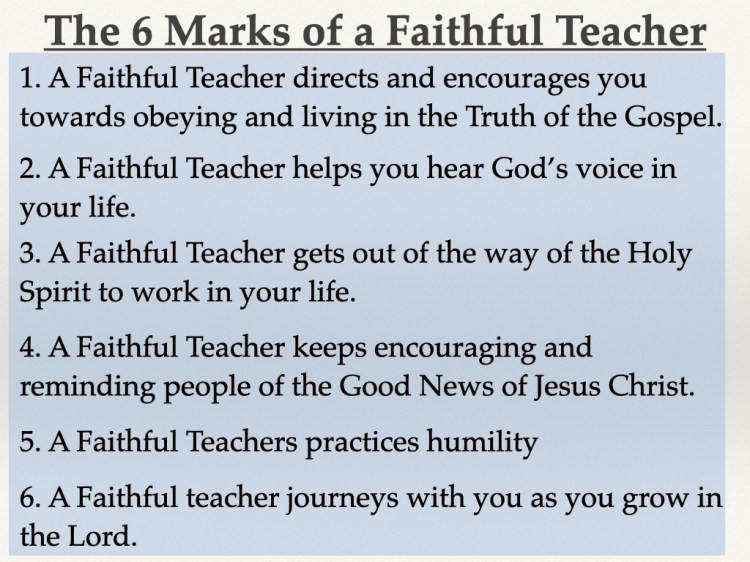
- A Faithful Teacher directs and encourages you towards obeying and living in the Truth of the Gospel.
- A Faithful Teacher helps you hear God’s voice in your life.
- A Faithful Teacher gets out of the way for the Holy Spirit to work in your life.
- A Faithful Teacher keeps encouraging and reminding you of the Good News of Jesus Christ.
- A Faithful Teacher practices humility.
- A Faithful Teacher is patient and journeys with you as you grow in the Lord.
Again, evaluate me by these marks, evaluate others by these marks, and evaluate yourself. How do you lead, how do you teach, how do you engage with other people?

The greatest teacher who has ever lived is Jesus Christ. Do we see these marks in him? I think so.
- (1) Jesus’ whole life was to direct us towards a trust and obedience of the gospel.
- (2) Every word that Jesus spoke and every action that he did was to help people to hear God, even the harsh words he spoke to those that opposed God.
- (3) And Jesus himself said it is better for me to go so that the Holy Spirit may come. If Jesus got himself out of the way for God’s Holy Spirit to come into your life, how much more important is it for us to do likewise?
- (4) Jesus proclaimed the good news to everyone. There were many things wrong in the ancient world. I am sure there was massive pressure on him to speak out about the various forms of political corruption, especially when the people wanted to make Jesus king after John the Baptist was beheaded. Still, Jesus kept pointing people the kingdom of Heaven and calling people to follow him.
- (5) Jesus practiced humility. (Matthew 11:29 (ESV) Take my yoke upon you, and learn from me, for I am gentle and lowly in heart, and you will find rest for your souls.). His greatest joy and contentment was to do the will of the Father.
- (6) Jesus did not call people to a religious ritual. He did not call people to perform some event or had some goal that had to be accomplished by his followers. He invited people to follow him with their lives. He called people to the ongoing every day journey of walking with Him, and in return, Jesus says, I will be with you always. And he is.
Jesus was and is the best teacher.
This passage was awkward for me to preach today. Today, is the anniversary of my family and me coming to Huntington, West Virginia 18 years ago. It has been an adventure. In these 18 years as a pastor, I have made and continue to make mistakes, I have my struggles and weakness, and the message today was as much to me as it was for you. I am grateful though that here in this church, there are have been many faithful teachers to me. People who have journeyed with me, prayed for me, let God work in me, challenged me, and encouraged me always towards the truth of the gospel. You have been a gift to me. Thank you.
By Pastor Trent Eastman, August 9, 2020 at New Baptist Church, Huntington WV
 Concerning the Word of Life