
“16 But I say, walk by the Spirit, and you will not gratify the desires of the flesh. 17 For the desires of the flesh are against the Spirit, and the desires of the Spirit are against the flesh, for these are opposed to each other, to keep you from doing the things you want to do. 18 But if you are led by the Spirit, you are not under the law. 19 Now the works of the flesh are evident: sexual immorality, impurity, sensuality, 20 idolatry, sorcery, enmity, strife, jealousy, fits of anger, rivalries, dissensions, divisions, 21 envy, drunkenness, orgies, and things like these. I warn you, as I warned you before, that those who do such things will not inherit the kingdom of God. 22 But the fruit of the Spirit is love, joy, peace, patience, kindness, goodness, faithfulness, 23 gentleness, self-control; against such things there is no law. 24 And those who belong to Christ Jesus have crucified the flesh with its passions and desires. 25 If we live by the Spirit, let us also keep in step with the Spirit. 26 Let us not become conceited, provoking one another, envying one another (Galatians 5:16-26, ESV).”

In the Gospel of John, there is a story of a man named Nicodemus who comes to Jesus at night. He wants to know what Jesus is doing, why he is doing it, and exactly who he is. Jesus responds to Nicodemus by saying, “Truly, truly, I say to you, unless one is born again, he cannot see the kingdom of God (John 3:3).” Nicodemus responds, “I do not understand, how can one be born again? To this, Jesus responds and says, “Truly, truly, I say to you, unless one is born of water and the Spirit, he cannot enter the kingdom of God. That which is born of the flesh is flesh, and that which is born of the Spirit is Spirit (John 3:5-6).” Jesus defines his mission. The water he speaks of is his work upon the cross through which we are washed clean, forgiven. But forgiveness is not the end of God’s work in our lives. God himself enters our lives with a power to change us, to birth in us the very things of God. This power of Christ in you is the Spirit of God.
The problem in these churches of Galatia is not only that people have come and taught the churches that to be saved, you need Jesus plus the law, but they have also taught that to be changed, made new, you do so through the law. These false teachers are saying that the transformation promised by Christ comes to you through works. In essence, they are saying, “You are born again by trying really really hard.” They are teaching that the struggles you have with the sins of the flesh are dealt with if you rely upon the law. To this false teaching, Paul is saying, “No!!!” The truth of the Gospel teaches that sin is put to death in you by the power of God that is in you. You must be born again by the Spirit of God. Our scripture today may be one of the best places in all of scripture that teaches us what it means and what it looks like to be born again, to be born of the Spirit. To understand this teaching, we need to first look at how Paul understands our human condition.
There have been many theological words and terms used over the years to describe our human condition, often called “the flesh” in scripture. Some have called this human condition the sinful nature or fallen nature. Some theologians speak of our condition as depraved or just sinful. One of the things that make our passage so amazing today is that Paul teaches us about the flesh, this thing we call the sinful nature, by using just one word. The Greek word is ἐπιθυμία, and it is used throughout this passage. We see it first in verse 16, “But I say, walk by the Spirit, and you will not gratify the desires (ἐπιθυμία) of the flesh.”
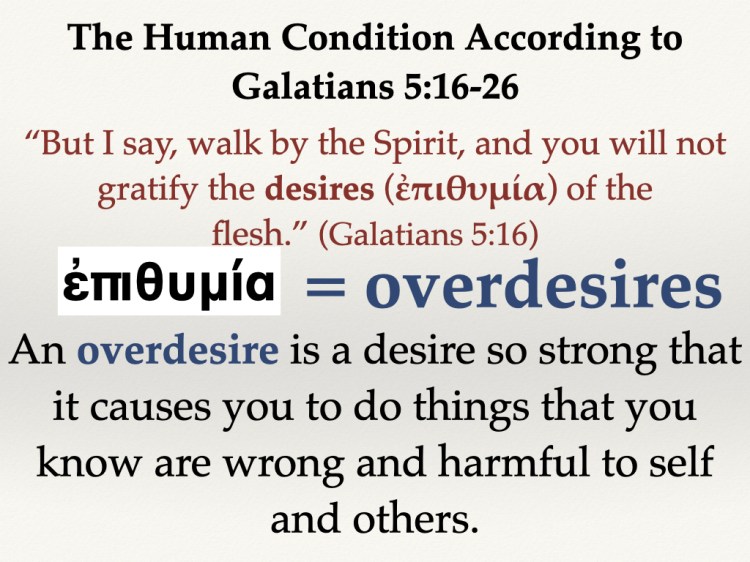
The word ἐπιθυμία is translated in our scripture as desires. This is a misleading translation. The word ἐπιθυμία does not mean desires, but rather it means overdesires. (And yes, I meant to write this as one word to reflect the Greek better). ἐπιθυμία is overdesires. Paul is not saying that there are good desires and bad desires, fleshly desires, and spiritual desires. That is how it is most often understood and has caused huge problems and has often created a toxic Christianity. This distorted thinking is usually found around sexual desire. To be clear, sexual desire is given to us by God. It is a part of how He made us; thus it is good. BUT, what has happened in our fallenness, our sin, is that the good sexual desire has become a sexual overdesire (good desire gone bad). An overdesire is a desire so strong that it causes you to do things that you know are wrong and harmful to yourself and others. Overdesires are godly desires that have become distorted and produce in us sin that Paul calls here “the works of the flesh.” This is my understanding of how Paul is describing our human condition.
Meth or heroin addiction is a visible illustration of the works of overdesire. Drug addiction is so strong that people do unthinkable things because of that overdesire. People addicted (overdesire) to drugs will commit horrible crimes against others and even against themselves merely as a means to get the next “hit.” The terrible corrupting control of addiction is an example of ἐπιθυμία, the overdesire that causes us to do things that we do not want to do. Again, verse 17, “For the ἐπιθυμία (over)desires of the flesh are against the Spirit, and the desires of the Spirit are against the flesh, for these are opposed to each other, to keep you from doing the things you want to do.” In verses 19 through 21, Paul lists the works of the flesh, which are the results of the ἐπιθυμία (overdesires). If you read this list of sins that Paul provides, you will notice that they can be grouped into four different categories. Each of these categories can be described as an overdesire. I am sure there are more overdesires than the four grouping categories of sins found in these verses, but these four overdesires are helpful for learning. Here are four overdesires that produce the works of the flesh.
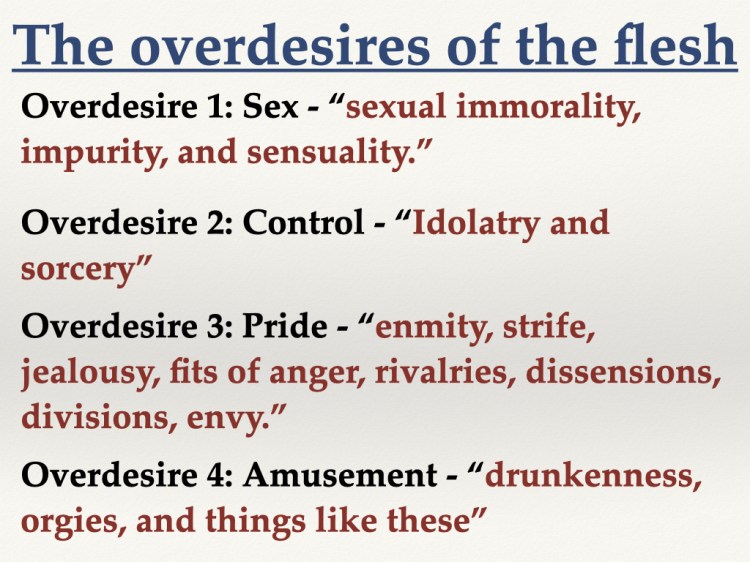
Overdesire 1: Sex. Some of the sins that this overdesire of sex produces are listed by Paul in verse 19, “sexual immorality, impurity, and sensuality.” Today, in our world, this overdesire of sex has become so dominant that people now identify themselves by a sexual preference (overdesire). Sexual desire for many has become their identity. And, the dominance of this overdesire of sex, in my opinion, has also demoted the sanctity and wonder of unborn life at the altar of this overdesire and sex and at the altar of the overdesire of control, which is number 2.
Overdesire 2: Control. The overdesire of control (power) is the desire to have complete control of one’s life to such an extent that it shapes and dominates everything a person does. This overdesire is the heart of “Idolatry and sorcery,” the sins listed by Paul here in vs. 20. Idolatry and sorcery are the ways that people seek to control God to force God to do what they want Him to do. That is what idolatry is ultimately all about. The thinking of idolatry is, “If I produce the proper sacrifice and speak the right prayer, then the gods will hear me and bless me.” Sorcery is much the same, for it seeks to access and control supernatural power through some ritual. Today, this overdesire of control comes out in how people turn things like wealth and power into modern forms idolatry. People think, “If I just have a little more money, then I will be happy and in greater control of my destiny.”
Over Desire 3: Pride. Pride is a wrong, often inflated view of self. Pride sees the self as the most important person in the room. Pride seeks to get one’s way often at the expense of other people. In our scripture today, Paul lists eight sins that are produced by pride, these are; “enmity, strife, jealousy, fits of anger, rivalries, dissensions, divisions, envy (20-21).” If measured by the number of sins listed by Paul, of all the overdesires listed here in our scripture, pride is the one that does the most damage.
Over Desire 4: Amusement. I have struggled to name this overdesire, but I think amusement is a good description. Paul names some of the sins produced by this overdesire of amusement as “drunkenness, orgies, and things like these (21).” The word orgy is a really bad translation. A better translation of this word would be overindulgence or excessive gratification. The overdesire of amusement is an obsession with always being entertained and finding pleasure. In 1987 Neil Postman wrote a book called Amusing Ourselves to Death. His argument in the book is that this overdesire and pursuit of being amused or entertained is going to destroy our country and impact everything, even politics. What would he say now on this side of the internet, Netflix and the phones we carry in our pockets to play “Candy Crush” and to watch cat videos on? I do not think he would be surprised that most people today get their news from late-night comedians. This overdesire of amusement produces in us overindulgence and excessive gratification to the point that the things that really matter in life are buried in the noise of seeking to be amused.
These are four excessive overdesires of the flesh. Again, the problem is not the desires; it is the overdesires that become so strong and demanding that people are enslaved to them, causing people to do things that are contrary to the way of God as well as opposed to the very things that you and I want to do and become. Listen to verse 17 again, “For the desires of the flesh are against the Spirit, and the desires of the Spirit are against the flesh, for these are opposed to each other, to keep you from doing the things you want to do.”
So, what are we to do, how are we to change? How are we to go to war against these overdesires in us? Well, the answer is not, IS NOT, relying on your own strength. That is the whole point of the book of Galatians. Legalism, which is all about relying on one’s strength, does not solve the problem of sin. Legalism does not change the overdesires of the flesh. We cannot change ourselves by our own strength; something from the outside has to come into us. And something, or better said, Someone, has to come into us. In Jesus Christ, God’s Holy Spirit enters the lives of all who believe. Paul has already said back in chapter 3 of Galatians verses 2 and 3, “Let me ask you only this: Did you receive the Spirit by works of the law or by hearing with faith? Are you so foolish? Having begun by the Spirit, are you now being perfected by the flesh?” We are changed (perfected) through the Spirit; God’s work in us creates something new. Paul describes this work of God in us through the Spirit as “the fruit of the Spirit.” Verse 22 to 23 reads, “But the fruit of the Spirit is love, joy, peace, patience, kindness, goodness, faithfulness, gentleness, self-control; against such things there is no law.” The fruit of the Spirit is the traits of God being grown in you, and these traits of God are in direct opposition to the overdesires of the flesh. The fruit of the Spirit describes what it looks like to live life in the Spirit.
So, what are we to do, how are we to change? How are we to go to war against these overdesires in us? Paul answers this question in verses 24 and 25. He says, “24 And those who belong to Christ Jesus have crucified the flesh with its passions and desires. If we live by the Spirit, let us also keep in step with the Spirit.” We live and go to battle against the overdesires of the flesh through the living and keeping in step with the Spirit.
Since keeping in step with the Spirit is in direct opposition to the overdesires of the flesh, I think it is possible to do an argument in reverse to help define what it looks like to keep in step with the Spirit. This argument in reverse is to flip the overdesires of the flesh as a means to describe what life looks like in the Spirit in opposition to these overdesires.
What does it look like to live and keep in step with the Spirit?
- If the overdesire is sex, then keeping in step with the Spirit is to “crucify the flesh with its passions and desires.” This is actually what Paul says in verse 24, “And those who belong to Christ Jesus have crucified the flesh with its passions and desires.” Crucifying the flesh, to me, means first that putting to death the overdesires of the flesh is a slow and painful process. In the ancient world, crucifixion was the most agonizing, painful, and slow means of death used. This tells me that my overdesires will not die easily; thus, the repeated practice of confession and repentance is a necessary discipline to crucify them. Second, to crucify my overdesires means to be driven to the cross of Jesus. The answer to the struggle with the overdesires of the flesh is to run to Jesus, never allowing guilt and shame to cause you to run away.
- If the overdesire is control, then keeping in step with the Spirit isa radical trust and faith in Jesus. To trust Jesus means to trust Him with your life. Trusting Him means to know and believe that His will for you is better than your will for your life. To trust Jesus means to surrender control of your life to Him. To trust Jesus means that He is Lord of your life. To walk in the Spirit is to trust the Lordship of Jesus Christ.
- If the overdesire is Pride, then keeping in step with the Spirit is humility. Humility is thinking of others as more important than oneself. In fact, this is where Paul points us in the very next verse after we are told to keep in step with the Spirit. He says in verse 26, “Let us not become conceited, provoking one another, envying one another.” And if you turn the page to chapter 6, you see that this humility and love is what Paul now talks about as the practical application of walking in the Spirit. “Bear one another’s burdens, and so fulfill the law of Christ (Galatians 6:2).”
- If the overdesire is Amusement, then keeping in step with the Spirit is worship, seeking the face of God. Worship here means the purposefully focus on the divine. Thus, to keep in step with the Spirit means to focus your mind and your heart on God intentionally. This focus on the Lord is done through such things as scripture, music, and prayer. Spend time seeking the beauty and glory of God.
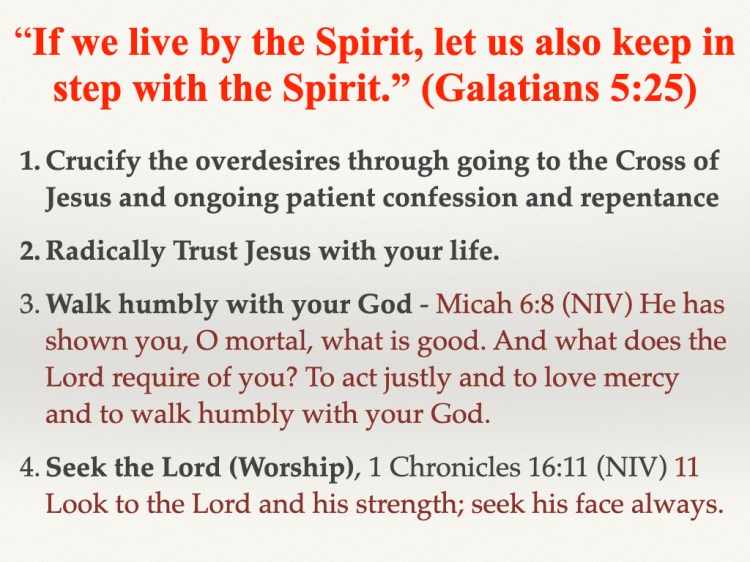
So how do we wage war with the flesh? What does it mean to live and keep in step with the Spirit? The answers from the Galatian 5:16-26 passage is;
- Crucify the overdesires through going to the Cross of Jesus and ongoing patient confession and repentance.
- Radically Trust Jesus with your life.
- Walk humbly with your God. “He has shown you, O mortal, what is good. And what does the Lord require of you? To act justly and to love mercy and to walk humbly with your God (Micah 6:8 (NIV).”
- Seek the Lord (Worship). “Look to the Lord and his strength; seek his face always 1 Chronicles 16:11).”
These four answers to the overdesires help describe how the Holy Spirit is working in your life. Will you walk with the Spirit and fight against the overdesires of the flesh? Walk with the Spirit of God, keep in step with Him, through the power of God, and you will be changed.
Message Preached by Trent Eastman on August 16, 2020 at New Baptist Church, Huntington West Virginia.
 Concerning the Word of Life