
“Brothers,if anyone is caught in any transgression, you who are spiritual should restore him in a spirit of gentleness. Keep watch on yourself, lest you too be tempted. 2 Bear one another’s burdens, and so fulfill the law of Christ (Galatians 6:1-2)”
Whenever I teach the books of Exodus, Leviticus, Deuteronomy, or Joshua, I like to highlight the radical new type of nation being created through Israel’s covenant with God. Looking at the history of the world, nearly all nations existed in some form of hierarchy where all power and wealth were consolidated at the top. Kings or the elites owned the land, controlled the armies, and made the rules. The nation of Israel, as defined by the law of God, was different. Instead of a few people owning land, the land was given to the families of Israel with protections in place to ensure that it could not be taken away. The people of power, the priestly caste (Levites), were forbidden to own land, thus limiting their wealth and power. When there would be a king, a king was forbidden to call the nation to war; it had to come through a prophet. Sabbath rest was given that no one could take away. Justice was implemented to care for the poor. And cities throughout the land were identified as places of refuge.
The purpose of a city of refugee was to offer a place for a person who accidentally caused the death of another (unintentional manslaughter) to live and not suffer the revenge from the deceased’s family. This was significant because, in the ancient world, it did not matter if the death was accidental or not; what mattered was the revenge upon the person who caused that death. So, if a person by accident caused harm or death to another person, that victim’s family has to take revenge. But, when vengeance is taken, it does not end; the new victim’s family must take revenge in return (think Hatfield and the McCoy’s feud). So whole families, communities, tribes begin to hate and devour and destroy each other. The cities of refuge stopped this cycle of revenge and mutual destruction. That is why they were necessary; it kept towns and families, and tribes from destroying each other.
I share all of this because the law is a reflection of God’s heart, who he is, and what he desires. And though the Old Testament law cannot win us salvation, it does instruct us as to what it looks like to live in covenant with God. It teaches us how we, as a community of people, a people of faith, are different from the world. Just as the Old Covenant created a new type of society, so too in the New Covenant there is a new type of community that has been made. This community is called the church. A community that is not defined by gender, defined by race, or defined by some social or economic standing. The church, as a new community, is defined by a common faith. To quote Galatians 3:28 again, “There is neither Jew nor Greek, there is neither slave nor free, there is no male and female, for you are all one in Christ Jesus.” One of the things that makes this community different is that the church, the community of faith, is to be a place of refuge foreshadowed by the cities of refuge of long ago.
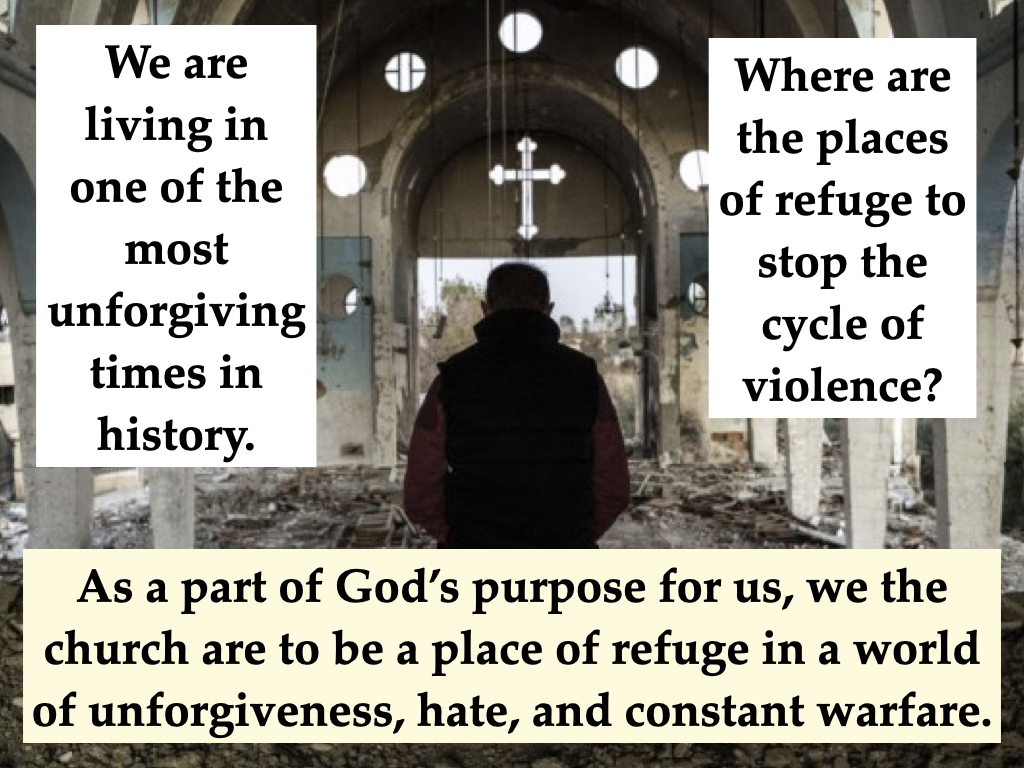
It seems to me that we are living in one of the most unforgiving times in history. With the creation of the internet and social media, there has been a meanness and hatefulness that has taken hold of our culture. We are eating ourselves alive. If a person says something wrong, voices a politically or culturally incorrect opinion, or just has the wrong view of things, there is a risk of being ostracized, excommunicated, shut down, and maybe violently harmed. Political tribes are at war with each other. The generational groupings (Boomers, and Generation X, Millennials, and iGen) belittle those outside their group. There are class warfare and cultural wars. There is no quarter given to people who have committed either real sins or perceived ones. As a nation, and as a people, we are eating ourselves alive. Where are the places of refuge? Where does the cycle of violence stop today?
The answer, I believe, is the church. As a part of God’s purpose for us, we, the church, are to be a place of refuge in a world of unforgiveness, hate, and constant warfare. In this place, among followers of Jesus, people are to find refuge for their souls. I think this is why Paul is so angry in the book of Galatians. People have come into the church with a system of legalism that defines who is more spiritual and who is not. The legalism preached by these false teachers is resulting in a community that is at war, where people are destroying each other, causing the church to fail in its purpose. Wounded people in this world need a place of refuge
Our scripture today, Galatians 6:1-2, shows us (1) what it looks like to be a place of refuge and (2) how it is done. These two points are the focus of this message.
A. What does it look to be a place of refuge?
B. How is it done? What are the everyday mechanics of being a place of refuge in our world today?
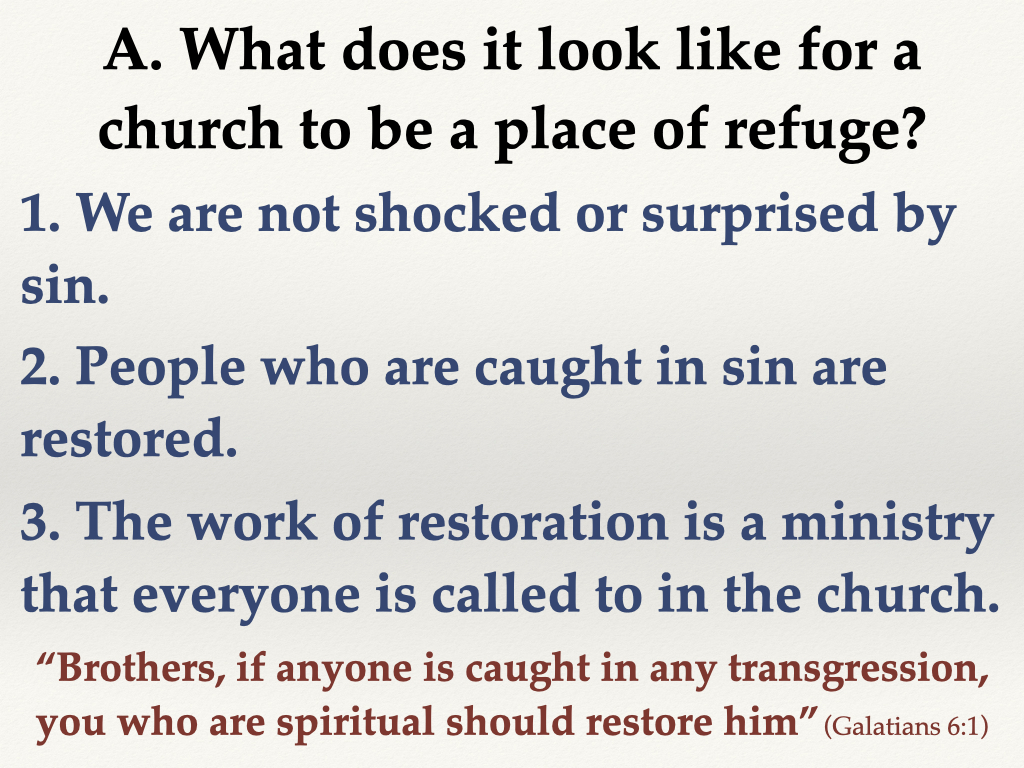
A. What does it look for a church to be a place of refuge?
1. We are not shocked, caught off guard when people sin. A church that is a place of refuge is not surprised by the sin in people’s lives. Not being surprised by sin does not mean that we do not grieve over sin, or do not seek holiness, or that there are no consequences to sin. It means that when a person sins, makes a mistake, says the wrong thing, does the wrong something, their life is not destroyed, they are not ostracized or shunned. Instead, a person who is caught in sin finds healing. Look at how verse 1 begins, “Brothers,if anyone is caught in any transgression…restore him…” People in the church will sin, and Paul does not list which sins are acceptable and which ones are not. He says if anyone is caught in ANY transgression. We are on a journey together towards holiness that reflects the divine glory, and sometimes on this journey, we stumble and fall. The response when a person sins or falls must not be like that of the world, where we shoot our wounded, but instead it must bend down to help lift up. I love the story told by Brother Lawrence in the book Practicing the Presence of God, when a fellow monk came to him to gossip to Lawrence of all the sins that some other monk is doing. When the gossiping monk is finished sharing the list of sins committed by another monk, Brother Lawrence responds by saying, “Is that all?” Being a place of refuge means we are not surprised or shocked by sin. A church that is shocked by sin is like a hospital shocked by sick people. This brings us to the second point of what it looks like for a church to be a place of refuge.
2. People caught in sin are restored. Reading on in verse 1, “Brothers,if anyone is caught in any transgression, you who are spiritual should restore him in a spirit of gentleness.” To be clear, the word restore here is different than how we usually use it in the church. Today, it seems that when the word ‘restore’ is used in the context of the church, it is used to talk about a process of restoring a person to a position. For example, a preacher has an affair; he goes through a process of restoration and regains his pulpit. That is not what this verse is talking about. Restoring a person caught in sin does not mean there are no consequences to that sin. To restore a person caught in sin means that which is broken in that person is healed. The Greek word here for restore is κα-ταρ-τί-ζω. It is a medical term used to describe the setting of a bone (reduction). That is the word here being used to talk about a person caught in sin. The response to a person caught in the grasp of sin is to be a vessel of healing in that person’s life, a vessel of healing used by God to heal that which is causing the sin and that which the sin has broken. Paul is saying when you see someone who is caught in any transgression, your response to that person should not be one of shock and shame, but one of healing and mending.
I love Martin Luther’s comments on this verse. He says, “This comforting sentence (Galatians 6:1) at one time saved my life… Paul explains how the fallen should be treated. Those who are strong are to raise up the fallen in the Spirit of meekness.” “[A Legalistic Church] teaches the exact opposite of what the Apostle commands. The [pastors] are tyrants and butchers of men’s conscience. Every small offense is closely scrutinized. To justify the cruel inquisitiveness, they say, “It is the property of good lives to be afraid of a fault where there is no fault.” “Our [teachings] must be feared (accepted), even if they are unjust and wrong.” On these pronouncements, the [legalists] base their doctrine of excommunication. Rather than terrify and condemn men’s consciences, they ought to raise them up and comfort them with the truth. Luther continues to say, “If any man be overtaken with a fault, do not aggravate his grief, do not scold him, do not condemn him, but lift him up and gently restore his faith. If you see a brother despondent over a sin he has committed, run up to him, reach out your hand to him, comfort him with the Gospel and embrace him like a mother.”
3. The work of restoration is a ministry that everyone is called to do in the church. Again, look at verse 1, “You who are spiritual should restore him in a spirit of gentleness.” Who are the spiritual ones in a church? It is everyone filled with the Holy Spirit, and everyone who trusts in Jesus is filled with the Spirit. This means that if you are a follower of Jesus, you have been given a ministry of restoration. A ministry that brings healing to people caught in sin.
Many of you may be wondering, “What is my call? What is my purpose? What does God want me to do?” Well, here is one part of your call. You are called to be a part of God, healing the lives of people.
- You are called not to run away when something offends you.
- You are called not to be arrogant and prideful when someone struggles with something that you do not.
- You are called to look beyond the outward sin and love the person.
- You are called to bring healing, to restore that person who is caught in ANY transgression.
The ministry of restoring people belongs to all who are filled with God’s Spirit. The world needs places of refuge today. The world needs the church. The next point (point B) is looking at HOW the people of the church do this ministry of restoration.
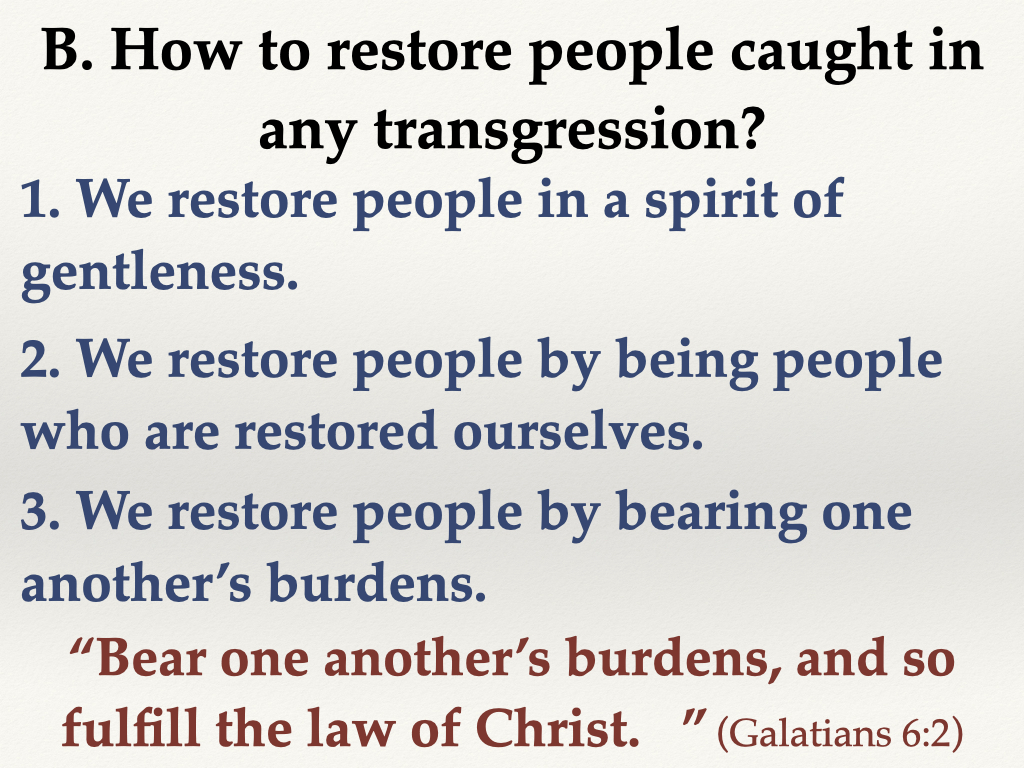
B. How to restore people caught in any transgression? What are the everyday mechanics of being a place of refuge in our world today?
1. We restore (bring healing to) people in a spirit of gentleness. The Greek word for gentleness is πραύτης, what a wonderful word. It is a word that denotes great strength and not weakness. Go back to that image of a person having a broken arm, and the doctor needs to set it. Can you imagine if the doctor was not gentle, how much pain and harm that would cause? The doctor is jerking the arm around and the fractured bone is cutting things up. Use that image for people who are caught in sin. Imagine what it is like for a person caught in sin whom people treat roughly. Imagine the harm done to a person if a sin becomes known, and people shun or shame that person, point fingers, talk about them, look down on that person, gossip, and say horrible things on social media. There is no healing, only destruction. To mend what is broken, a gentleness is required. Be gentle with people. Ephesians 4:2, “with all humility and gentleness, with patience, bearing with one another in love.”
2. We restore people by being people who are restored ourselves (Healed). The work of restoring a person in the Spirit of gentleness requires that you, the restorer, have done the necessary work on your own soul. This is how I understand verse 2 when it says, “Keep watch on yourself, lest you too be tempted.” Clearly, God can use anyone. In Numbers 22, God uses a donkey to preach to Balaam. If God can use a donkey, he can use anyone. God uses us despite ourselves, and even often despite our sins. But, how much more can God use us if the vessel (our lives) that God uses is made ready for every good work. In 2 Timothy 2:20-21, Paul says to Timothy, “Now in a great house there are not only vessels of gold and silver but also of wood and clay, some for honorable use, some for dishonorable.Therefore, if anyone cleanses himself from what is dishonorable, he will be a vessel for honorable use, set apart as holy, useful to the master of the house, ready for every good work.” Do you want to be useful to the master? Then keep watch on yourself. Notice the phrase, “keep watch” is not past tense. It is not something to do and then be done but is an ongoing way of life. Know thyself, deal with your struggles and sins, get the logs out of your own eye, and be ready for every good work.
3. Bear one another’s burdens. This is verse 2, “Bear one another’s burdens, and so fulfill the law of Christ.” To bear a burden means to help carry and lift the weight being felt by the person. It also means to identify with the person, to really understand what they are going through. I love our English word “understand.” Literally, to understand means to stand under the burden that a person is carrying. Bearing one another’s burdens is to stand under a burden with them. It takes time, patience, and often sacrifice to understand what a person is going through. But, as Paul says, it fulfills the law of Christ.
Where are you in this message today? Are you someone who has found real healing in the Gospel, and the Spirit of God has done the work of restoration in your own life? If this is you, then you have a calling. You are called to be a vessel useful to the master for every good work. You are called to be used by God to restore others who are caught in sin gently. The Lord has placed us together on a journey towards his glory. Together, we are the place of refuge in this world. Maybe you are someone who is caught in a transgression. A certain sin, a certain attitude, has claimed ownership of your life, and you cannot get out. Because of this certain sin, you feel ashamed, unworthy to be used by God, trapped. If this is you, know that God is for you, and he is at work in your life. If this is you, know that there is a path to healing and holiness. It begins first of all by trusting the Lord and leaning into him. It begins by accepting that Jesus took the sins of the world upon himself. If you have never surrendered your life to the Lord, I invite you to do so. He is near, call to Him. If you are a Christian, you are called to a self-watchfulness through the ongoing disciplines of confession, repentance, and fellowship.
We are living at a challenging time right now, which means that being the church is more important now than ever before. Let us be a place of refuge for people who are caught in the storm. Amen.
Preached on August 30, 2020 By Pastor Trent Eastman at New Baptist Church
 Concerning the Word of Life