Several years ago, I read a book called Christianity Rediscovered, an Epistle to the Masai by Vincent Donovan. The book is about a missionary who went about the work of evangelism and church planting in a very different way among the Masai tribe of Kenya. What Donovan did was to go to a village and simply tell stories of Jesus. There was no church, there were no sermons, there were no worship times. When he came to a village, people would gather and he would tell a story about Jesus. This would go on for a year and sometimes longer. Finally, at some point in time, when all the stories had been told and retold, he would ask the people there two questions. Who do you think this person Jesus was? Nearly always, people would respond that Jesus is the Son of God. Ok, second question, “What are you going to do? How will you respond to these stories that you have been told about Jesus, the Son of God?” Some would answer, “We recognize who he is, but we do not want to follow him.” Donovan would respond, “Ok,” and he would leave that village. But there were some villages that when asked this question of what they would do would respond by saying, “We want to follow this man Jesus.” In these villages, a church was born.
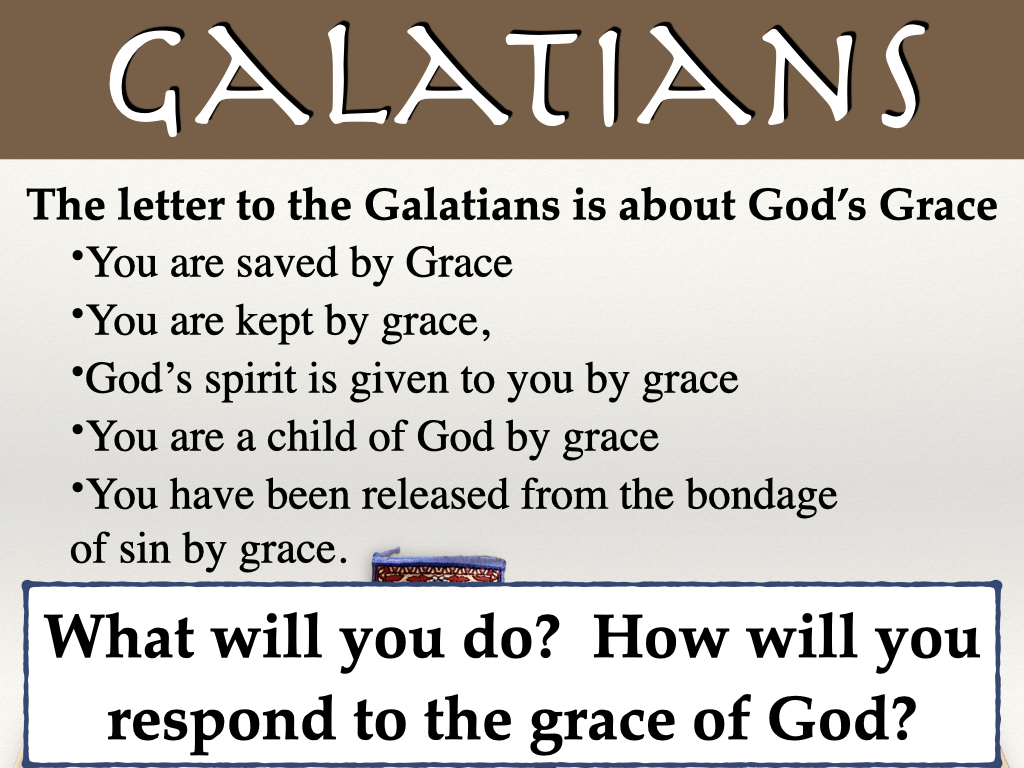
I share that story because I feel that this is what is happening in our text today. The background to the book of Galatians is that some people have come from Jerusalem and have taught a false gospel. The false gospel they preached was that salvation is gained and kept by Jesus plus the law. The false gospel they preached, due to its reliance on works, was causing brokenness and division within the church. Thus, Paul’s letter to the Galatians is about God’s grace. In this letter, Paul will say multiple times;
- You are saved by grace.
- You are kept by grace.
- God’s Spirit is given to you by grace.
- You are a child of God by grace.
- You have been released from the bondage of sin by grace.
The letter to the Galatians is about grace. Our passage today (Galatians 6:1-10) is Paul’s question to the churches after hearing about God’s grace; “What will you do? How will you respond to the grace of God?” I hear this question asked in verses 7 and 8, where Paul says, “7 Do not be deceived: God is not mocked (which means you cannot fool God), for whatever one sows, that will he also reap. 8 For the one who sows to his own flesh will from the flesh reap corruption, but the one who sows to the Spirit will from the Spirit reap eternal life.” Paul has not reverted back to legalism. He is asking the people in the churches of Galatia (and you), “What will you do with the Grace of God?” “Will the Spirit of God lead you into a new life, or will you hang onto your religion of works?” Either you are serious in your faith and walk with the Lord, or you are just playing games with God. Either your life is led by the Spirit, or it is not. Which is it?
Today is communion Sunday. In 1 Corinthians 11, there are instructions for how we are to come to the Lord’s table. A section of the instruction reads, “26 For as often as you eat this bread and drink the cup, you proclaim the Lord’s death until he comes. 27 Whoever, therefore, eats the bread or drinks the cup of the Lord in an unworthy manner will be guilty concerning the body and blood of the Lord. 28 Let a person examine himself, then, and so eat of the bread and drink of the cup. 29 For anyone who eats and drinks without discerning the body eats and drinks judgment on himself (1 Corinthians 11:26-29).” The unworthy manner that Paul is talking about in verse 27 is if a person is trying to fool God. Some examples of how people play games with God are to use religion as a means of virtual signaling or somehow to think one is worthy to come to the Lord’s table through their own works. The unworthy manner that Paul speaks of is exactly what he is fighting against in this letter to the Galatians. The unworthy manner is trying to approach God through one’s works or false religion. One is unworthy of the Lord’s table if they seek to come to it in any other way except through the grace of God.
Thus, as we come to the Lord’s table today, let us examine ourselves so that we may remember and receive the bread and the cup with proper thanksgiving knowing that we come to it by the Grace of God alone. To help us examine ourselves, I have drawn-out four questions from our scripture passage today (Galatians 6:1-10). These four questions are themes that Paul highlights as he begins to end the letter. I have turned Paul’s instructions into questions for us to use as tools for self-examination as we approach the Lord’s table. Here is the first question.
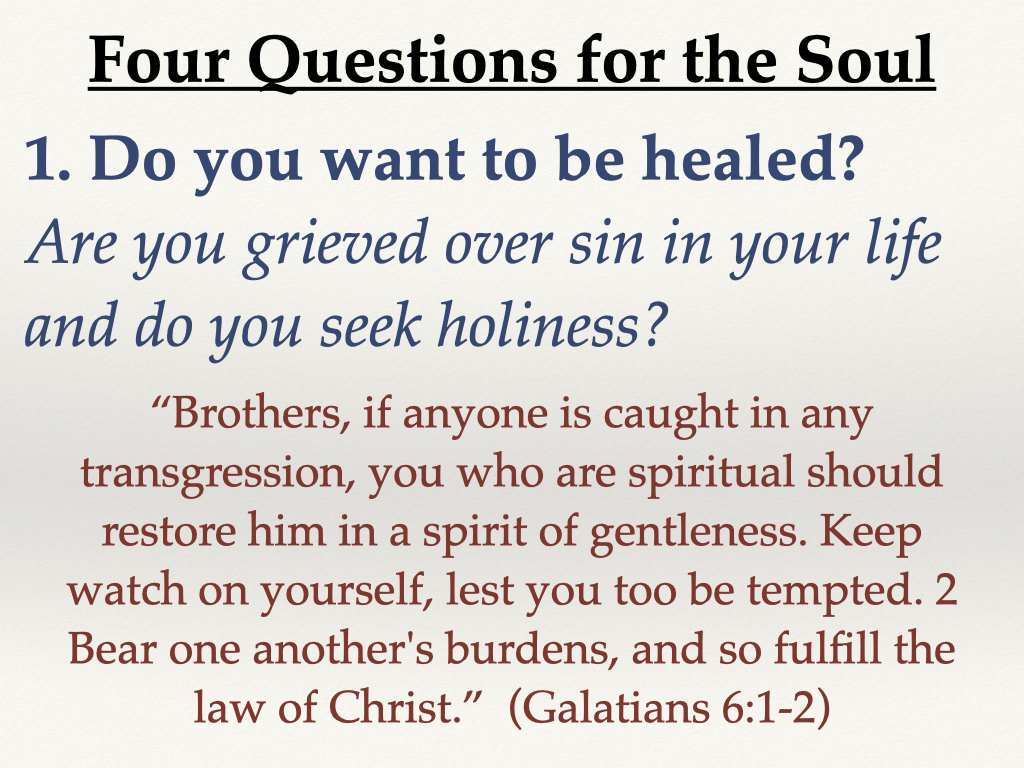
Question 1. Do you want to be healed? Yes, you are forgiven of your sins in Jesus Christ, but sin still has brought and brings wreckage in our lives. The old habits still remain; the world still pushes in on our souls. Are you grieved over sin in your life, and do you seek holiness? Do you want to be healed? Galatians 6:1-2. “Brothers, if anyone is caught in any transgression, you who are spiritual should restore him in a spirit of gentleness. Keep watch on yourself, lest you too be tempted. 2 Bear one another’s burdens, and so fulfill the law of Christ.” Bearing one another’s burden in verse 2 is about helping people escape the crushing weightiness of sin in their lives. If bearing another’s burden fulfills the law of Christ, then it tells us how important it is to God that we take sin seriously in our lives and the lives of others.
In the Gospel of John 5, there is a story of Jesus’ finding a man who was lame, sitting at the pool of Bethesda; he asks him, “Do you want to get well?”. The man responses not with a “Yes, I want to get well” but rather with excuses as to why he is not healed. I think this story is a good image of how many people are comfortable with sin in their lives, happy to provide excuses for their anger, attitudes, and behaviors. A person unwilling to address sin in their life responds by saying such things as, “It is how I was raised; it is what I know; it is how I am wired; other people are doing it; it is not hurting anyone; it Is not a big deal and so on.” Jesus died for our sins. He gave his life so that you may be forgiven and reconciled to the Father. Jesus took sin in your life seriously; do you? Do you want to be healed? Do you grieve over your sin? Do you seek for your soul to be mended and restored?

Question 2. Are you serious about following Jesus? Do you take your faith seriously?
Galatians 6:3-5, “3 For if anyone thinks he is something when he is nothing, he deceives himself. 4 But let each one test his own work, and then his reason to boast will be in himself alone and not in his neighbor. 5 For each will have to bear his own load.” The context of this passage is that the people in the churches of Galatia have been spiritually boasting and patting themselves on the back as they compare themselves to other people, “Look how good I am next to that person over there.” And what Paul is saying here in these verses is that when you compare yourself to other people and pat yourself on the back at how spiritual you are compared to some person, you are deceiving yourself. Comparing yourself to others is a faulty means of measurement. We, people in general, love to compare ourselves to others and feel good about ourselves if, in our comparisons, we see ourselves as better. There was a study done a few years ago. Researchers asked a group of people: “Would you rather receive $50,000 a year and everyone else receive $25,000, or would you rather receive $100,000 a year while everyone else received $200,000?” Prices do not change. The higher amount received equates to a better life. 56% of the people chose the $50,000. It was more important for them to be better than others than all having more. People measure their worth and value by comparison to others.
Comparing oneself to others is not biblical and causes self-deception. This is what Paul is talking about when he says, “3 For if anyone thinks he is something when he is nothing, he deceives himself.” Look at your own life and work, not at the work of your neighbor. And then verse 5, “For each will have to bear his own load,” which I understand to mean that each person is measured and judged by the same standard. Paul does not voice what that standard is, but we know what it is, it is Jesus. He is our standard. The measurement of a good and godly life is Jesus. The life that pleases God is his life. If you want a life that pleases God, then follow Jesus. Walk as he has walked. Compare and match your life to his life. And so the question, Are you serious about following Jesus?

Question 3. Do you take God’s word seriously in your life? Is God’s word important to you, worthy of time and study? Do you trust His word? Do you seek to live by it? Does His word shape your life? Do you take God’s word seriously? The passage that I draw this question from is verse 6, “6 Let the one who is taught the word share all good things with the one who teaches.”Again, the context. Paul is giving instructions for how these churches can begin to find healing, and central to a church’s finding healing is biblical teaching. Thus, Paul is instructing the churches to support the office of a preacher because faithful teaching of God’s word is critical for the healing and transformation of people’s lives.
As a pastor, I like this verse, and in humor, I sometimes like to point out what this verse does not say. It does not say, share all BAD things with the one who teaches, but it seems that is what people think it says. People share with the preacher all the bad stuff in their lives, like their sins and sicknesses and emotional hurts and pains. People always invite me to their funerals but never to their vacations. Here is a Personal request, in accordance with God’s word, I need to hear from you the good that God is doing in your life. Share the good with me and not only the bad.
Let us return to the context of our passage. The books Ezra and Nehemiah are about the exiles returning to the land of Judah. The temple is rebuilt, and then the walls of Jerusalem. Worship is happening, the word is preached, people have dedicated themselves to the Lord, and it seems that now, finally, God’s people are on the right path. But in chapter 13, Nehemiah goes away for some time and comes back to chaos. People have slipped back into the old ways. One of the things that he identifies as a factor of their slipping back into sin and forgetting God is that the people ceased to support the priests and worship leaders, those who did the work of the temple. Nehemiah 13:10 reads that each fled to his own field.
I came across a report published last week. Due to Covid19 and the shutting down of public spaces, it is estimated that 20% of churches in America will close. How true or accurate this report is, I do not know, but it is terrifying to me. Along with the closure of churches, I am aware of many Bible colleges and seminaries that are struggling to keep their doors open. There is a threat to the faithful learning, teaching, and training of people for the gospel. We pray about revival, and we pray for a spiritual movement in our country, as we should. But I believe that revival in our country cannot happen when God’s word is silent. God’s word must be taught; it must be proclaimed if there is to be healing in this world. That is the broader context of verse 6.
For us today, the question for self-examination is this; “Are you serious about God’s word? Is God’s word important to you and worthy of time and study? Do you trust it? Do you seek to live by it? Does it shape your life? Do you support the teaching of it? Do you take God’s word seriously?

Question 4. Do you trust the Lord with your suffering? What do you do when you are discouraged or depressed? Do you trust the Lord when the storms of life come your way? What do you do when you do not have an emotional lift and don’t feel like it? What do you do when the expectations of your life do not pan out? Do you give up, cease to be involved, or do you continue to do good? Listen again to Paul, vs. 9: “And let us not grow weary of doing good, for in due season we will reap, if we do not give up. 10 So then, as we have opportunity, let us do good to everyone, and especially to those who are of the household of faith.”
Possibly one of the most significant areas of the Christian faith that people do not know or do not understand is that following Jesus does not result in protection from suffering; it rather results in the transformation of the suffering. This is what Paul is saying. When times get hard, and you grow weary (and there will be times), don’t give up, don’t stop, don’t be discouraged, for there shall come a day when that fog will lift and the light of God will fill your life and our world. Do you trust the Lord with your suffering? If you do, according to the promise of verse 9, in due season, something good will be reaped. That good thing may be something in your own life, or it may be something in another person’s life. God works in and through our hardships; thus, we do not grow weary and continue to do good.
From our text this morning, these are the four questions of self-examination I would like us to use as we come to the Lord’s table.
- Do you want to be healed?
- Are you serious about following Jesus?
- Do you take God’s word seriously in your life?
- Do you trust the Lord with your suffering?
Let us do this now. Let us spend time in prayer, in the Spirit’s help, allowing these questions to probe our soul. Amen.
Galatians 6:1-10 (ESV) 1 Brothers, if anyone is caught in any transgression, you who are spiritual should restore him in a spirit of gentleness. Keep watch on yourself, lest you too be tempted. 2 Bear one another’s burdens, and so fulfill the law of Christ. 3 For if anyone thinks he is something, when he is nothing, he deceives himself. 4 But let each one test his own work, and then his reason to boast will be in himself alone and not in his neighbor. 5 For each will have to bear his own load. 6 Let the one who is taught the word share all good things with the one who teaches. 7 Do not be deceived: God is not mocked, for whatever one sows, that will he also reap. 8 For the one who sows to his own flesh will from the flesh reap corruption, but the one who sows to the Spirit will from the Spirit reap eternal life. 9 And let us not grow weary of doing good, for in due season we will reap, if we do not give up. 10 So then, as we have opportunity, let us do good to everyone, and especially to those who are of the household of faith.
Preached on September 6, 2020 by Pastor Trent Eastman at New Baptist Church.
 Concerning the Word of Life