
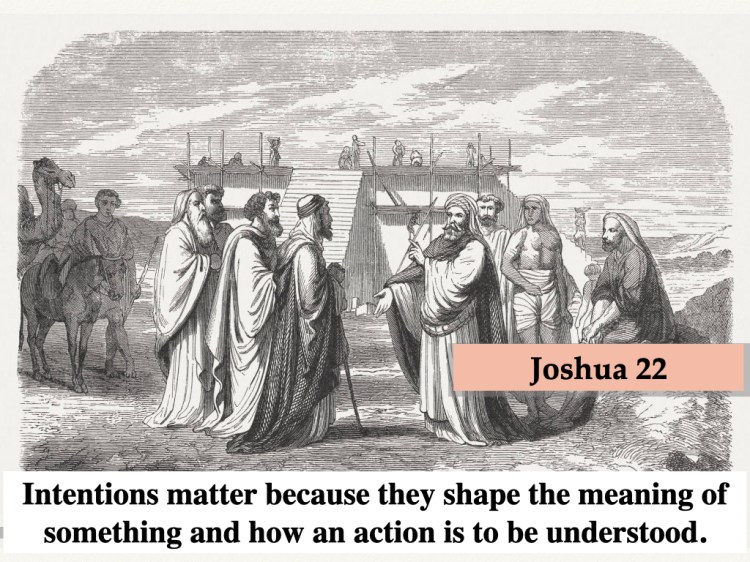
There is a saying that you have probably used at least once in your life; it goes like this, “It’s the thought that counts.” This saying is used when something not very good is done, but there is a recognized intention behind the effort that shifts the meaning of the act. A great example of this in the Bible is in the book of Joshua 22. At the end of the book, after all the battles are over and the tribes of Israel have taken possession of their land, the three tribes that settle East of the Jordan (Reuben, Manasseh, and Gad) build an altar. When the people of Israel hear of this altar being built, they form an army to destroy these three tribes thinking they have broken faith with the covenant. When the army arrives, representatives come out from the three tribes and say, “We built this altar as a reminder to you that we are a part of you and that you will not forget us.” Those that came to do war against them said, “Praise the Lord” and returned home, all is well (See Joshua 22:10-34). Intentions matter because they shape the meaning of how an action is to be understood.
Paul, in this final summary to the Galatians, is revealing the intentions behind the actions of the false teachers that preach a false gospel. Their intentions are not good; they are evil. The false gospel they are preaching is that to be saved, you need more than Jesus. You need Jesus plus the law. And what is even worse, they preach this false gospel not out of love for the people nor out of zeal or passion for God. (Those are good intentions that may have shaped the way Paul reacted differently.) Their intentions behind the preaching of a false gospel are pride, selfishness, and the pursuit of power. Notice what Paul says in verses 12 and 13, “It is those who want to make a good showing in the flesh who would force you to be circumcised, and only in order that they may not be persecuted for the cross of Christ. For even those who are circumcised do not themselves keep the law, but they desire to have you circumcised that they may boast in your flesh.” Paul is saying, “They don’t care about you, they don’t love you, they don’t care about the truth, they only care about being able to brag about all the people who showed up at their circumcision party.” They want to control you, they want to manipulate you, and they want you to conform to a way of life that they define. In the second half of verse 12, Paul tells us the fundamental reason that their gospel is distorted and why they preach a false gospel. He says they do this “only in order that they may not be persecuted for the cross of Christ.”
In the eyes of the world, Christianity’s greatest scandal was that its God died upon a cross. Today, we do not understand the scorn, the shame, and the scandal of the cross. For us, the cross has become an object of beauty, made into jewelry, put into stained-glass windows, but in the day of Paul, the cross was ugly and shameful. Christians were persecuted over the fact that their God died on a cross like a common criminal. “What type of God is that?” Many people of Jewish background, like these false teachers, saw the cross as something to ignore, to sweep under the rug. I am sure such people said things like, “Jesus was a great teacher and a prophet, he did miracles, he showed us how to approach God.” Yet the cross they would not mention. They despised the cross not only because it was the most shameful form of public execution, but also for what it stood for in the context of the true gospel.
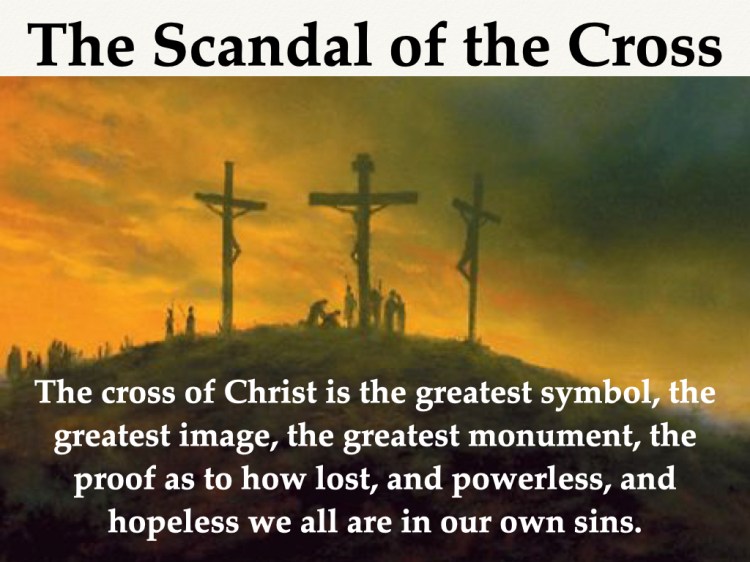
On the night that Jesus was betrayed, just hours before his horrific death, Jesus takes the bread and breaks it and says that this bread broken represents his body being given for you. Later in the meal, he takes the cup and pours wine in it and says, this wine represents my blood shed upon the cross, given to you for the forgiveness of sins. In that last supper, Jesus is telling his disciples in a very tactful way that his death on the cross is for them. Jesus is saying, “You are the reason I die that death; you are the reason I suffer that wrath; you are the reason I choose the cross. I do it for you.” To those who seek to have control and power over their lives, to be masters of their own fate, the cross is despised. The cross of Christ is the greatest symbol, the greatest image, the greatest monument, the proof as to how lost and powerless, and hopeless we all are in our sins. The cross as a symbol of our powerlessness is one of the reasons that it is scorned, hated, and rejected by many. But there is another reason as well.
On May 25th of this year, a man by the name of George Floyd was killed by a police officer in Minneapolis, Minnesota. I think you would agree that what happened to George Floyd was a crime and a heinous act of brutality. In the days that followed, because of that unjust and brutal death of George Floyd, people raged. Peaceful protests quickly turned violent, stores were plundered, and buildings were set on fire. The acts of violence were the outflow of the rage and wrath because of gross injustice. Nineteen years ago, on September 11, four planes were hijacked by terrorists. Two were flown into the trade towers of New York City, killing thousands; one was flown into the Pentagon, and the last one crashed into an open field. Our nation, after this terrorist attack, was enraged and in its wrath, entered a war a month later that lingers on today.
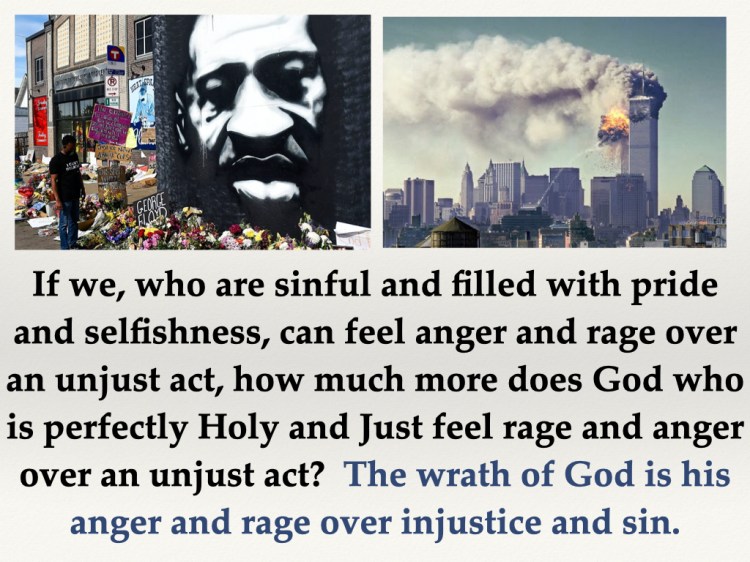
I share these stories because if we, who are sinful and filled with pride and selfishness, can feel anger and rage over an unjust act, how much more does God, who is perfectly holy and just feel rage and anger over an unjust act? The wrath of God is his anger and rage over injustice and sin. In our holy God, there is a rage against sin, wrath upon all that is unjust. But this rage and wrath are not directed at a group of people; it is not directed at only the Romans, it is not directed at only the police, it is not directed at only the Taliban, it is not directed at those people, black or white, but at us all. We all stand guilty; this is the other reason why the cross is hated and despised and scorned. The cross is a declaration of our guilt and the Just wrath of God that is due upon all sin and injustice. Here are the two reasons that the cross was and is despised.
- The cross of Christ is the greatest image and proof as to how lost and powerless and hopeless we all are in our own sins.
- The cross is a declaration of our guilt and the Just wrath of God that is due upon all sin and injustice.
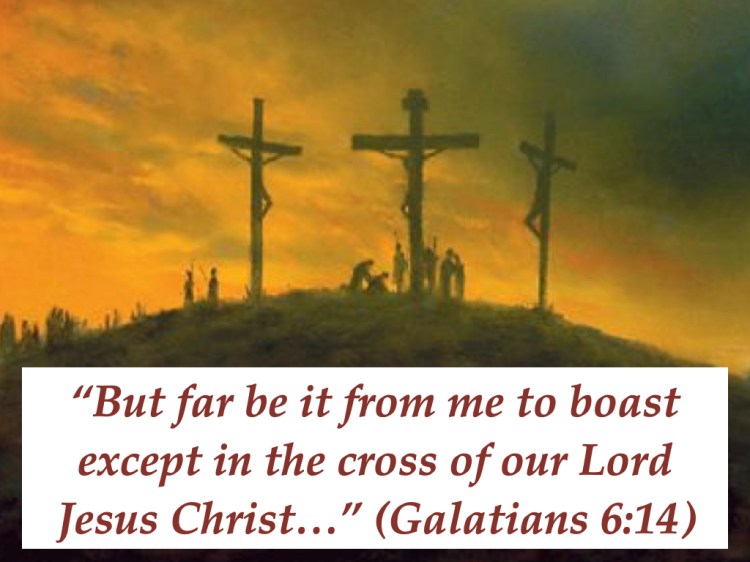
The inability to confess the cross because of pride and hidden agendas is why Paul is so blooming angry at the false teachers. These false teachers, instead of recognizing and confessing their sin, instead boast at how wonderfully good they are at keeping the law and are at work to get people to be just like them. They reject the cross because to them a cross is an object of shame, a symbol of weakness and powerlessness, and a punishment that they do not think that they deserve. Yet Paul, far from running from the cross, embraces it. Reading on in Galatians 6:14, it says, “But far be it from me to boast except in the cross of our Lord Jesus Christ, by which the world has been crucified to me, and I to the world.” Paul is speaking in a very strong manner. He is saying, may I never ever boast in anything but the cross of our Lord Jesus Christ. It is the cross that has saved me and is the heart of the gospel.
Let us go back to the current social justice movement and the Black Lives Matters protests happening in our country today. When a person is enraged (again think of the death of George Floyd or Sept 11) or when a gross injustice has been done, one of the thoughts that rage and wrath produces is “Someone has to pay. Someone has to suffer for what has been done.” That is why there is violence; that is why there is war. That is why the police precinct in Minneapolis was burned down; that is why bombs were dropped on Afghanistan. Someone has to pay for the crime that was done and for the harm that was caused.
But the Lord says, “Vengeance is mine, I will repay, says the Lord.” (Romans 12:19). And Indeed, vengeance is His. This vengeance is God’s wrath being worked out and is his alone to render, but in his love, it is also his to take. All vengeance is his; he has taken it all. All wrath, all guilt, all shame, all punishment has fallen upon him. The cross of Jesus Christ is the place where God’s rage and wrath are rendered. Jesus suffers the wrath of God for all sin and injustices. This is why Paul boasts in the cross. In the cross, Paul sees not only the truth of his sin and helplessness, but he also sees God’s love, and that because of that love, God gives himself for us in Christ. Jesus died so that we may live; his death brought us life. I am saved by what the Lord has done for me; thus, Paul boasts in the cross, which is the heart of the gospel. A Gospel that causes and creates a new way of life in this world.
Because of the cross, we live in the possibility of the cycles of violence and hate ceasing. Because of the cross, we live in the possibility of a truly just and good society for all people. Because of the cross, we live in the possibility of our own lives being whole and holy. These possibilities are the new creation that is born because of the cross. This is what Paul is pushing the people of Galatia to understand. Because of Jesus Christ and the death he died for you, the old way of life is gone; it has to be because you are a new creation. This is how Paul says it in our scripture today, “14 But far be it from me to boast except in the cross of our Lord Jesus Christ, by which the world has been crucified to me, and I to the world. 15 For neither circumcision counts for anything, nor uncircumcision, but a new creation (Galatians 6:14-15).”
The old way of life, the old creation, is where we boast in our accomplishments; we take pride in how many followers we may have; we manipulate and seek control and seek a self-righteousness through works. The old creation segregates people by what they look like, what they have, and what they do, all broken down into tribal units in competition or at war with each other. That is the old way of the world. But in Christ, there is a new creation, a new way to be alive in this world. Through the book of Galatians, Paul keeps pointing to this New Creation that we have and have become in Jesus Christ. Paul describes this New Creation to the Galatians as;
- Born again as a Children of God
- Offspring of Abraham, according to the promise
- Justified by faith, not by works of the law
- No longer slaves, but heirs of God
- Set free by Christ.
- We are redeemed from the curse of the law.
- Alive because Christ lives in us
- Living by faith at work through love
- And through that faith having received the Spirit
- we walk with the Spirit
- and are led by the Spirit
- and keep in step with the Spirit
- and live by the Spirit
- and bear the fruit of the Spirit
- And through the Spirit, we cry out to God, “Abba, Father!”
- This is the new creation. Because of Jesus Christ, his work and his Spirit is given to us; we live now as people no longer defined by race, or nationality, or any other human means by which people are judged and segregated. Our identity (the present), our heritage (the past), and our inheritance (the future) are as a child of God. This is the new creation that we have become and are to live now.
Concerning living in this new creation, Paul says, verse 16, “16 And as for all who walk by this rule (a life lived in the new creation), peace and mercy be upon them, and upon the Israel of God. He is talking about the church here, descendants of Abraham by faith. We are the new creation in this world, made alive by the New Covenant of Jesus Christ.
Paul now signs off, his final words of the letter, “17 From now on let no one cause me trouble, for I bear on my body the marks of Jesus. 18 The grace of our Lord Jesus Christ be with your Spirit, brothers. Amen (Galatians 6:17-18).” Verse 17 is such a cryptic statement. Is it a plea? Is it a warning? To me, verse 17 seems to be a reminder of his spiritual authority and intentions. I do not believe that Paul literally had nail marks in his hands. When he says, “I bear on my body the marks of Jesus,” I think what is happening here is that Paul is asking the people of Galatia to decide who they are going to trust, him or the false teachers. Speaking to the people, Paul is asking, “Are you going to give authority to a person who marks his own body and believes that by cutting off a little bit of flesh that they are put right with God? Or are you going to trust and give authority to a person who has suffered for the gospel and bears on his body the marks of being whipped, beaten, and imprisoned?” These are the marks of Jesus. The marks of Jesus are wounds received out of love for another. Paul is saying that it is by these wounds of sharing the gospel out of love that you can recognize and know of my intentions towards you. Intentions matter. 18 The grace of our Lord Jesus Christ be with your Spirit, brothers. Amen.”
Preached by Pastor Trent Eastman on September 13, 2020 at New Baptist Church
 Concerning the Word of Life