“Which book of the Bible was written to encourage the church?” There are many books of scripture written to encourage people. Still, I think the most encouraging book in the Bible for God’s people in a time of chaos, persecution, and discouragement is the book of Revelation. The book of Revelation is the final word in scripture that tells God’s people that God wins. Jesus, our Christ, is victorious. The Lamb of God is Triumphant. Thus, for such a time as we are in, we begin our study of the book of Revelation. Our text today is the first eight verses of Revelation.
(Revelation 1:1–8) “1 The revelation of Jesus Christ, which God gave him to show to his servants the things that must soon take place. He made it known by sending his angel to his servant John,who bore witness to the word of God and to the testimony of Jesus Christ, even to all that he saw. 3 Blessed is the one who reads aloud the words of this prophecy, and blessed are those who hear, and who keep what is written in it, for the time is near. 4 John to the seven churches that are in Asia: Grace to you and peace from him who is and who was and who is to come, and from the seven spirits who are before his throne, and from Jesus Christ, the faithful witness, the firstborn of the dead, and the ruler of kings on earth. To him who loves us and has freed us from our sins by his blood and made us a kingdom, priests to his God and Father, to him be glory and dominion forever and ever. Amen. 7 Behold, he is coming with the clouds, and every eye will see him, even those who pierced him, and all tribes of the earth will wail on account of him. Even so. Amen. 8 “I am the Alpha and the Omega,” says the Lord God, “who is and who was and who is to come, the Almighty.”
The Book of Revelation begins with important introductory information that lays the groundwork for how we should read and understand this book. I want to talk through verse 1 and highlight some of these introductory words. It begins; “The revelation of Jesus Christ, which God gave him.” The word revelation in Greek is Ἀποκάλυψις. It is the word that we have in English as apocalypse. Our English word apocalypse means the ‘end of the world’ because the book of Revelation (Ἀποκάλυψις) speaks of the end times. But, and this is important, the word Revelation does not mean end times; it means to reveal or to uncover. Thus, this book of Revelation (notice it is singular and not plural) begins by telling us that it is a book of truth and knowledge that is being revealed to us by Jesus. How do you know truth? Well, you know truth through experience, and through tradition passed down, and through methods of observing this world (we call that reason and science). All of these forms of truth are important but have limits on what knowledge can be gained. Thus, truth or knowledge that exists outside of our experience or study of the world must be revealed. We must be shown truth. This is the purpose of the book of Revelation, to reveal to us a truth that we cannot see in this present world. And this is the truth that this book reveals that the lamb of God is triumphant. That God, through the Lamb of God, rescues his people, routs evil, defeats Satan, restores creation, and dwells with us in the new heaven and the new earth. This truth is given to you for you to have hope and courage in this day that we live.
“To show to his servants.” The word SHOW is significant. In Greg Beale’s commentary on the book of Revelation, he argues convincingly that this word “show” means to convey a message through signs, symbols, or images, which means that John is telling us up front that this revelation from God is communicated to us as signs, symbols or images. This is important. A literal reading of the book will cause the reader to miss certain signs and images meant to convey truth. One example is in the passage we will look at next week. In Verse 16 of chapter 1, a two-edged sword comes out of the mouth of Jesus. I do not think that it is literally true, but I believe it is symbolically true. I believe that the words of Jesus are like a double-edged sword, piercing to the division of soul and of spirit. I absolutely believe that everything in the book of Revelation is true, and we get to that truth by understanding the images and signs and symbols used in the book. And, on a side note, (will talk more of this in the future), the meaning behind the images and signs and symbols are found in scripture. We are not to subjectively invent what a symbol means; rather, we are to search the scriptures to discover what it means (Again, more on this in the future).
“The things that must soon take place.“ This phrase is also significant, and I believe it tells us how we are to read this book. Some people read this to mean that the events of Revelation are all fulfilled in the days of John. This is called the Preterist view of Revelation. The word “preterist” means the past and holds that everything from the beginning of the book until about Chapter 19 has already been fulfilled in the first 40 years after Jesus’ resurrection. The destruction of the temple and Jerusalem in 70 AD is what this book is mostly about, and it has been fulfilled. The Preterist supports this view by arguing that the book is believed to have been written around 60 AD, ten years before the destruction of the temple.
Other people interpret this phrase, the things that must soon take place, through the lens of 2 Peter 3:8, which says, “that with the Lord one day is as a thousand years and a thousand years as one day.” Thus this group, whose view is called the Futurist view, sees the book of Revelation as God’s view of time, and only a couple of days have passed. Therefore, the book of Revelation is about the future (which is why it is called the Futurist view), where everything is fulfilled in the time just before the return of Christ.
A third way to understand this phrase (and this is how I understand it) views this phrase of immediacy to mean that we are living in the Latter Days. Again, Greg Beale argues convincingly that this is a phrase connected to the book of Daniel. In Daniel 10:14, Daniel is given a vision for what is called “the latter days or the last days about the Son of Man, which is Jesus.” He argues, and I agree with him, that when John in the book of Revelation says things like “the things that must soon take place” or like at the end of verse 3, “for the time is near” it is John’s way of saying that we now are living in the latter days. The time between the resurrection and ascension of Jesus to his return is called the latter days, or the last days, or the end times. This means that we, today, are living in the end times; we are living in the last days. Now is this the end of the end times? I do not know. The point is that we are to interpret this book as a book for us, a people living in the last days. It is not just for those who lived 2000 years ago, and it is not just for those of the future, but it is for the whole church throughout its days. This means to me that there are sections of Revelation that have been fulfilled in the past, and there are sections of Revelation that will be fulfilled in the future and that there are sections that are being fulfilled now, in our day. And, those things of the past and the future speak to our present-day as well. There are themes, patterns, truths, and actions of God for the whole church. This view is called The Redemptive-Historical Idealist view. That is how I will be interpreting the book of Revelation.
He made it known by sending his angel to his servant John,who bore witness to the word of God and to the testimony of Jesus Christ, even to all that he saw. There is a lot I want to say about John, but do not have time to do so today; thus, we will return him later. Briefly, though, John is the disciple that followed Jesus, who is also the author of the Gospel of John and the letters of John.
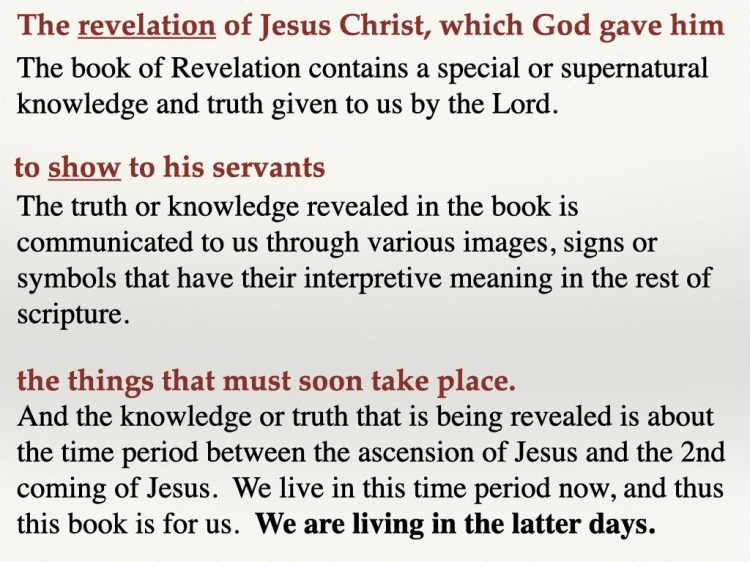
Let’s pause here to summarize what verse 1 tells us about the book of Revelation.
- It is a book that contains a special or supernatural knowledge and truth given to us by the Lord.
- This truth or knowledge is communicated to us through various images, signs, or symbols that have their interpretive meaning in the rest of scripture.
- And the knowledge or truth that is being revealed is about the time period between the ascension of Jesus and the 2nd coming of Jesus. We live in this time period now, and thus this book is for us. We are living in the latter days.
Therefore, this book, as a revelation given by God, is a blessing to us. And this is what John now says. Verse 3, “Blessed is the one who reads aloud the words of this prophecy, and blessed are those who hear, and who keep what is written in it, for the time is near.” Notice the blessing being given to what we are doing right now, the reading and hearing of God’s word. Also, notice that “to hear and keep what is written” would include understanding the written word and obeying it. This means that the book of Revelation is meant to be understood. The book is not some mysterious code that no one can break. You can and are to understand this book and to obey it, which means it has an application to our lives today.
Now we come to one of the most important theological truths of God in the book, and possibly in the entire New Testament. Verse 4 starts out saying, “ John to the seven churches that are in Asia: Grace to you and peace from …” Grace and peace from whom? When writing this letter at around 90 AD, John would have been around 75 to 80 years old. He has walked with the Lord, sat at his feet, witnessed Jesus’ death, run to the empty grave, eaten fish cooked by the resurrected Lord; he saw Jesus ascend into heaven, he cared for Jesus’ mother, he was filled with the Holy Spirit, preached the gospel, and witnessed the church grow under much persecution. And through these past 60 years of life lived after the resurrection, John has had time to reflect and ponder and be taught much about God. Who is the Lord? What is he like? How are we to understand Him? We see now, in verses 4 to 6, John’s articulation of the very nature of our God that he has gained over a lifetime.
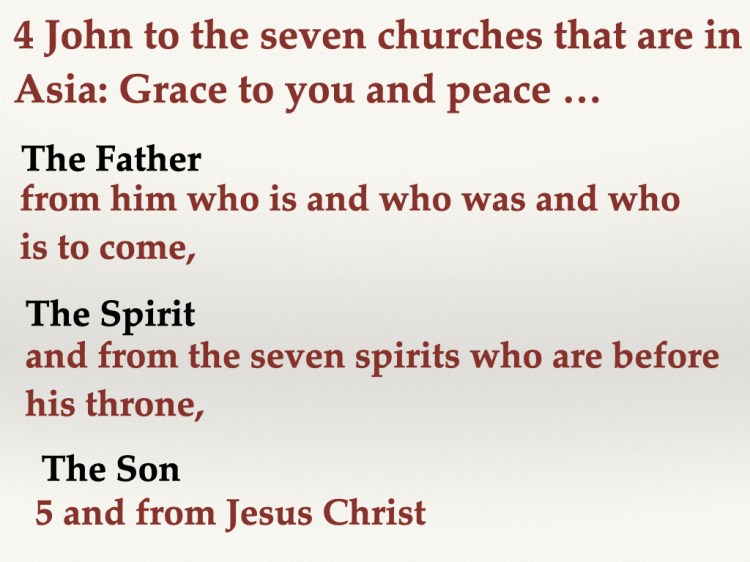
First, John says, “Grace to you and peace from him who is and who was and who is to come.” Who is John talking about? This is not Jesus because, in verse 5, Jesus is named as the third person from whom this letter is written. Who else could it be? John does not call this person the Father, but that is who it is. I think John was pointing us to Isaiah 41:4, a section that describes Yahweh’s, the Lord’s Mighty Power. Isaiah 41: 4 reads, “Who has performed and done this, calling the generations from the beginning? I, the LORD, the first, and with the last; I am he.”
Grace to you and peace from him who is and who was and who is to come (the Father), and from the seven spirits who are before his throne.” This is another good example of understanding the symbol and not taking it literally. There are not literally seven spirits of God. John is communicating something about the Holy Spirit. The number 7 denotes completeness or wholeness. Examples of this in scripture include the seven days of creation, which means all of creation, or the seven times the priest must sprinkle the blood before the Lord to complete the forgiveness (Leviticus 4:6). When John says, “Grace to you and peace… from the seven spirits who are before his throne,” he uses symbolism to say that the Holy Spirit is fully, completely, and wholly God sent by the Father.
Grace to you and peace from him who is and who was and who is to come (the Father), and from the seven spirits who are before his throne (The Holy Spirit), and from Jesus Christ (the son). John begins his letter with a blessing from our Triune God; Father, Son, and Spirit. Now notice what John says about Jesus.
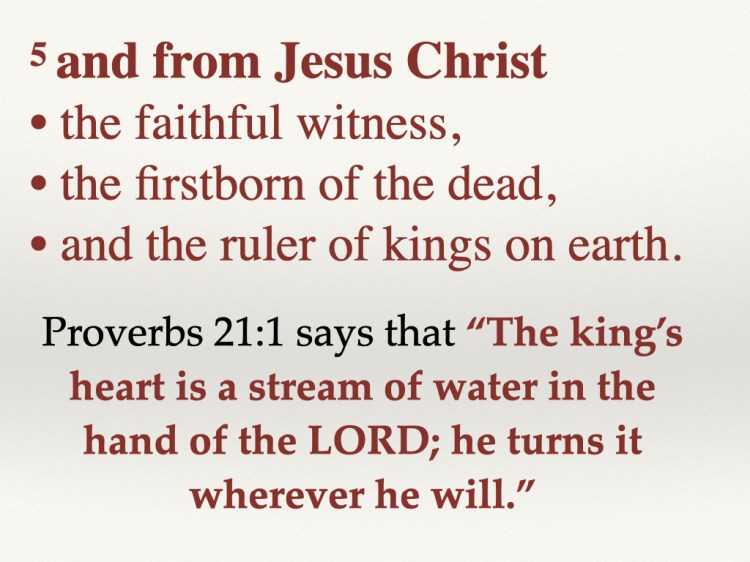
- Jesus is the faithful witness, which means that Jesus never lies. Jesus always speaks the truth. That is what a faithful witness does. Then he says,
- Jesus is the firstborn of the dead. This does not mean that Jesus is born again. The word firstborn is a title of rank and privilege. Jesus is the firstborn. He is the one who inherits the kingdom as we read in Psalm 89:27, “And I will make him the firstborn, the highest of the kings of the earth.”
- Jesus is the ruler of kings on earth. We need to hear that today. Jesus is the ruler of the kings of the earth. Proverbs 21:1 says that “The king’s heart is a stream of water in the hand of the LORD; he turns it wherever he will.” Jesus has that power. Does that mean Jesus is the ruler of;
- Raul Castor of Cuba? Yes, it does.
- Xi Jinping of China? Yes, it does.
- Angela Merkel of Germany? Yes, it does.
- Benjamin Netanyahu of Israel? Yes, it does.
- Kim Jong-un of North Korea? Yes, it does.
- How about Donald Trump of the United States of America? Yes, it does.
Jesus Christ is the ruler of the kings on earth. Today it is easy to be discouraged when watching the news or surfing the internet. There is so much junk and division and lies and meaninglessness that it is hard to imagine what life will be like in the years to come. That is why I am so glad that Jesus is the ruler of kings on earth. I am so glad that all of this junk and garbage that we witness every day is all in the hands of Jesus.
I must confess that there are times that I look at the world and wonder, is anyone running this ship. In the United States, in this past week, the west coast is on fire, the south is suffering historic floods, and the east coast is starting to shut itself down again due to the COVID pandemic, and then a Supreme Court Justice died Friday evening. When I look beyond our borders into the world, my heart sinks, especially when I see how the church is being persecuted today. In Nigeria today, Christians are being slaughtered; some are calling it a genocide. Reports coming out of Egypt say that 500 Christian girls have been abducted. China is increasing its ban on churches and offering people rewards if they send in pictures of any churches that are meeting. The persecution of Christians in India has grown worse, followers of Jesus being violently attacked. In Ethiopia, we are told that hundreds of Christians have been killed since June. The list goes on. There is global persecution on Christianity today.
It is important to remember that when the Revelation was given to John and sent to these seven churches of Asia, the world did not look any less chaotic. There was not any less persecution upon the church. Nero was burning Christians on crosses to provide light for his garden and feeding them to the lions for entertainment. Rome still held control of its empire, but only through constant warfare and intimidation. It was a rough time to live; thus, the words of John to them are the same to us. Do not lose hope. WHY? Because Jesus is King, he is seated with Majesty upon high, ruling, and exercising sovereignty over the middle east, North Korea, China, Russia, Europe, Africa, and the United States.
How does he do it? How does he reign? I do not know. Sometimes the only answer I have, when I see this world in chaos but know and believe that Jesus reigns, is Romans 11:33, which reads, “Oh, the depth of the riches and wisdom and knowledge of God! How unsearchable are his judgments and how inscrutable his ways!”
- The word inscrutable means impossible to understand, something that cannot be traced out; it is unfathomable. God’s wisdom and knowledge are so deep, and so reaching that they are immeasurable.
We will not always be able to discern why something is happening in this world, why there is this suffering, why things seem in chaos. I do not know why. But we can know and find comfort in the fact that God is not absent; rather, he is leading and guiding us to something that is wonderful, and glorious, and good. We are going to get a glimpse of what is that good in this book.

And it is this faith and trust in the reign of Jesus that causes John to explode with praise. “To him who loves us and has freed us from our sins by his blood and made us a kingdom, priests to his God and Father, to him be glory and dominion forever and ever. Amen (Revelation 1:5b-6).” We may not have many answers to how God works in our world today, but here is a hint. God works through those who call upon Him. Look at the text, “He made us a kingdom.” Us, we people, those who believe upon Jesus Christ, and confess his name are a kingdom that is separate from all other kingdoms in this world. And we are a kingdom that has a purpose, “Priest to his God and father.” Being a priest means that we have a calling and purpose of interceding on behalf of others. That is our job. You are a priest for heaven’s sake. And it is in interceding, being a kingdom of priests, that God is glorified.
Also, I would like you to notice something that appears at the end of verse 5 that does not appear anywhere else in the New Testament. “To him, who loves us and has freed us from our sins by his blood.” Do you see it? This is the only verse in the New Testament that the word love (as a verb) is in the present tense when seen as an action of God. In all other verses, when the verb love is used, it is past tense. For example;
- For God so loved the world (John 3:16).
- “As the Father has loved me, so have I loved you. Abide in my love.” (John 15:9)
But here in Revelation 1 verse 5, it does not talk about how God loved us, but how he loves us. Present tense; He loves you. You may be in a place today that you do not feel God’s love. You may be struggling to get out of bed and to go to work. There may be financial problems, health problems, family problems. You may be struggling with depression and just barely hanging on, longing to encounter the love of God. Here is how you know He loves you; it is the cross. This is what John points to as evidence of his present love. “To him who loves us and has freed us from our sins by his blood.” That is the cross. Whenever you are struggling with knowing or feeling God’s love for you, don’t look at the present circumstances or situation, but look to the cross. Jesus died for you and set you free by his blood. This is how you know you are loved.
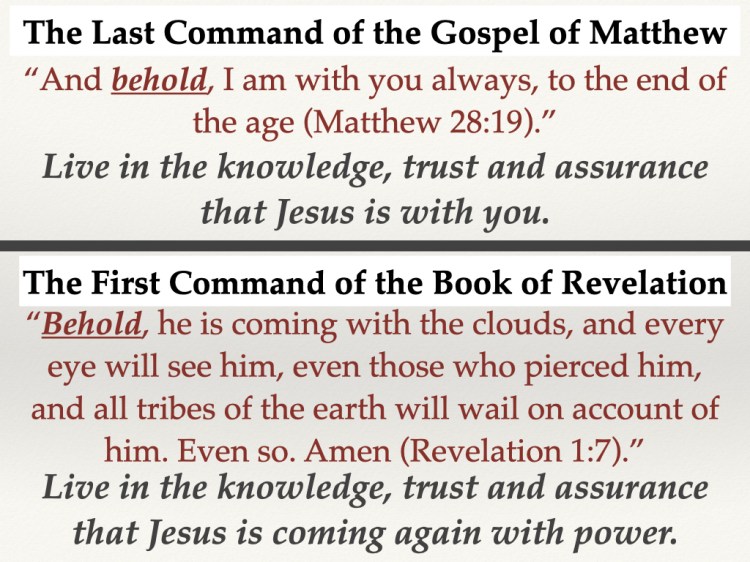
We now come to the first command in the book of Revelation. What makes this command special is that it is the same command given by Jesus as the very last command in the book of Matthew. In Matthew 28:19, Jesus commands, “And behold, I am with you always, to the end of the age.” The command is to behold, which means to see, to know, to trust, and to depend upon. You are to live this life with the assurance that Jesus is with you. Here is the first command in the book of Revelation, “Behold, he is coming with the clouds, and every eye will see him, even those who pierced him, and all tribes of the earth will wail on account of him. Even so. Amen.” Just as you are to live in the knowledge and trust that Jesus is with us always, so too are you to live with the knowledge and trust that Jesus is coming again with power.
8 “I am the Alpha and the Omega,” says the Lord God, “who is and who was and who is to come, the Almighty.” When Jesus says he is the Alpha and Omega, it is just a way for him to say that he is the Lord of all time and history. He, Jesus, has the first word, and he has the last word. He is God, and all of history is his; every moment, every second, every millisecond is his. And because it is all his, by his almighty power (the word almighty means power), he exercises providence and control over all that is transpiring. Every struggle, every accident, every fire, every breath of wind, every drop of rain, the almighty God has it all in hand.
As a pastor, I hear a lot of stories of hurt. People share with me the wreckage of their lives. I am asked to pray when a job is lost. I have felt the grief of people when a loved one dies. I have prayed with people who tell me their body is sick, and the soul is hard. I have traveled into those holes of depression with people, and I have heard too often of the sins that destroy families and homes. And people have shared with me their anger at God. Why did God make me like this? Why is God allowing this to happen? What bizarre purpose does God have for making me go through this? When I hear these stories, I often wish that I had the power to snap my fingers and make all the hurt and pain go away. I truly do. I wish I can solve or fix every problem, but I don’t. I wish I had the wisdom to provide an answer to every question and to give a reason to every heartache, but I don’t.
God’s ways are inscrutable; his judgments are unsearchable. I do not know why we have the coronavirus. I do not know why there are fires in the west, and I do not know why people get cancer. But what I do know is that He, the Lord God Almighty, intends for me (and you) to trust him, to trust Jesus. This is what the book of Revelation is all about. It is not a code that God intends for you to figure out, but rather it is a gift given to us that teaches us to trust Him, to trust Jesus, in these last days. Why? Because;
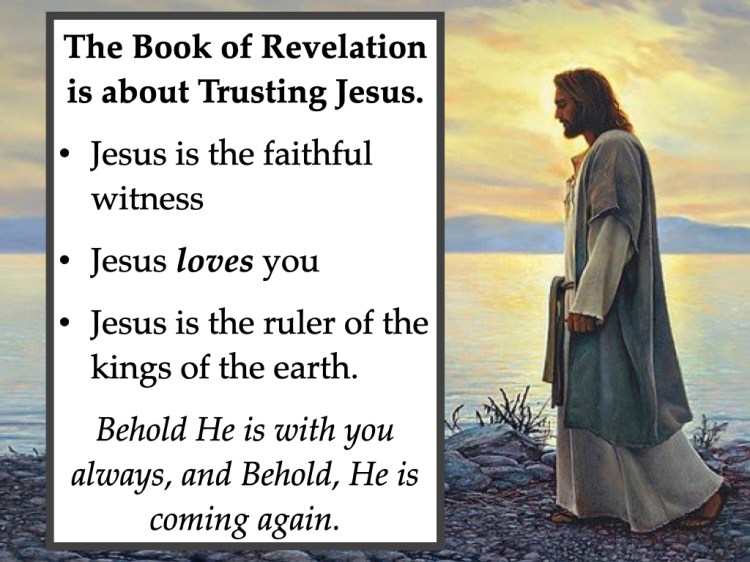
- Jesus is the faithful witness. He never lies and always forever is the source of truth.
- Jesus loves you. He loves you with a love so great, so almighty, that he died for you. Whatever situation you are going through right now does not change the fact that he loves you.
- Jesus is the ruler of the kings of the earth. S He is the first and the last, the alpha and the omega, and holds all of history in his hands. And If he has the power to do that, Then he has the ability to hold you in his hands and to guide your life.
That is why I, and you, can trust him and behold that he is with us always, and behold that he is coming soon. Amen.
Preached by Pastor Trent Eastman on September 20, 2020 at New Baptist Church
 Concerning the Word of Life