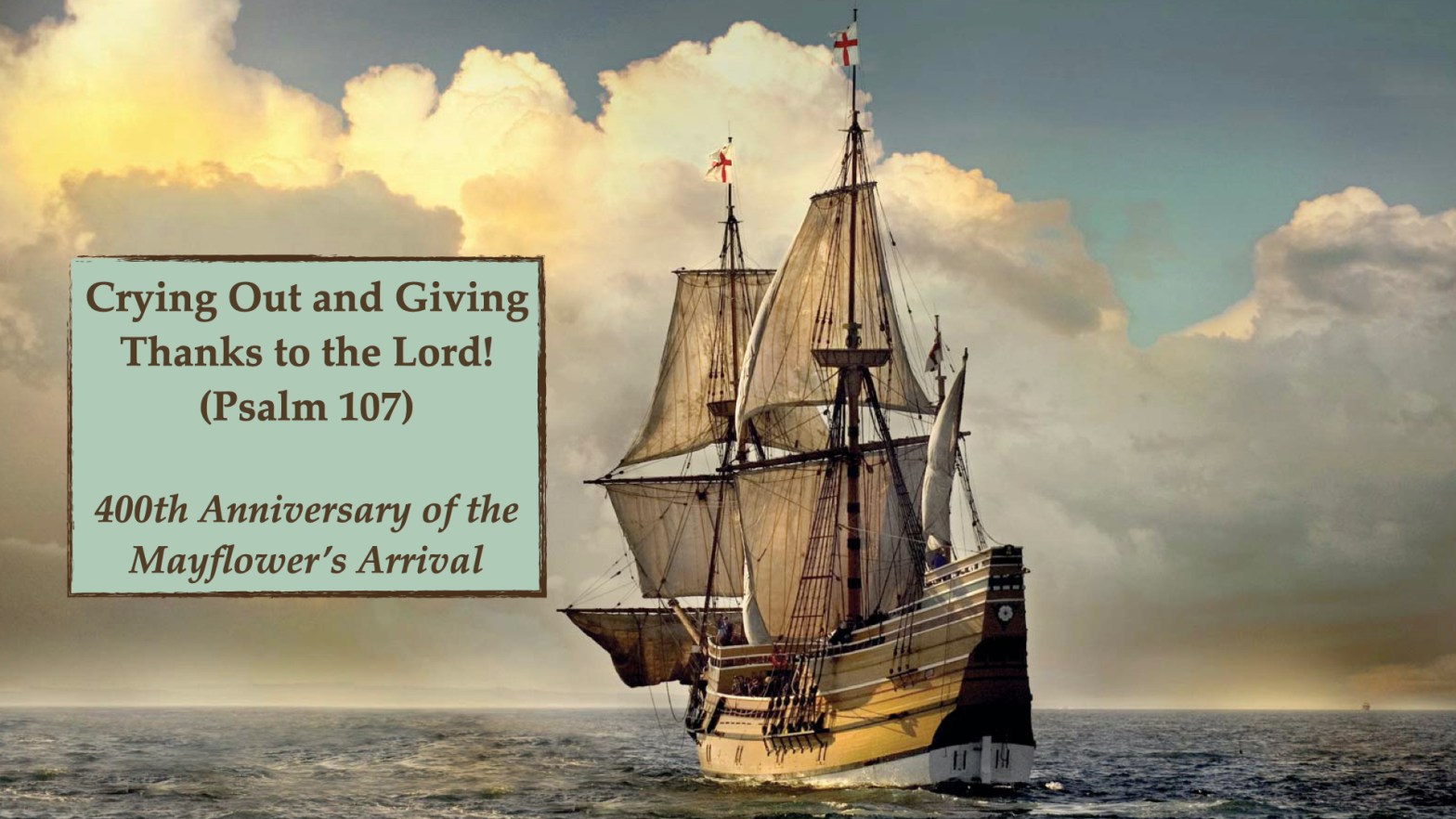
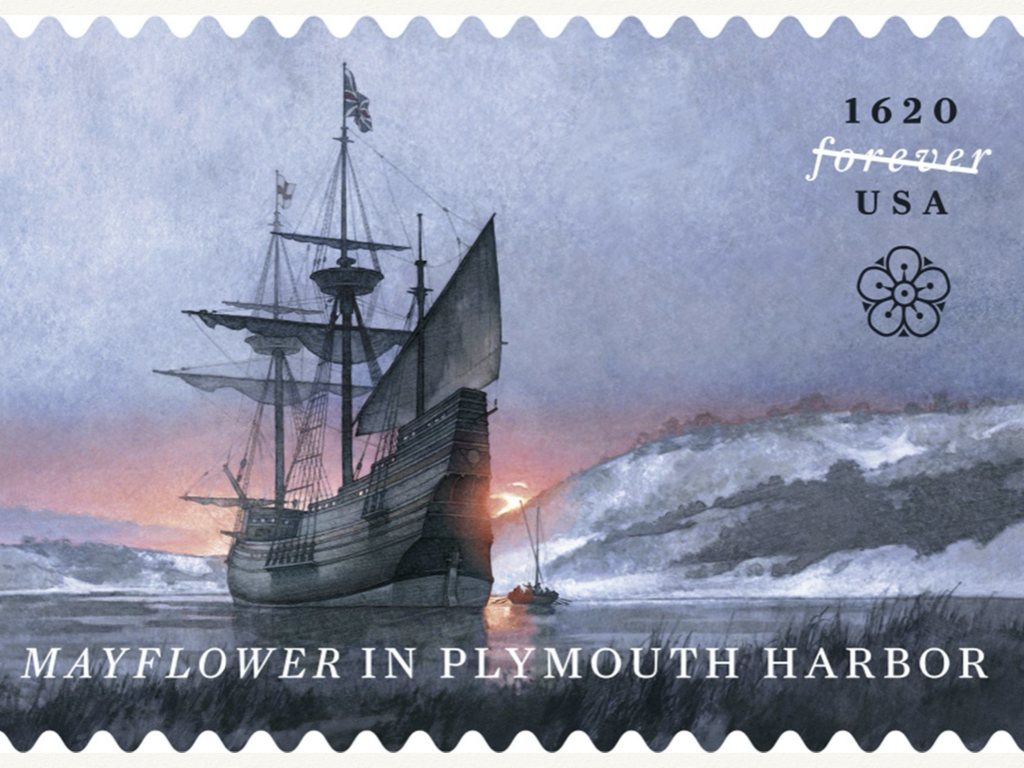
(The 400th Anniversary of the Mayflower) 2020 is a special year. I do not know if you know it or not, but today (November 11) is the 400th anniversary of the Mayflower arriving in the New World with a group of passengers known as Pilgrims. These pilgrims were puritan separatists who suffered persecution in England and sought a land where they could worship freely. This desire drove them to establish a colony in the land we call America today. They set sail in September of 1620 and dropped anchor near the tip of Cape Cod, Massachusetts, on November 11, 1620. They were not the first to come to this land, nor would they be the last, but what made this group of people so unique is that they were “the first to form a consensual government in Western history between individuals with one another, and not with a monarch. The colony was a mutual enterprise, not an imperial expedition (The Mayflower by Rebecca Fraser).” They wrote and signed the first constitution that was democratic and acknowledged liberty under law, giving people the right to participate in government.
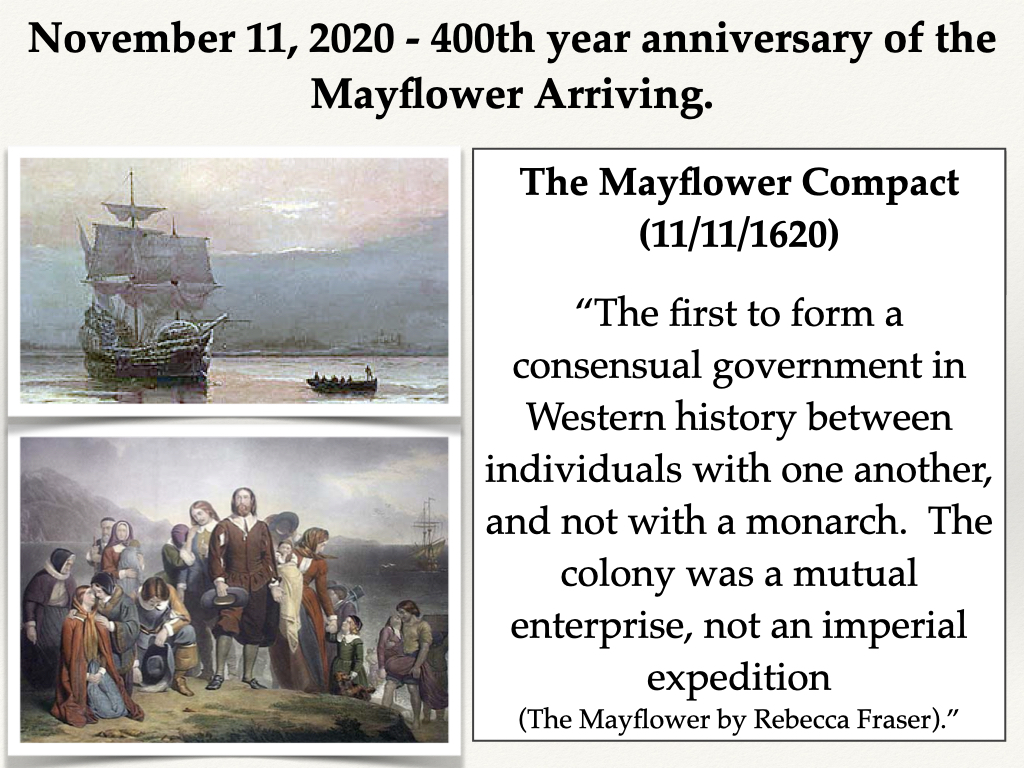
I want to pause and just reflect on this historical event for just a moment. Today there is a tremendous amount of emotionally charged rhetoric about threats to our democracy. We just went through an election that was very close. One side accuses the other of stuffing the ballot box and thus a threat to democracy, while the other side makes the accusation that not conceding the election is a threat to democracy. Here is my question, “If democracy took root and grew out of the desire and need to protect religious freedom (The Mayflower Compact), would that not then mean that our greatest threat to democracy is when religious liberty is threatened?” I think, yes. The 400th Anniversary of the Mayflower is a crucial opportunity to be reminded of and to exercise our religious freedom.
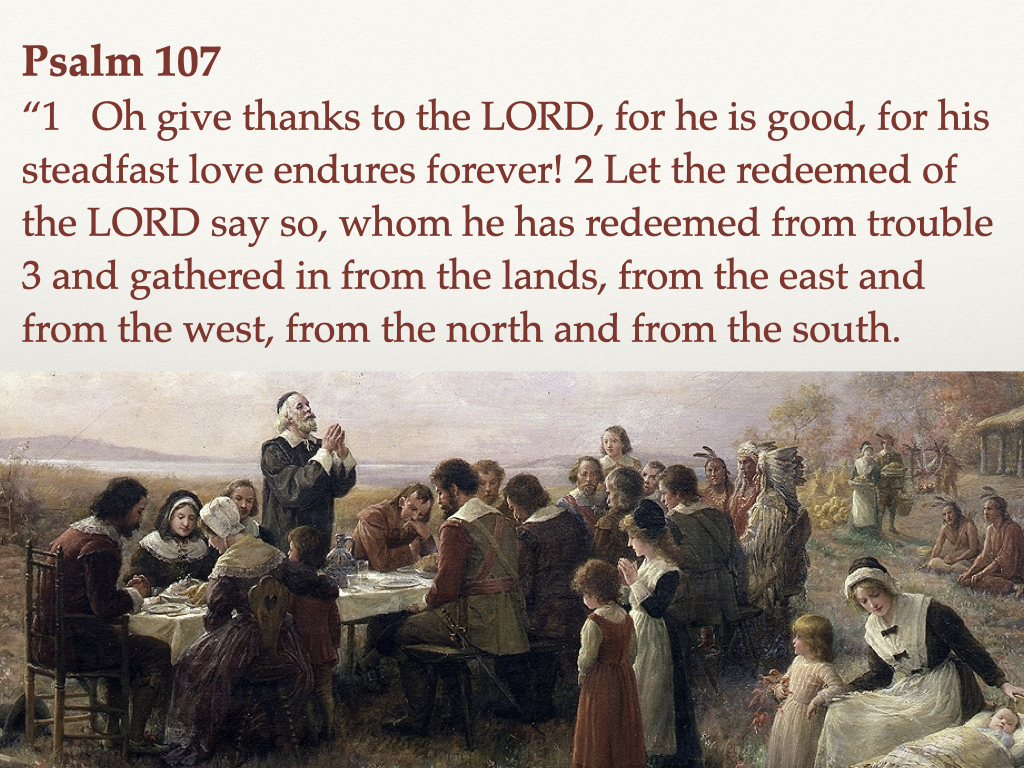
After a long voyage, what do you think was the first passage in the Bible the Pilgrims read? On the first Sunday after coming ashore, they gathered for a worship service, and the scripture that was read was Psalm 107, thus the passage for this study. Psalm 107 begins, “1 Oh give thanks to the LORD, for he is good, for his steadfast love endures forever! 2 Let the redeemed of the LORD say so, whom he has redeemed from trouble 3 and gathered in from the lands, from the east and from the west, from the north and from the south.” After this opening, we come to four stories of redemption that describe the people he has redeemed from trouble.
The first story of redemption is homelessness. 4 Some wandered in desert wastelands, finding no way to a city where they could settle. 5 They were hungry and thirsty, and their lives ebbed away. 6 Then they cried out to the LORD in their trouble, and he delivered them from their distress. 7 He led them by a straight way to a city where they could settle. 8 Let them give thanks to the LORD for his unfailing love and his wonderful deeds for men, 9 for he satisfies the thirsty and fills the hungry with good things.
The second story of redemption is a story of people in bondage. 10 Some sat in darkness and the deepest gloom, prisoners suffering in iron chains, 11 for they had rebelled against the words of God and despised the counsel of the Most High. 12 So he subjected them to bitter labour; they stumbled, and there was no-one to help. 13 Then they cried to the LORD in their trouble, and he saved them from their distress. 14 He brought them out of darkness and the deepest gloom and broke away their chains. 15 Let them give thanks to the LORD for his unfailing love and his wonderful deeds for men, 16 for he breaks down gates of bronze and cuts through bars of iron.
The third story of redemption is a story of those suffering and afflicted. 17 Some became fools through their rebellious ways and suffered affliction because of their iniquities. 18 They loathed all food and drew near the gates of death. 19 Then they cried to the LORD in their trouble, and he saved them from their distress. 20 He sent forth his word and healed them; he rescued them from the grave. 21 Let them give thanks to the LORD for his unfailing love and his wonderful deeds for men. 22 Let them sacrifice thank-offerings and tell of his works with songs of joy.
The fourth and last story of redemption is a story of those caught in a storm. 23 Others went out on the sea in ships; they were merchants on the mighty waters. 24 They saw the works of the LORD, his wonderful deeds in the deep. 25 For he spoke and stirred up a tempest that lifted high the waves. 26 They mounted up to the heavens and went down to the depths; in their peril their courage melted away. 27 They reeled and staggered like drunken men; they were at their wits’ end. 28 Then they cried out to the LORD in their trouble, and he brought them out of their distress. 29 He stilled the storm to a whisper; the waves of the sea were hushed. 30 They were glad when it grew calm, and he guided them to their desired haven. 31 Let them give thanks to the LORD for his unfailing love and his wonderful deeds for men. 32 Let them exalt him in the assembly of the people and praise him in the council of the elders.
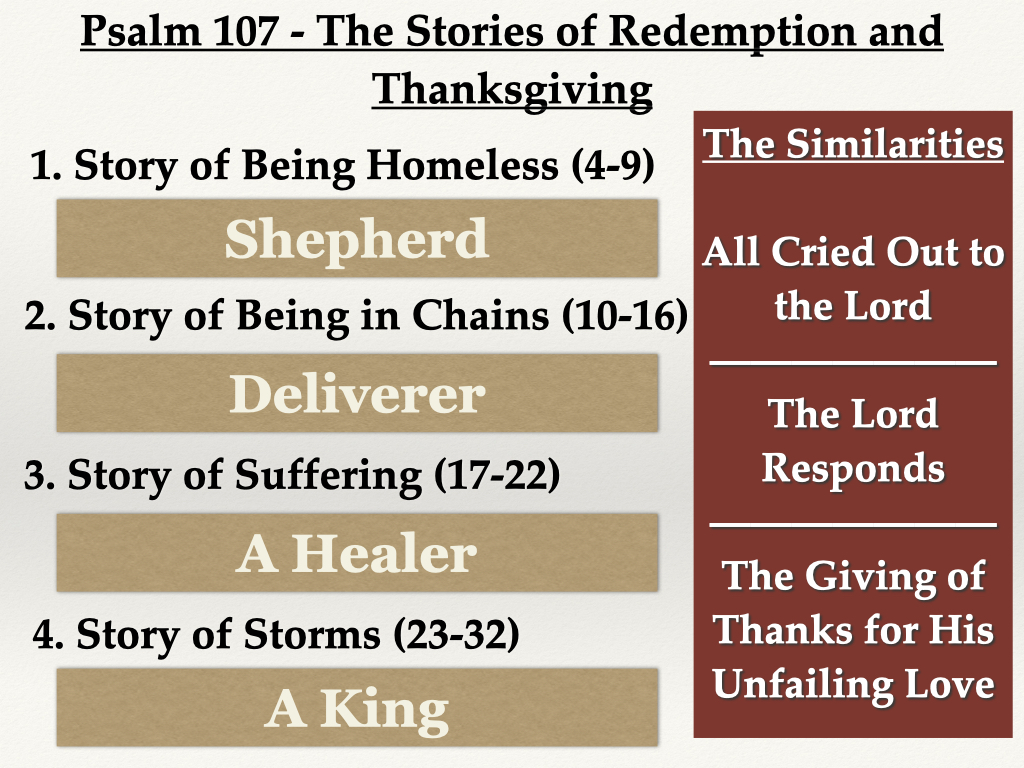
Did you catch how each story is similar? In each of the four stories, there was a turning point when “they cried out to the LORD in their trouble, and he brought them out of their distress.” To those who were homeless, the Lord responded as a shepherd to guide them home. To those in prison and held captive, the Lord responded as a deliverer who set them free. To those suffering and afflicted, the Lord responded as the healer who rescued them from the grave. To those caught in the storm, the Lord responded as the King that could calm the storm with but a whisper. At the end of each story, the people give thanks to the Lord. Reading again, verse 31, “Let them give thanks to the LORD for his unfailing love and his wonderful deeds for men.”
I love these images of God; He is a shepherd, a deliverer, a healer, and a mighty king. What story is your story?
- Maybe your story is that you are lost in life, without direction. If this is you, cry out to the Lord, and he will save you. He is the great shepherd who guides his sheep.
- Maybe your story is one of captivity. There are worries, or fears, or sins, or addictions that hold you captive, and you just cannot escape from. If this is you, cry out to the Lord, and he will save you. He is the deliverer that sets the captives free.
- Maybe your story is one of sickness. You are hurting physically and spiritually. Your heart is heavy. If this is you, cry out to the Lord, and he will save you. He is the healer that heals the sick.
- Maybe your story today is that your life is in chaos. Life is hard; you are stuck in a daily rut that is filled with ups and downs. If this is you, cry out to the Lord, and he will save you. He is the King that quells the storms.
Our Lord is full of unfailing love and worthy of all thanksgiving and praise.
It is easy to see why the Pilgrims would choose this Psalm to read on their first day of worship in the new world. These stories of redemption were their stories.
- They were homeless (The pilgrims were driven from place to place, escaping England for Holland, and then fleeing Holland).
- They were held captive (as English separatists, they were hunted and, if caught, placed in prison).
- They suffered at sea (on the voyage, over four died at sea).
- And they suffered much sickness and affliction. It humbles me when I recall what happened that first winter, the winter of 1620. Out of the 102 Pilgrims that came ashore, in a year, only 53 remained alive. Of those 53, only 16 were adults. It is hard to imagine.
What do you think they did when that first-year pasted after they lost half of those who came ashore? We know what they did; they gave thanks. We call it the first thanksgiving. What Psalm do you think they read on the first thanksgiving? They read Psalm 107. They proclaimed on that day, “Let them give thanks to the LORD for his unfailing love endures forever (Psalm 107:31).” The next year was not much easier; crops failed, sickness returned, there was a drought, conflict with other colonies, cheated by ship captains. They suffered much. What do you think they did? They continued to give thanks to the Lord for his unfailing love endures forever.” Both in the valleys and on the mountain tops. The ups and downs of mountain tops are how the rest of Psalm 107 reads.
- In verses 33 and 34, there is a valley. “33 He turned rivers into a desert, flowing springs into thirsty ground, 34 and fruitful land into a salt waste, because of the wickedness of those who lived there.”
- Then in verses 35 through 38, there is a mountain top. “35 He turned the desert into pools of water and the parched ground into flowing springs; 36 there he brought the hungry to live, and they founded a city where they could settle. 37 They sowed fields and planted vineyards that yielded a fruitful harvest; 38 he blessed them, and their numbers greatly increased, and he did not let their herds diminish.”
- But now, in verses 39-40, they go back into another valley. “39 Then their numbers decreased, and they were humbled by oppression, calamity and sorrow; 40 he who pours contempt on nobles made them wander in a trackless waste.”
- Finally, in verses 41 and 42, there is another mountain top. “41 But he lifted the needy out of their affliction and increased their families like flocks. 42 The upright see and rejoice, but all the wicked shut their mouths.” And then the Psalm ends. 43 Whoever is wise, let him heed these things and consider the great love of the LORD.”
Psalm 107 describes life. Life has valleys, and it has mountaintops, ups, and downs. What do you think the Pilgrims did in the valleys of life? They did Psalm 107, “they cried out to the Lord and gave thanks to the Lord.” What do you think they did on the mountain tops? They did Psalm 107, “they cried out to the Lord and gave thanks to the Lord.” It is time for us to do the same. It is time for us as a nation and as individuals to cry out to God and give Him thanks, for great is his love. Amen.
This lesson was taught by Pastor Trent Eastman at New Baptist Church on November 11, 2020
 Concerning the Word of Life