
The Gospel of Luke begins with two surprise birth announcements. In Luke 1:5-25, the angel Gabriel tells the priest Zechariah that he and his wife Elizabeth will have a son who will be “mighty in the Lord”. The son born to Zechariah and Elizabeth was John the Baptizer. Six months later, the angel Gabriel is dispatched again to announce another birth. This time though, the announcement does not take place in the temple to a priest but instead to a young woman named Mary who lived in a small town known as Nazareth (Luke 1:26-38). In this encounter between Mary and the angel, three miracles take place. These three miracles are the miracles of Christmas and they do indeed change the world. If you read all of the Christmas stories from the other Gospels, there are also other miracles. Last week we heard about the miracle of a barren couple having a child. In the Gospel of Matthew, some would call three wise men traveling together, stopping to ask for directions a miracle. And, I am sure we could add everyday miracles like the sun rising and flowers blooming. The miracles found in our passage today are real historical events of God that changed the world and opened up the way of salvation for us.
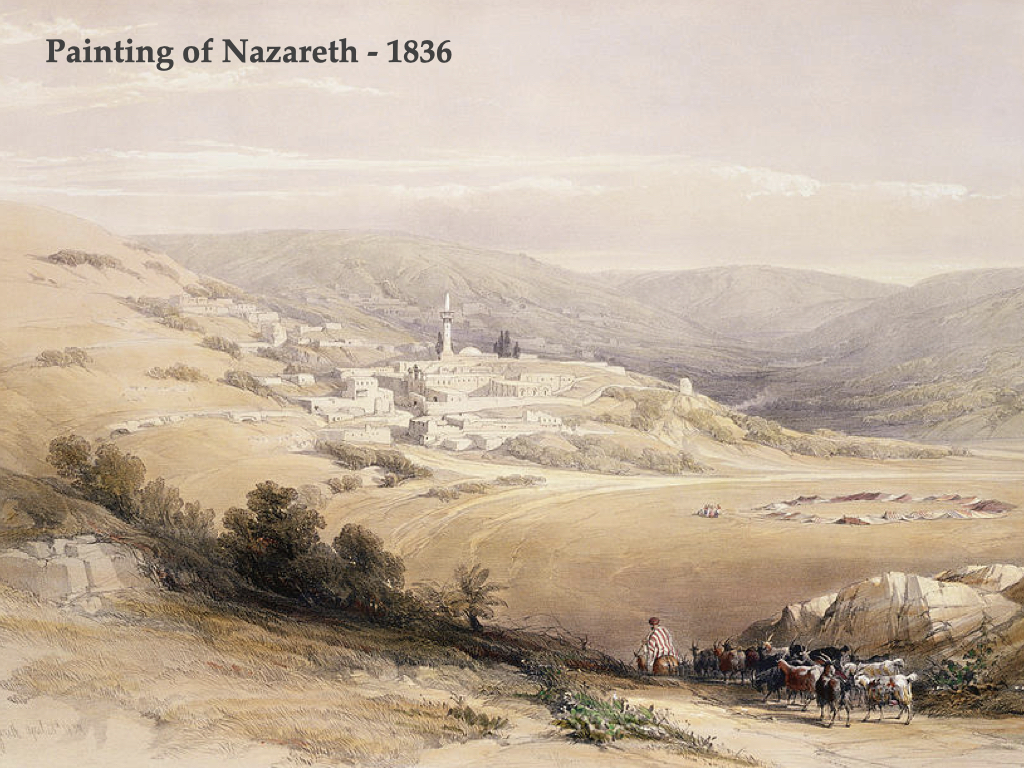
The three miracles of Christmas took place in a town that did not exist in Old Testament times. Nazareth came into existence by Jews who returned from the exile. It is located in the Galilee region along the old tribal borders of Zebulun and Naphtali. The town sat in a mile-long “holler”, surrounded by hills. If Jesus as a teenager would have stepped out onto his front porch and looked East, he would have seen Mt Tabor, the place where he will later take three of his disciples to reveal his glory–the transfiguration. If he were to look west, he would see a hill that separated the small town of Nazareth from Sepphoris. Sepphoris was a Hellenized Jewish city, a city where the Jews were more like Greeks or Romans than Jews. This may be why Nathaniel, a Jew among Jews, in the Gospel of John questions if anything good can come from Nazareth due to its proximity to Sepphoris. If Jesus looked south, he would see the plain of Megiddo, often call the Jezreel Valley, where so much Biblical history had taken place. And if he looked north west, he could have seen the tops of the hills surrounding the Sea of Galilee.
To this town of Nazareth, an Angel is sent to a very young woman named Mary. We read in verse Luke 1:26, “In the sixth month the angel Gabriel was sent from God to a city of Galilee named Nazareth, 27 to a virgin betrothed to a man whose name was Joseph, of the house of David. And the virgin’s name was Mary.” We know that Mary is very young because she is betrothed and not married. Betrothal happens at a very young age, while the girl and maybe even the boy are still children. It is how families arranged marriages. A young girl would stay betrothed until the time that she went through puberty. I am sure there was a window of time that could last a couple of years between puberty and marriage dependent upon various factors, but our being told she was betrothed means that Mary could be as young as 14 to as old as about 16. She is a very young woman.
The Angel Gabriel says to her, verse 28, “Greetings, O favored one, the Lord is with you!” We read on in verse 29, “But she was greatly troubled at the saying, and tried to discern what sort of greeting this might be.” I think Mary is so troubled and confused about the angel’s greeting because of how women were viewed during that time. If we were to create a hierarchy of social status with the most important people at the top and those least important at the bottom, a teenage girl in a small, poor Jewish community would be near the very bottom. There is some evidence to suggest that their value would be less than that of a farm animal. Zechariah, the priest, would be way up there at the very top, but Mary, a young woman of little or no standing, would be at the very bottom. What this angel says to Mary has probably never been told to Mary before, “Greetings, O favored one, the Lord is with you!” She probably looked around and thought, “Are you talking to me?” It is no wonder she is confused; the words of the angel do not line up with the probable reality she lived.
The Angel Gabriel now delivers his message, and we hear of the first miracle. “30 And the angel said to her, “Do not be afraid, Mary, for you have found favor with God. 31 And behold, you will conceive in your womb and bear a son, and you shall call his name Jesus. 32 He will be great and will be called the Son of the Most High. And the Lord God will give to him the throne of his father David, 33 and he will reign over the house of Jacob forever, and of his kingdom there will be no end.”

These words of the angel give us the first miracle of Christmas that has changed the world. It is the miracle of God becoming flesh. That Jesus shall be born of a woman, thus being fully human, yet he never ceases to be fully God. It is the miracle that we call the incarnation. Jesus is fully God and is fully Man. The Gospel of John begins by telling us that Jesus is God. The Gospel reads, “1 In the beginning was the Word, and the Word was with God, and the Word was God. 2 He was in the beginning with God.” (John 1:1–2), and then down in verse 14 of John chapter 1 it reads, “And the Word became flesh and dwelt among us.” Mary is going to give birth to a male child who is fully human while still being fully God. J.I.Packer says it this way, Jesus, “Remaining what he was, he became what he was not. Christ was not now God minus some elements of his deity, but God plus all that he had made his own by taking manhood to himself.”
There is a mystery to the incarnation that is beyond my ability to understand and explain. One of the best ways to explain what it means for Jesus to be fully man and fully God is the verse John 3:16. It reads, “For God so loved the world, that he gave his only Son, that whoever believes in him should not perish but have eternal life.” Older translations read that God gave his only begotten son. The word begotten can be misleading because it suggests progeny; that God fathered a child. This is a wrong understanding. Jesus has always been God and has existed with the Father. God has always been Father, Son, and Spirit. When the Bible says that God gave his only begotten son (the Greek word is monogenism), it means the same essence, of the same nature as God. That is what John 3:16 is saying, that Jesus is in his very essence and nature, God.
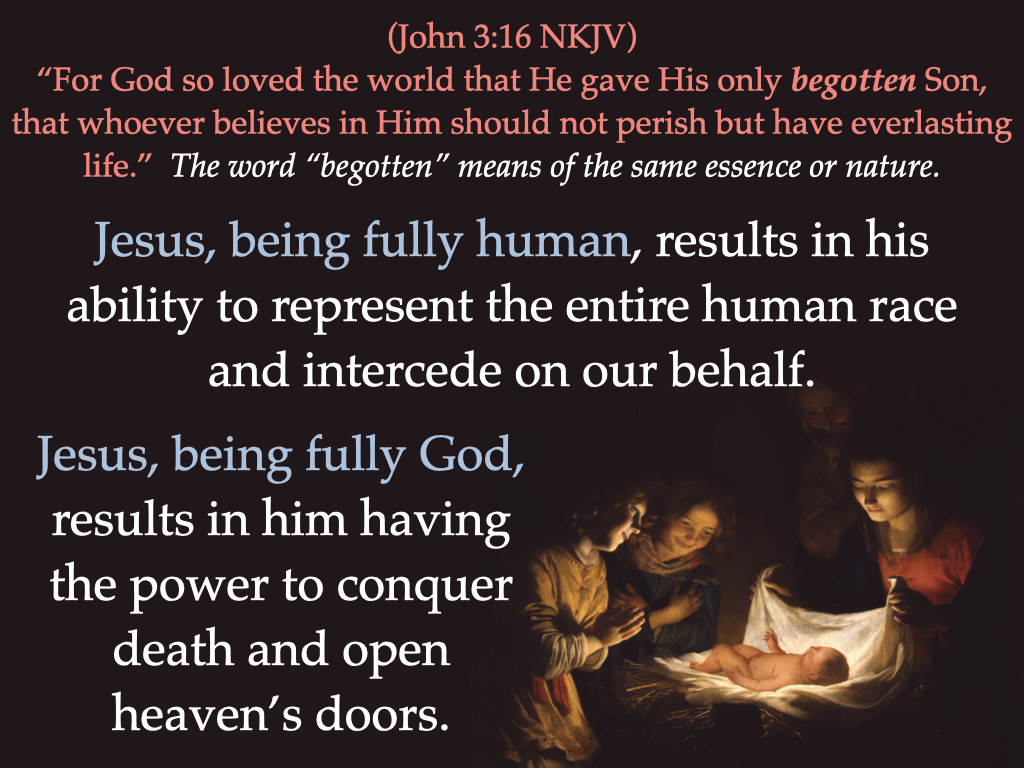
The miracle of the incarnation changed the world because, for the first time, there is a man who represents you and me in his humanity and is powerful enough in his divinity to do what you and I cannot do. Jesus’s being fully human results in his ability to represent the entire human race. That is what it means for him to be the High Priest. From all the nations of the world, God chose one nation to be priests, representatives of all nations (Israel). And from this one nation, he chose one tribe to be priests, the Levites, to represent all the other tribes of Israel. And from this one tribe, he chose one man to be the high priest to represent all the other priests. The whole Old Testament points us towards a single person who represents us and intercedes on our behalf. As being fully man, Jesus represents us to God, and that is great news because Jesus was a perfect man. There was no sin found in him, and since he represents you and me, God looks at us through him. Yet, Jesus is also fully God. This means that through the power of God, he really does conquer death; he really does open heaven for us. He really is creating a new earth and a new heaven, preparing a place for you and me. The is the first miracle of Christmas that changes the world, The Incarnation.
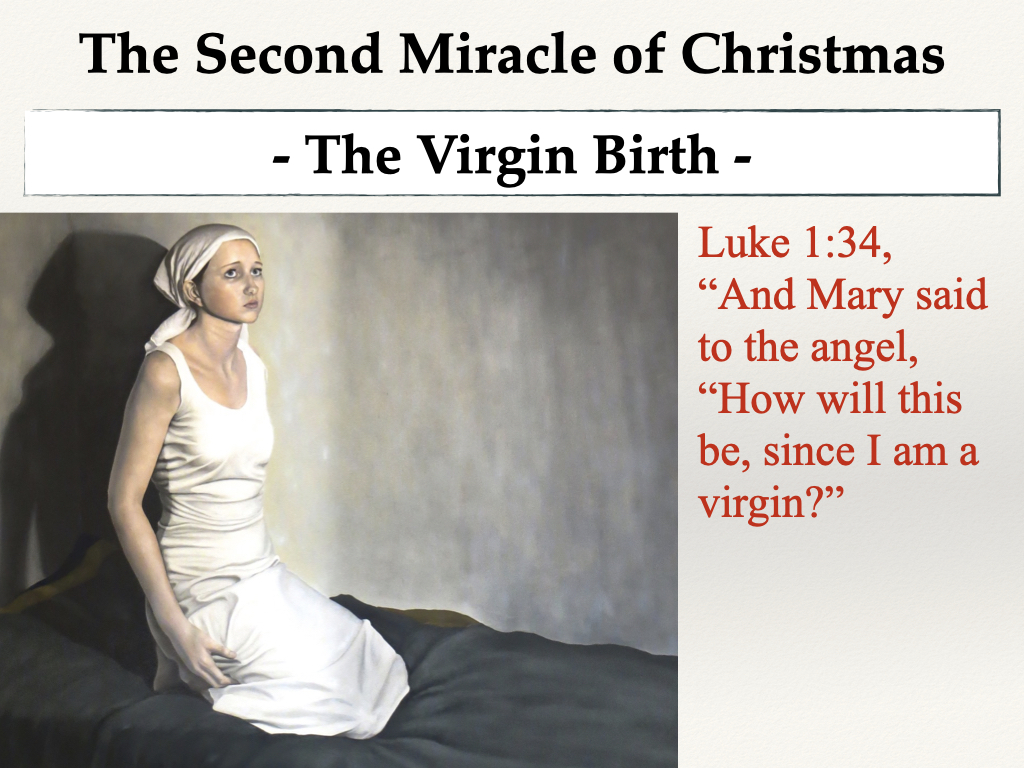
The second miracle that changed the world is the virgin birth of Jesus. Reading on in verse 34, “And Mary said to the angel, “How will this be, since I am a virgin?” I find humor in this part of the dialogue between Mary and the angel. The angel has just said some amazing things to Mary. “Jesus will be great and called the son of the Most High. He will be given the throne of David, reign over the house of Jacob forever, and his kingdom will never end.” These are remarkable promises. Not only are these promises the fulfillment of prophecy, but they are divine miracles in and of themselves. “Mary, did you hear that Jesus, your son, is going to reign forever.” But it seems that Mary heard none of these promises. As soon as the angel said to her, “You are going to have a son,” Mary’s brain locked up (a baby?). It focused only on that part of Gabriel’s message about her having a baby. Clearly, yes, Mary did know how babies are made. Thus, the question, how am I going to have a baby since I am a virgin?
The Angel Gabriel says to her, in response to Mary’s question by telling her that nothing is impossible for God. He says in verse 35,“And the angel answered her, “The Holy Spirit will come upon you, and the power of the Most High will overshadow you; therefore the child to be born will be called holy—the Son of God.” 36 And behold, your relative Elizabeth in her old age has also conceived a son, and this is the sixth month with her who was called barren. 37 For nothing will be impossible with God.” There has been a tremendous number of people arguing that the word virgin here means a “young girl” and not someone who has never had sexual relations. I think our passage is making it very clear that Mary recognizes that she cannot have a child because she has never been with a man before. Here, the word virgin means precisely how we understand that word, a woman who has never known a man intimately. Thus, her pregnancy is a miracle, and it is a miracle that changed the world and is a type of miracle necessary for our salvation.

To be clear, Jesus is born of a virgin not because sex is bad, sinful, or evil. Rather, sex is good because, in part, that is how God creates life. It is necessary for Mary to be a virgin because we, all of humanity, are in bondage and cannot save ourselves. We are held in the bondage of our wills, the bondage of our minds, and the bondage of our sins, all of which lead to the enslavement of death itself. We need something, or someone, to step into our world that is not a part of our world. If the Messiah was born naturally, of both an earthly mother and father, and nothing new from outside of this creation was added, we would still be caught in our bondage of sin and death because we, individually and as the human race, cannot save ourselves. We need a savior.
Thus, the importance of this miracle of Jesus’s being born of a virgin. This miracle means that God has created something new in this world and that our salvation has come to us from God, outside ourselves. One of today’s great lies is the mythology of atheistic humanism that says that humanity, through a process of progressive change, helped by science and reason, can improve itself to the extent that humanity is liberated, freed from all forms of all bondage. That if we work hard enough, we can have a perfect world and perfect lives. This is a lie that is evident in the fact that humanity’s bondage and brokenness taint everything we do, everything we create, and everything we seek. We cannot, as individuals or as a race, save ourselves. We need someone outside of this creation, stepping in it to do what we cannot do. The virgin birth is God stepping into this creation. The miracle of Jesus’ birth is the doctrine of grace taking human form. And just as how you receive God’s grace, Mary received this miracle of grace, of God’s doing something new in this world, by hearing the Word of God and responding to it by faith.

This is the third miracle necessary for salvation, Faith. “8 And Mary said, “Behold, I am the servant of the Lord; let it be to me according to your word.” And the angel departed from her.” What Mary displays here is faith, and faith is a miracle. It is a miracle in two ways. First, faith is a miracle because it is a work of God. Before a person believes the word of God and trusts the Lord, God, through His Spirit, had already been doing something in that person’s life. I think that Mary was made ready for this moment by the Lord. We do not have Mary’s back story, but we do know that Mary knew God’s word in how she responded to Elizabeth (Luke 1:46-55). Everything she says in her praise is from scripture. God had been at work in her life before she believed. Thus, her faith is a work of God and therefore a miracle.
And second, faith is a miracle because it is not a work. The only thing that Mary had to do for this great promise to be born in her was to trust the Lord, “Let it be to me according to your word.” That is it. Nothing else was required of Mary but faith. She was not required to climb a mountain or visit some priest somewhere. Faith was sufficient for the Word of God to enter her life. Thus, faith is a miracle. It is a miracle that we can receive eternal life, the forgiveness of sins, and fellowship with the living God through faith. Faith is a miracle because God himself works it into us, and faith is a miracle because God’s grace is gained through faith and not by works. Faith is the third miracle that changes the world and is a miracle that will change your life.
I do not know if you caught it, but I said that all three of these miracles take place in our text at the start of this message. We see the miracle of faith in our passage, but what about the other two miracles, the miracle of the incarnation and virgin birth? Please notice something. In the very next verse, Mary is already pregnant (Luke 1:39-42). How did that happen? We read, verse 39, “In those days Mary arose and went with haste into the hill country, to a town in Judah, 40, and she entered the house of Zechariah and greeted Elizabeth. 41 And when Elizabeth heard the greeting of Mary, the baby leaped in her womb. And Elizabeth was filled with the Holy Spirit, 42 and she exclaimed with a loud cry, “Blessed are you among women, and blessed is the fruit of your womb!” It seems that as soon as the angel departed, Mary goes in haste to Elizabeth, and her pregnancy is confirmed by the unborn John the Baptist doing a happy dance. When did Mary become pregnant? In every movie that I have seen, attempts to portray this event have the angel leaving. Then the scene shifts and Mary is alone, and all of a sudden, a whoosh of wind comes in, and there is some mystical experience that ends up causing Mary to be pregnant. I think this portrayal of Mary’s conception is wrong.
Mary becomes pregnant at the moment she believes, at the moment she trusts the Lord, at the moment of faith. She is given a child at the moment she says, “Let it be to me according to your word.” That is the moment when the Word of God became flesh, and a virgin conceives a child. I believe this because, one, she runs off in haste. There is no time for the mystical experience of whooshing wind. And two, receiving the grace of God by faith at the moment of faith is what God does. God’s gift of grace to Mary, and you, is given to you, not after you go through some mystical experience but at the moment of faith. At the moment you trust Him, you are born again. God’s word has entered you.
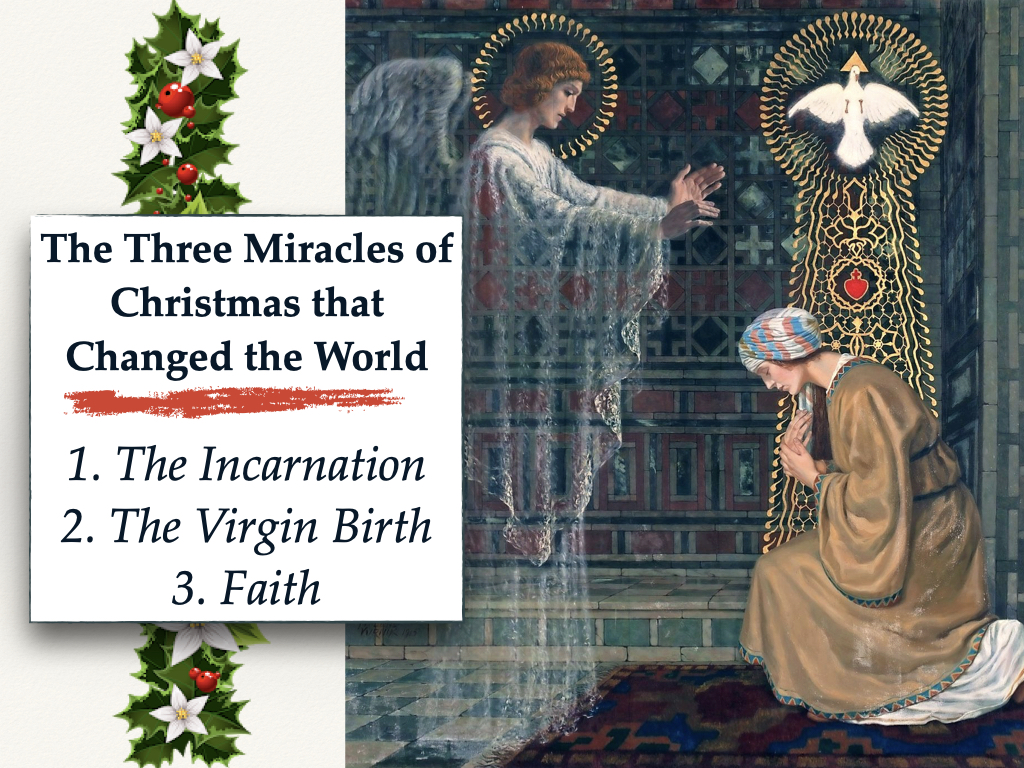
How do you celebrate Christmas rightly? You do so through celebrating, giving thanks, and remembering these great miracles that God worked for our salvation. You celebrate Christmas by having faith in what God has done for you in Christ Jesus. Amen.
This message was given by Pastor Trent Eastman on December 6, 2020 at New Baptist Church, Huntington West Virginia.
(Luke 1:26–38 The Holy Bible, English Standard Version) “26 In the sixth month the angel Gabriel was sent from God to a city of Galilee named Nazareth, 27 to a virgin betrothed to a man whose name was Joseph, of the house of David. And the virgin’s name was Mary. 28 And he came to her and said, “Greetings, O favored one, the Lord is with you!” 29 But she was greatly troubled at the saying, and tried to discern what sort of greeting this might be. 30 And the angel said to her, “Do not be afraid, Mary, for you have found favor with God. 31 And behold, you will conceive in your womb and bear a son, and you shall call his name Jesus. 32 He will be great and will be called the Son of the Most High. And the Lord God will give to him the throne of his father David, 33 and he will reign over the house of Jacob forever, and of his kingdom there will be no end.” 34 And Mary said to the angel, “How will this be, since I am a virgin?” 35 And the angel answered her, “The Holy Spirit will come upon you, and the power of the Most High will overshadow you; therefore the child to be born will be called holy—the Son of God. 36 And behold, your relative Elizabeth in her old age has also conceived a son, and this is the sixth month with her who was called barren. 37 For nothing will be impossible with God.” 38 And Mary said, “Behold, I am the servant of the Lord; let it be to me according to your word.” And the angel departed from her.”
 Concerning the Word of Life