
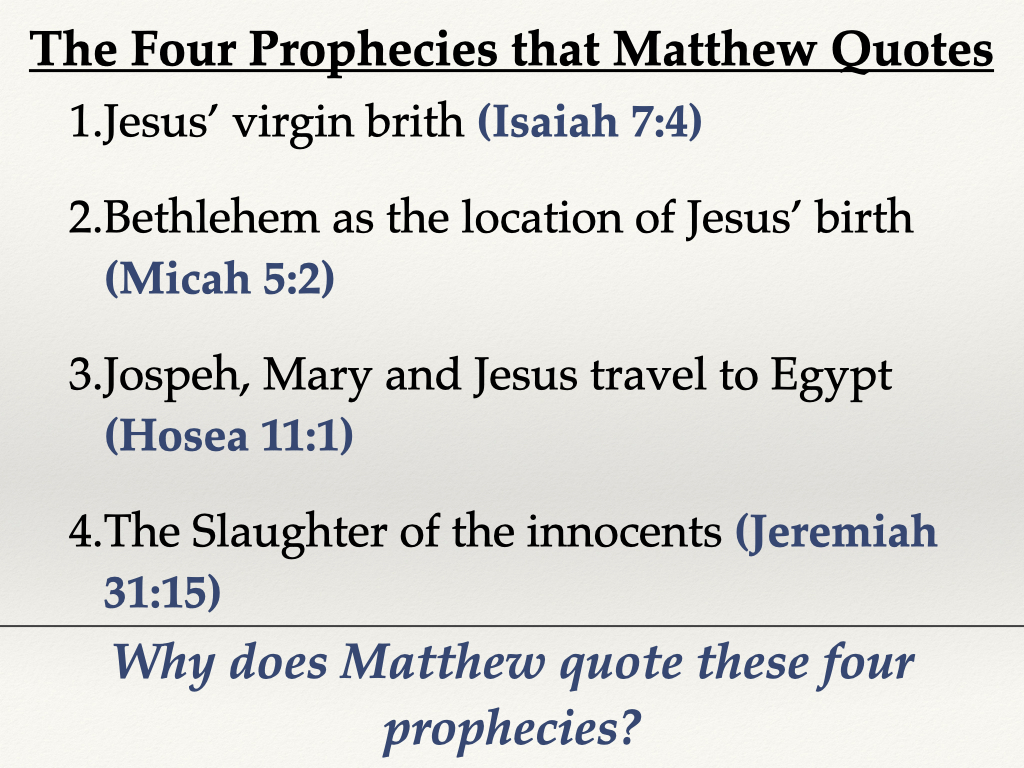
Have you ever looked closely at the prophecies surrounding Christ’s birth and are quoted by the Gospel writers? There are many prophecies referred to or mentioned by the gospel writers, and I believe there could have been many more references from the Old Testament describing Jesus’ birth. This belief prompts a question, “WHY, in the example of Matthew, does he quote the four prophecies that he does? Why does he not add other prophecies about the shepherds, the manger, the wise men, or the star?” The four historical events that Matthew attaches Old Testament references to are Jesus’ virgin birth, Jesus born in Bethlehem, the family fleeing to Egypt, and the slaughter of the innocents.
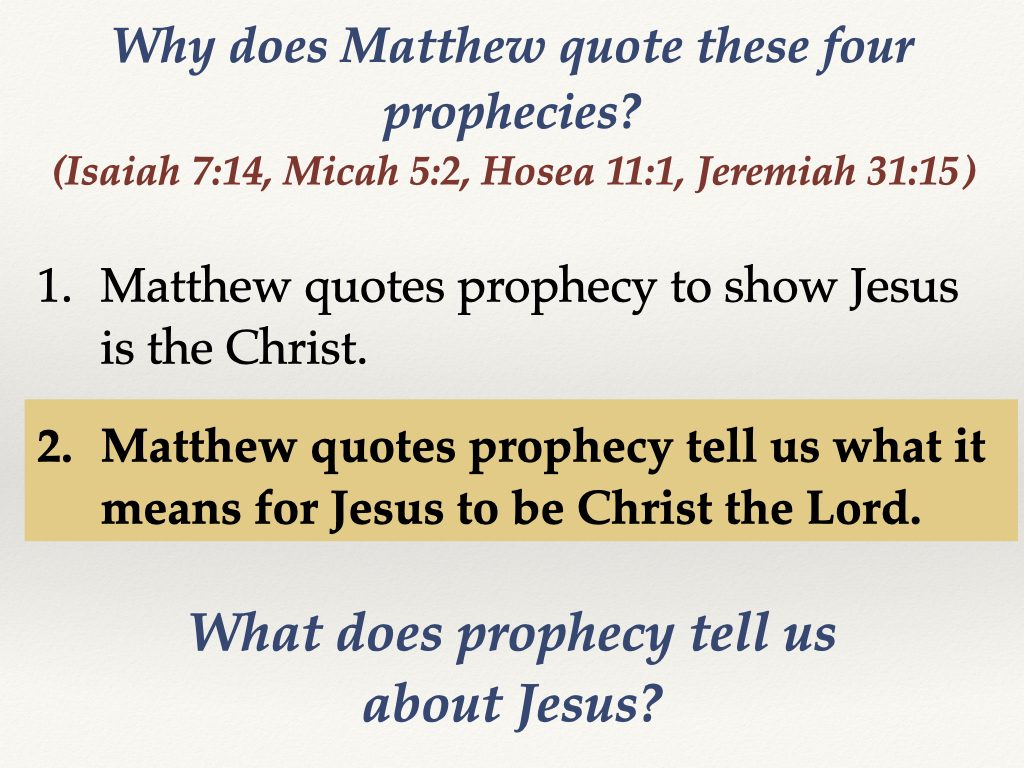
Why then does Matthew choose these prophecies and not others? Clearly, Matthew is using prophecy as a type of indicator to show us that Jesus is the Messiah, that Jesus is the one that fulfills prophecy. The prophecy tells us who Jesus is; he is Christ the Lord. But I also think that Matthew quoted these four prophecies to say to us what it means for Jesus to be Christ the Lord; what it means for Jesus to be born. I am going to look at each one of these prophecies quoted by Matthew and ask the question, “what does this prophecy tell us about Jesus? “
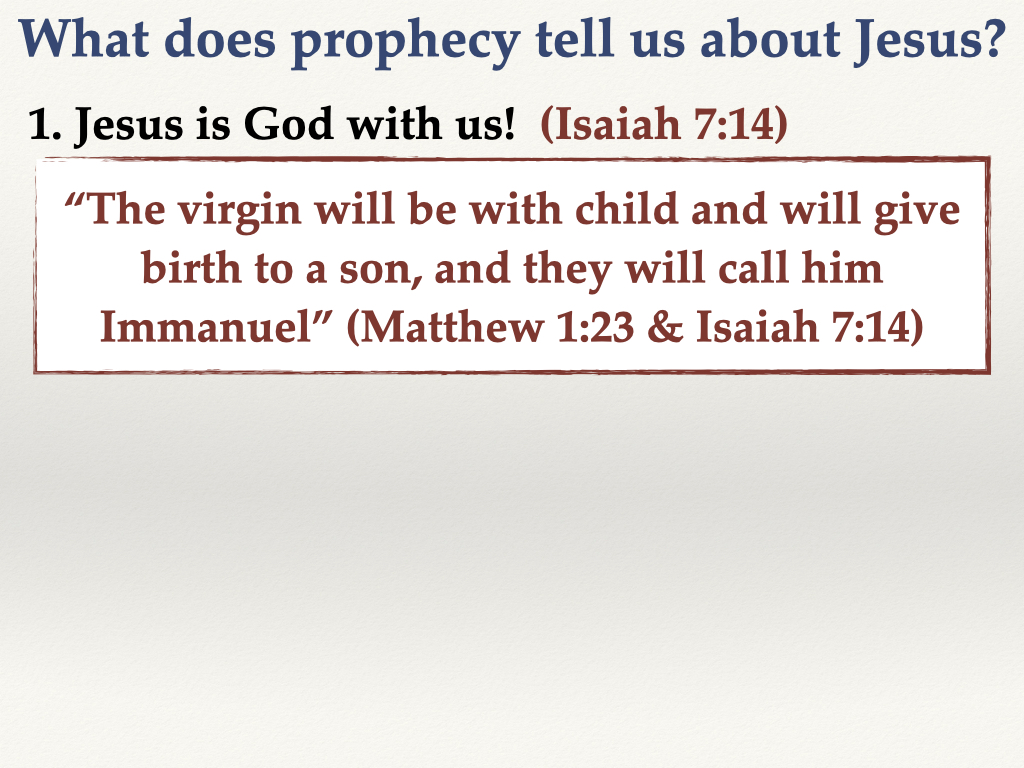
Matthew’s first prophetic reference is when Joseph is told not to divorce Mary, that she is pregnant by the Holy Spirit and that he is to name the child Jesus. Matthew then quotes Isaiah 7:14, “The virgin will be with child and will give birth to a son, and they will call him Immanuel” Matthew goes on to say – –which means, “God with us.” The context in Isaiah of this reference is Jerusalem being attacked by two separate kingdoms. The enemy surrounds the city, but the Lord says through the prophet Isaiah to the King of Israel, “the Lord will save you.” Isaiah speaks to the King, “don’t be afraid, don’t let your heart be faint, don’t wail or weep, for a sign is given to you. A virgin shall give birth to a son, and by the time he is just a few years old, your enemies will be destroyed. How is this possible? The reason is Immanuel; God is with us.” I think Matthew quotes Isaiah 7:14 because he is reminding us that in this world surrounded by darkness, God has not forgotten us, that God is with us. Thus, the first prophecy quoted by Matthew is a reminder that Jesus is God with us.
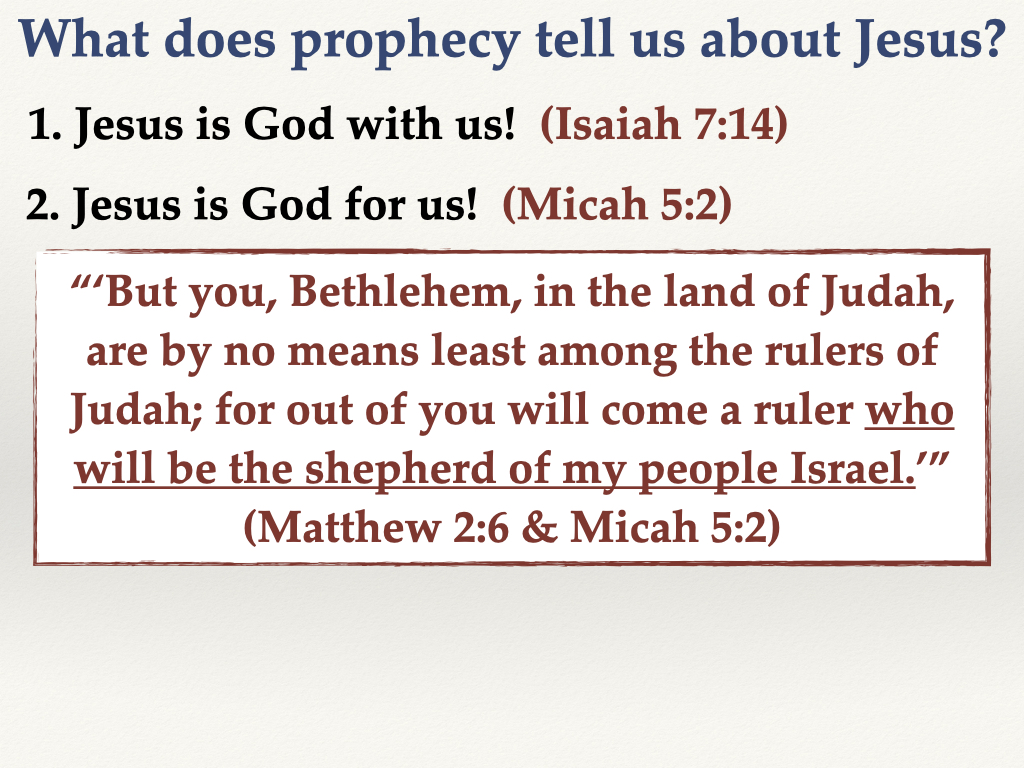
The second prophecy referenced by Matthew is Micah 5:2. The context of this reference is when the wise men tell Herod about the King to be born. King Herod assembles all of the religious teachers to ask them where this birth will take place. The religious leaders tell Herod that the Messiah will come from Bethlehem and then quote Micah 5:2, which reads, “‘But you, Bethlehem, in the land of Judah, are by no means least among the rulers of Judah; for out of you will come a ruler who will be the shepherd of my people Israel.’” This prophecy in Micah is a part of a larger passage that talks about a king who rules for his people’s good. Thus, the second prophecy quoted by Matthew is a reminder that Jesus is God for us.
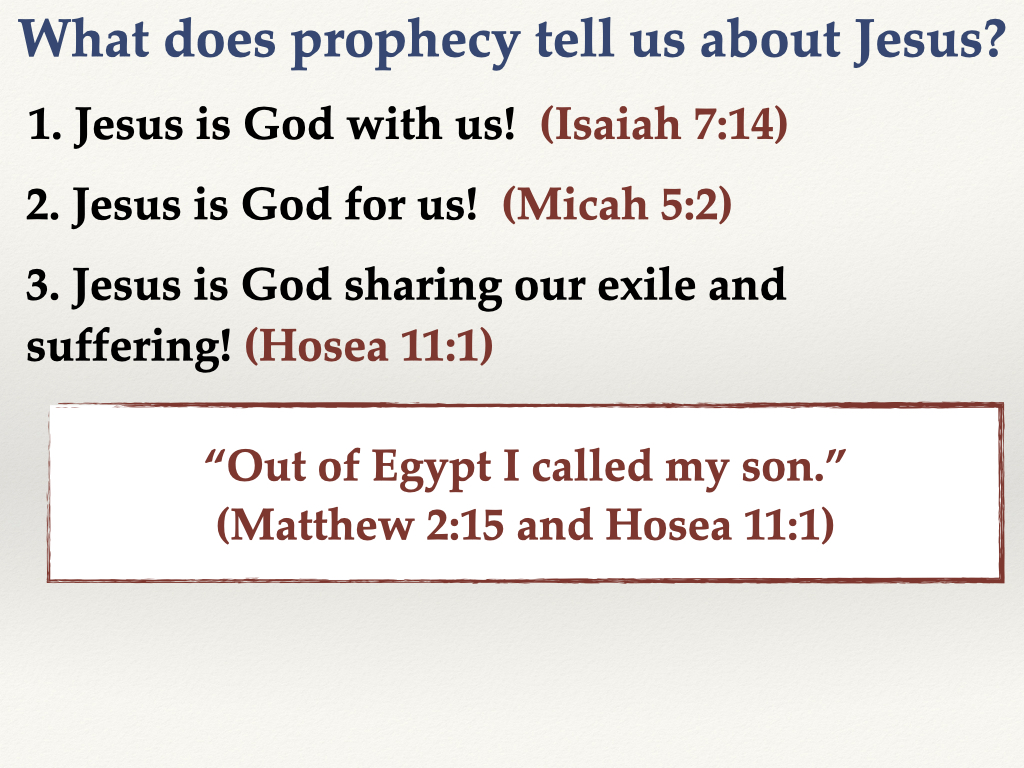
The third prophetic reference is found in Matthew 2:15. The context is Joseph being told to take Jesus and his mother and flee to Egypt, and to remain there until the death of Herod – thus the prophecy quoted by Mathew from Hosea 11:1. It reads, “Out of Egypt, I called my son.” If you read Hosea chapter 11, you may be thinking, “how is this a prophecy?” The passage clearly links this phrase of coming out of Egypt to the Exodus event. Hosea’s passage goes on to describe the unfaithfulness and sin of Israel, which leads to their exile. Thus, I think that Matthew quotes this passage from Hosea as a way of saying that Jesus, the Messiah, fully shares in our exile; he shares in our struggles and our pain. Therefore, not only is God with us, and that God is for us, but that Jesus is God identifying with us.
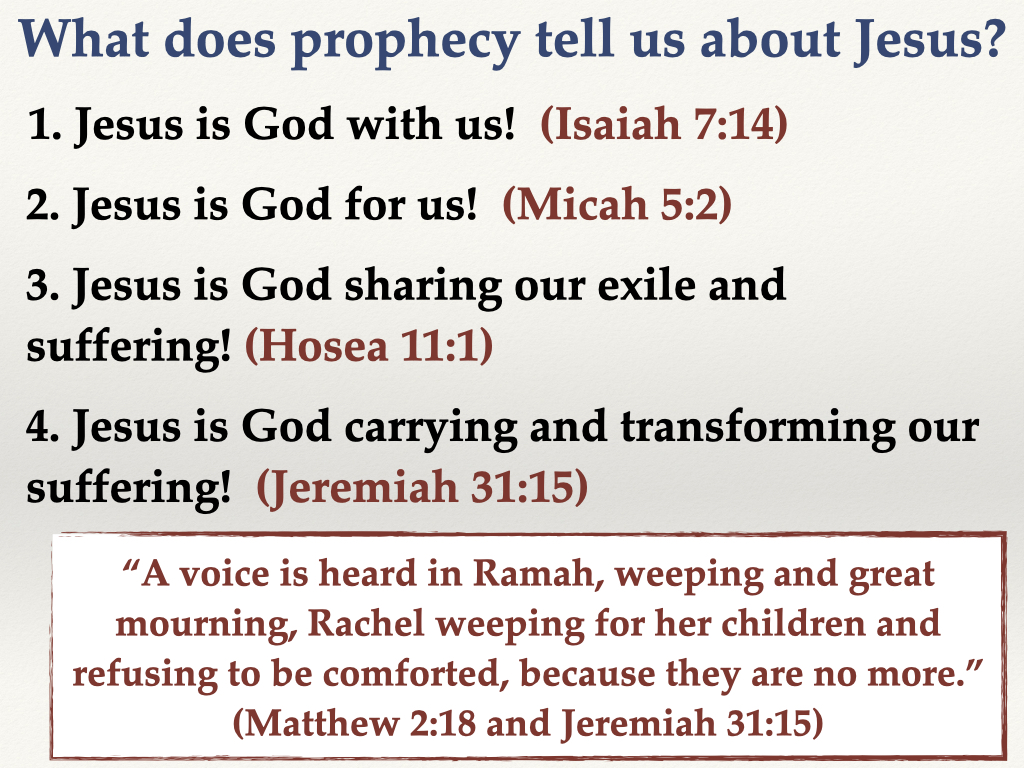
The fourth prophetic reference of the birth story is found in Matthew 2:18. The context is King Herod sending out his soldiers to slaughter all the male boys two years of age or younger. Archeology puts Bethlehem’s size during this time at around 1000 to 1500 people, which would mean statistically that the number of children slaughtered would have been about 20 to 25. And it is here. at this massacre, that Matthew quotes Jeremiah 31:15, which reads, “A voice is heard in Ramah, weeping and great mourning, Rachel weeping for her children and refusing to be comforted because they are no more.”
This verse is packed with meaning. Rachel was the wife that Jacob loved. She gave Jacob two sons, Joseph and Benjamin. We read in Genesis 35 that as they were traveling to Bethlehem, Rachel died giving birth to Benjamin, who she names Ben-Oni, meaning “son of my trouble.” She dies weeping; that is why she is not comforted. The place she is buried at is Ramah; it sits just a few miles from Jerusalem. During the days of Jeremiah, the prophet, Jerusalem was destroyed, and the people were taken into exile. There was no comfort for them as they mourned over the destruction of the city and temple. Some believe that Ramah was the staging area for those taking into exile. Thus, in Jeremiah, this quote is powerful. Rachel symbolizes the land of Judah weeping for her children because they have been beaten and removed from the land. Yet, in the context of Jeremiah 31, where this prophecy sits, the larger message is a message of great hope. Yes, Rachel is weeping for her children, but despite the horrors happening, the prophecy is that there shall come a day when God will turn their weeping into Joy. A day shall come, the exile will be over.
King Herod’s slaughter of the innocents is only one manifestation of this world’s darkness and the bondage we suffer. We live in a world where people, like King Herod, fight against God and do unnatural, sinful, and often brutal things to hang onto the idols of our hearts. I believe Matthew’s quote of Jeremiah 31 recognizes the horrors of our world but reminds us that God is still sovereign. That even in the most tragic events we suffer, there is still hope. Not hope as in wishful thinking but hope in God at work transforming our suffering. This hope is fulfilled in Jesus, who transforms the ultimate object of shame and suffering, the cross, into an object of victory and life. Not only is God with us, and that God is for us and that God is intimately involved in us, but God’s activity shares in your pain, transforming it according to his purpose and glory. Through Christ, God takes the evil that surrounds us and leverages it for good and his glory. This is the essence of the Gospel. The murder of the son of God resulted in salvation for the world. Thus, the fourth prophecy quoted by Matthew is about Jesus as God’s transformative and redemptive power-saving us. The prophecy that Matthew quotes shows that Jesus is God with us, God for us, God identifying with us, and God saving us. Amen.
Wednesday Bible Study – December 16, 2020 – Pastor Trent Eastman
 Concerning the Word of Life