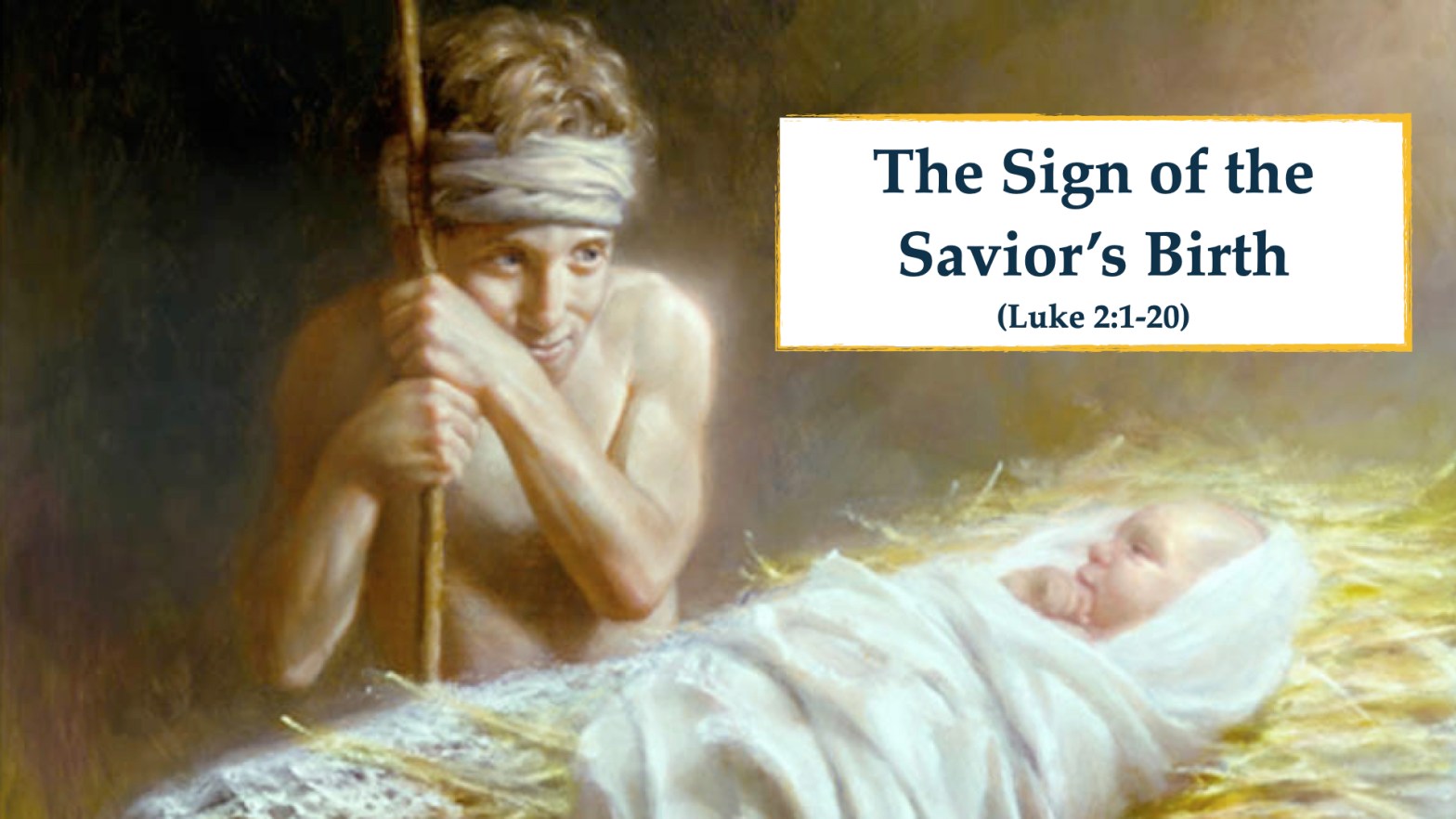
Have you ever thought about how obscene was the power of Caesar Augustus? The description of Jesus’ birth in the Gospel of Luke begins with a man, the emperor of Rome, decreeing that a census is to be taken of people he has never seen, nor will ever meet. Luke 2:1-7 reads, “1 In those days a decree went out from Caesar Augustus that all the world should be registered.” “2 This was the first registration when Quirinius was governor of Syria. 3 And all went to be registered, each to his own town. 4 And Joseph also went up from Galilee, from the town of Nazareth, to Judea, to the city of David, which is called Bethlehem, because he was of the house and lineage of David, 5 to be registered with Mary, his betrothed, who was with child.” 6 And while they were there, the time came for her to give birth. 7 And she gave birth to her firstborn son and wrapped him in swaddling cloths and laid him in a manger, because there was no place for them in the inn.”

Caesar Augustus knows nothing of Joseph or Mary; they are nothing to him. Because of this decree for a census, Joseph and Mary must travel from Nazareth to Bethlehem. This journey means they would have walked roughly 90 miles, with Mary being nine months pregnant. I think the first part of the trip would have been okay. They would have traveled the road down from Nazareth into the Jezreel Valley and then down along the Jordan River. But once they got to Jericho, they would have turned towards Jerusalem and traveled the last 16 miles all uphill. The journey probably took them five days, maybe six. And upon arrival in Bethlehem, there was no proper place for them to stay. The scripture says, “There was no place for them in the inn.”

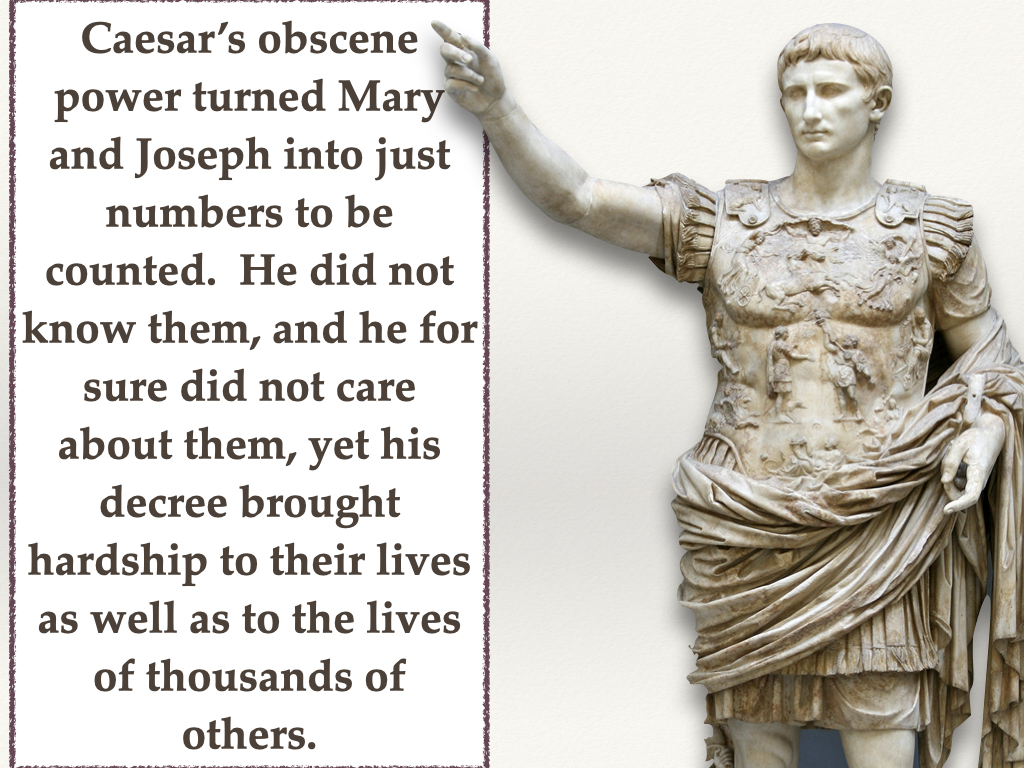
This is very shocking, and it makes me angry. How can there not be a place for a woman about to give birth? Either people know that Mary is pregnant out of wedlock and thus don’t want her staying at her house due to any stigma her presence may bring, or Joseph and Mary are so poor that no one was willing to be inconvenienced for what little they could pay. I think that we can accurately suppose that if Mary and Joseph had money, there would be a room found in the inn. Thus, Mary and Joseph are sent to the barn where Jesus is born, wrapped in cloths, and placed in a feeding trough. Was this barn a part of the house, as some suggest? Maybe. Or was the barn a cave used to shelter animals on cold nights? Maybe. I do not know. Both are possible. The point is that Joseph had to walk 90 miles with a pregnant woman so that she could give birth in a barn because some guy in Rome, 4000 miles away, wanted them to be counted in his census. Caesar’s obscene power turned Mary and Joseph into just numbers to be counted. He did not know them, and he, for sure, did not care about them, yet his decree brought hardship to their lives as well as to thousands of other lives.
I wish today were different, but it is not. The obscene power of this world continues to turn people into numbers. We live in a day when numbers judge a person’s value. What is your test score? How many likes did you get? How many followers do you have? What is your credit score? What is your BMI? How old are you? How big is your bank account? What is your blood pressure? Our value to this world is judged by whatever numbers summarize our lives. Being just a number is deeming, isolating, and makes one wonder, “Do I really matter?”
By the time of Caesar Augustus’ death, people had started to call him divine, even the “son of god.” Unfortunately, today many people think of God in the same way that people of the day must have thought of Caesar. Many people think or feel that God is rather like Caesar. People think that God, like Caesar, is distant and does not care, that he does not listen, and does not know them. That like Caesar Augustus ordering a census that turns people into numbers, God also treats people like numbers, counting every single sin, and placing upon people the burden of the law, all causing people to wonder and ask, “Does God know me? Does he care?”
The Christmas story is the answer to that question. “Yes,” God does care. Not only does he care, he knows you, he knows your name, he knows everything about you. He knows your worries, your fears, your needs, and your dreams. We know that God knows and cares for us to be true in part because Jesus was born in a barn and placed in a manger. The birth of Jesus was shameful. If you want to read about how a birth was supposed to happen, see the story about John the Baptist’s birth at the end of Chapter one of Luke. John had a beautiful birth. John was born into a very good home, a priestly home, filled with family and friends all celebrating. But Jesus’ birth was shameful. Mary and Joseph were alone. He was placed in an animal feeding trough. WHY? I think the answer to this question, in part, is that from the moment of birth, Jesus identifies with us. The story of his birth reflects Jesus entering our shame, isolation, and brokenness.
There is a prophecy in the Bible about the Messiah. It is Isaiah 53, which reads in part, “3 He was despised and rejected by men, a man of sorrows, and familiar with suffering. Like one from whom men hide their faces he was despised, and we esteemed him not. 4 Surely he took up our infirmities and carried our sorrows, yet we considered him stricken by God, smitten by him, and afflicted.” We usually, and I think rightly, read this passage in the context of Jesus’ death. Still, we also need to see that Jesus is fulfilling this prophecy of taking up our infirmities and carrying our sorrows at the time of his birth. At the moment of his birth, he is entering into our sorrows, hurts, isolation, and shame. Jesus enters this world not in isolation from us, but in full knowing and identification with us. This is why I can say that you are not a number to God. Jesus’ birth in a manger is about God knowing you and drawing near to you.
We now arrive at the second part of the passage. Not only does Jesus’ birth mean that God knows you and enters into our world of hurt and sorrows, but that he also saves us. He saves you. God does not just know you as you are; he knows you as you shall be in Christ. He saves you. We are told this plainly in the second part of our story. We read on in scripture, “8 And in the same region there were shepherds out in the field, keeping watch over their flock by night. 9 And an angel of the Lord appeared to them, and the glory of the Lord shone around them, and they were filled with great fear. 10 And the angel said to them, “Fear not, for behold, I bring you good news of great joy that will be for all the people. 11 For unto you is born this day in the city of David a Savior, who is Christ the Lord. 12 And this will be a sign for you: you will find a baby wrapped in swaddling cloths and lying in a manger (Luke 2:8-12).”
I like to imagine these shepherds just minding their own business, maybe enjoying a campfire, and roasting some s’mores. All of a sudden, without warning, an angel shows up with the glory of the Lord shone around him. We read at the end of verse 9 that the shepherds were (to quote the Greek) “terrified by fear.” That is literally what it says, “great fear terrorized them.” But the angel says to the shepherds, “Fear not, for behold, I bring you good news of great joy that will be for all the people. For unto you is born this day in the city of David a Savior, who is Christ the Lord.” Not only does Jesus, God made flesh, fully know, and identify with us in his birth, he also comes to save us. “For unto you is born this day in the city of David a Savior (Luke 2:11).” Notice the language; the angel does not say that the child born will become the savior, but that he is the savior. He is Christ the Lord. What do you think the shepherds understood about this baby being the savior? In answer to that question, please notice what the angel says next.

I think the angel is not only telling these shepherds how to identify the newborn savior but is giving them a prophetic understanding of what it means for this child to be the savior. The angel says to them, verse 12, “And this will be a sign for you: you will find a baby wrapped in swaddling cloths and lying in a manger.” A child wrapped in swaddling clothes and placed in a manger is a sign. A sign of what? We tend to paraphrase this verse in our minds and understand it to be saying, “This is how you will recognize the child; you will find him wrapped in cloths and lying in a manger.” But that is not what this verse is saying. The angel is saying something more than just giving the means or recognition. The angel says that how this child is born and where he is born is a sign. A sign of what? I think the answer is that Jesus, born in the city of David, wrapped in cloths and placed in a manger, is a sign of how he saves, a sign of how Jesus is the savior.
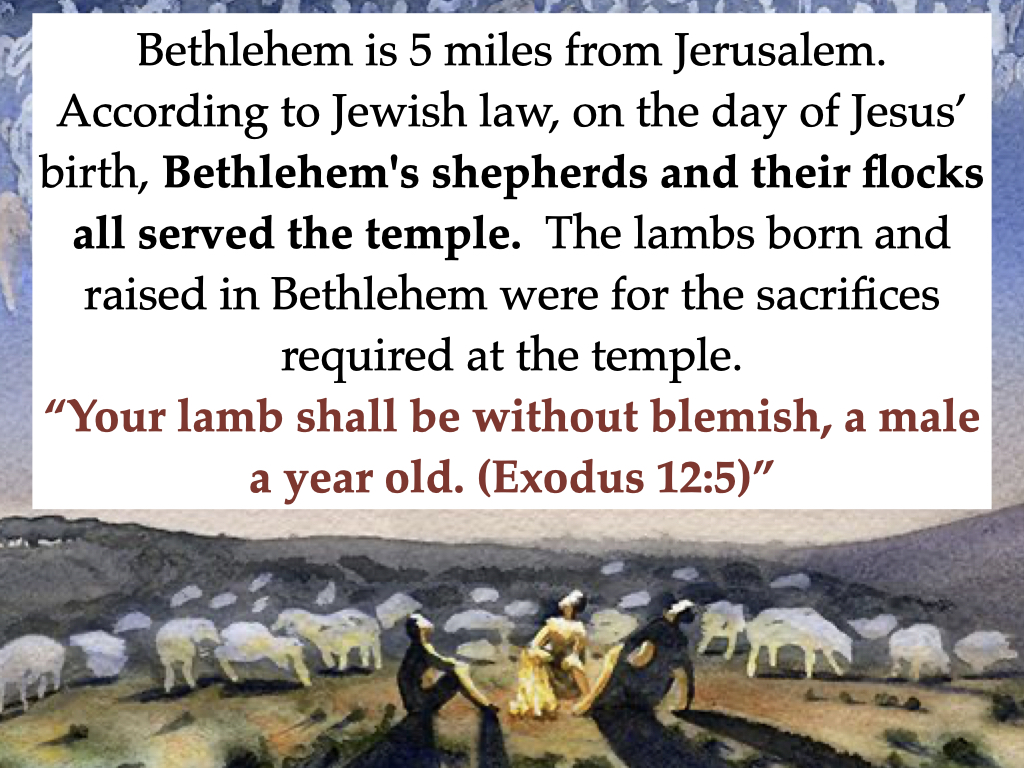
Bethlehem, the town where David is from, sits just over 5 miles from Jerusalem. It is not very far. According to Jewish law, during the days of Jesus’ birth, Bethlehem’s shepherds and their flocks all served the temple. Due to Bethlehem’s proximity to Jerusalem, the lambs raised in Bethlehem were for the sacrifices required at the temple. According to Jewish law known as Mishnah, herds of animals were actually forbidden to be kept anywhere in the land except in the wilderness (Bab K. 7:7; 80a). But the animals for the temple sacrifices could be kept in places like Bethlehem. These shepherds served the temple; they may have even been a priestly order. It was their job to provide to the temple unblemished lambs for sacrifice. We read in places like Exodus 12:5, where instructions for the Passover sacrifice are given, they are told, “Your lamb shall be without blemish, a male a year old.”
Now everything I have said so far, in terms of the shepherds and their flocks in Bethlehem, has reliable historical references, but now I am going to conjecture a little. I looked for a book on how newborn lambs were cared for at birth in the time of Christ; I could not find any book like that. But I found the next best thing, the Tractor Supply Company on how to care for a newborn lamb. It seems that the most dangerous thing to a newborn lamb at birth within the first 24-48 hours is hygiene and hyperthermia. At birth, lambs do not gain any natural immunity passed on from the mother, so cleaning the lamb and placing it in a clean place is critical. And, if it is cool or cold, keeping the lamb warm is vital. Thus, modern-day instructions talk about drying the lamb off with cloths and even wrapping the newborn lamb in cloths if it is cold. Make sure the lamb is placed in an area that is clean with fresh straw and separate it from other lambs. There are further instructions about the lamb bonding with the mother, and so on. Here is the point. I don’t think it is a far stretch to compare the description of baby Jesus wrapped in cloths and placed in a manger as something unfamiliar to these shepherds. In their job to provide unblemished sacrifices to the temple, they may have done exactly the same thing to lambs born on cold nights.

Thus, my conjecture of how the baby wrapped in cloths and lying in a manger is a sign of the savior that these shepherds would understand. The sign that the angel gives these shepherds points to this child, Jesus, as the unblemished lamb of God who takes away the sin of the world. By Jesus’ atoning sacrifice for our sins, he is the savior, and thus the sign points to the nature of his salvation. 1 Peter 1:18-19 reads, “You were ransomed from the futile ways inherited from your forefathers, not with perishable things such as silver or gold, 19 but with the precious blood of Christ, like that of a lamb without blemish or spot.” Why was Jesus born in a place for sheep? Where else would we expect the Lamb of God to be born. The Lamb of God who takes away the sins of the world. The unblemished Lamb of God whose righteousness becomes ours. The Lamb of God whose death offers us eternal life. The Lamb of God who is despised and rejected. Reading from Isaiah 53:5, “ But he was pierced for our transgressions; he was crushed for our iniquities; upon him was the chastisement that brought us peace, and with his wounds we are healed. …7 He was oppressed, and he was afflicted, yet he opened not his mouth; like a lamb that is led to the slaughter.” Jesus is the lamb of God.
Why would God do such a thing? The angels tell us why. Going back to our text, Luke 2:13 and 14 say, “And suddenly there was with the angel a multitude of the heavenly host praising God and saying, “Glory to God in the highest, and on earth peace among those with whom he is pleased!” The Christmas story is the story of God entering our world, entering our lives, and entering our shame and isolation. But God does not just know us or identify with us; he saves us. He saves us by dying for us as the Lamb of God. And this action of entering our world, identifying with us, and dying for us is how peace is found. Real peace is found only through forgiveness and reconciliation with God. How should we respond to such a God? First, we should trust him. That is faith. And second, we should praise him and give him thanks. Let us give him all glory and praise. Glory to God in the highest. Amen.
Pastor Trent Eastman – December 20, 2020 – New Baptist Church
 Concerning the Word of Life