

Something has to change. Today is the first Sunday in the new year, 2021. Today, most of us would like this year to be a different sort of year than last year (2020). As Christians, followers of Jesus, there are certain things we should be in prayer for as we start this new year. We should pray for the Covid sickness and virus to be gone. As a church, community, and nation, we should pray that we can return to gathering together. I long for that. And I think we should pray for a spiritual revival in our nation and world. And by spiritual revival, I mean that people are transformed by a relationship with Jesus. To me, that is the mark of revival. Revival is a season when people are radically transformed through fellowship with Jesus. Sometimes, evidence of a revival may be marked by a number of baptisms, but what we are looking for is not an event but people being truly transformed. And by transformed, I mean that people across this country and our world live with a higher level of kindness, a greater trust in the Lord, a more infectious joy, the habitual practice of patience and grace, and a deep longing for personal holiness. To me, a spiritual revival is about a movement of God’s Spirit among us, causing the lives of many people to draw near to Jesus and so be transformed. That is the change I pray to see in 2021.
In 2 Corinthians, Paul describes the type of change and spiritual revival that I am talking about as moving from one degree of glory to another. He says in 2 Corinthians 3:17 and 18, “Now the Lord is the Spirit, and where the Spirit of the Lord is, there is freedom. 18 And we all, with unveiled face, beholding the glory of the Lord, are being transformed into the same image from one degree of glory to another. For this comes from the Lord, who is the Spirit.” To say this differently. God is at work in this world by being at work in you. His work is your being changed, transformed from one degree of glory to another. The Lord is making you ready for heaven. He is preparing you to stand in the presence of his glory. He is working in you a type of life that pleases and glorifies Him and, in return, gives you joy.

This transformation from one degree of glory to another is often described or named in different ways. People sometimes call it spiritual formation, personal growth, drawing closer to the Lord, maturing, growing in holiness, walking with Jesus, becoming Christlike, or sanctification. All of these descriptive terms are pointing to the most important change you should be seeking in 2021. Above and beyond any other new year’s resolution or goal, you should desire to be like Jesus, to be so transformed by the renewal of your mind that you walk as he walked, you love as he loved, you forgive as he forgave.
Paul says in Philippians 2:12-13, “Work out your salvation with fear and trembling, for it is God who works in you, both to will and to work for his good pleasure.” Working out your salvation is not the same as working for your salvation. You are saved in Christ the moment you have believed upon him. Notice though in vs. 13 again, “For it is God who works in you.” When Paul talks about “working out your salvation,” he means for you to welcome God’s work into your life, to agree with God’s work in your life, to be willing for God to not only change you but to also put to death those things that do not belong in His presence nor belong in you.
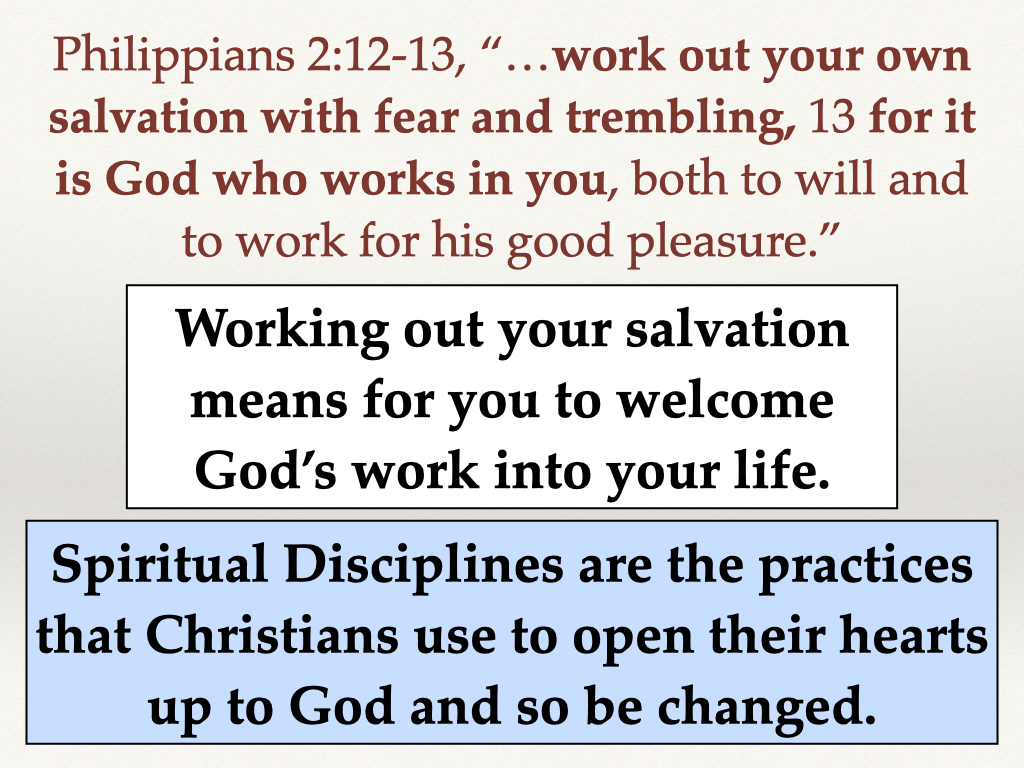
The name that has been given to the ways that we open our lives up to the work of God is “spiritual disciplines.” Spiritual Disciplines are those practices that people keep daily that open their hearts up to God and his work in changing us. Some of the most important spiritual disciplines include reading scripture, prayer, study, praise, gratitude, fellowship, and obedience. During January, my goal is to talk about some of these spiritual disciplines as we begin a new year.

Today though, the spiritual discipline I want to talk about is the discipline of self-examination or self-reflection. Scripture tells us in 1 Corinthians 11:28, “Let a person examine himself, then, and so eat of the bread and drink of the cup.” Self-examination is the desire to see our lives as God sees them. Self-examination is the practice of hearing God’s Spirit speak into our lives. Jesus, the shepherd of our souls, was constantly pushing people to see themselves in relation to truth, in relationship to him. He often helped people examine their hearts through the asking of questions. Jesus asked a lot of questions. In the four gospels, there are 339 questions asked by Jesus. Yes, certain stories are repeated in some of the gospels; thus, some of those questions are duplicates, but even if we look at just the unique questions, the number is near 300. Jesus asked questions and engaged people, probed their hearts, and helped people see things in their lives that kept them from knowing and following him.
I read through all of these 339 questions, and my heart was gripped and convicted by many of them. Yes, there is a historical context and situation for every question, but they took on a very personal and present immediacy in hearing only the questions. Thus, the structure of this morning’s message as we begin the new year. I am going to ask you four questions that represent four categories of relationships. The four categories are this: your relationship with God, your relationship with self, your relationship with your church, and your relationship with your vocation. In each of these categories, I have listed some of the questions asked by Jesus. His questions are reveling, they open the soul, and thus my request is for you to use these questions as a tool for personal self-reflection.

The first category I would like you to examine is your relationship with God. How will you glorify and enjoy God more in 2021? Do you enjoy God? Is he your joy? I think that the greatest and most transformative change that can happen in your life is for you to simply enjoy God more. I have listed some questions asked by Jesus that I think speaks to a person’s enjoyment or lack of enjoyment of God.
- “How can you believe since you accept glory from one another but do not seek the glory that comes from the only God?” (John 5:44). What powerful question, Jesus is saying that the source of our doubts and struggle to glorify and enjoy God is because we are more concerned about pleasing people than we are about pleasing God.
- “Who is it you are looking for?” (John 20:15b). Enjoying God is about enjoying the person and presence of the Lord, not his benefits as great as those benefits may be. If your enjoyment of God is tied to how blessed you feel, you probably do not have a high enjoyment of God. On the other hand, if you know what it means to enjoy him, you know that there is no blessing in this life that compares to Him.
- “Do you understand what I have done for you?” (John 13:12b). If you are struggling to enjoy God and do not know how to go about doing it, I recommend that you look at the cross.
- “Do you love me more than these?” (John 21:15b). In this question, I hear the hierarchy of love. Where does your love for God rank in comparison to your other loves? Having a right order of love is key to glorifying and enjoying God.
- “What do you want me to do for you?” Jesus asked him. (Mark 10:51) and adding to that question, Jesus asks, “Do you believe that I am able to do this?” (Matthew 9:28b). Central to enjoying God is trusting and depending upon him. The place that your trust and dependence upon the Lord are most evident is in your prayer life. Are you bold in your prayer life, or are you timid? Do you take your deep worries and concerns to him? Being able to do so is key to glorifying and enjoying God.

The second category of reflection your relationship with self. “In what area of your life do you need and seek healing?” This area of life could be a sin, or an addiction, maybe a vice. It could also be an attitude like a critical heart or an inability to give thanks. It could also be a very real physical problem that you need God to speak into. Here are some questions that Jesus asked that relate to your relationship with yourself.
- “Do you want to get well?” (John 5:6b). It is a good question.
- “Why do you look at the speck of sawdust in your brother’s eye and pay no attention to the plank in your own eye?” (Matthew 7:3). We are experts in seeing problems in others but do not do such a good job in ourselves. Why is that? What are you doing to discover the plank in your eye?
- He replied, “You of little faith, why are you so afraid?” (Matthew 8:26). I love that song by Zach Williams; Fear Is a Liar. The reframe of the song reads – Fear he is a liar. He will take your breath. Stop you in your steps. Fear he is a liar, He will rob your rest, Steal your happiness. Cast your fear in the fire, Cause fear he is a liar. What fears are keeping enslaved?
- Knowing their thoughts, Jesus said, “Why do you entertain evil thoughts in your hearts?” (Matthew 9:4). Notice the question; he does not ask, “Why do you have these evil thoughts,” but “ Why do you entertain them.” “Why do you keep them and not cast them out?” Entertaining evil thoughts shows an area of life that needs to be healed. What needs to be healed in your life?
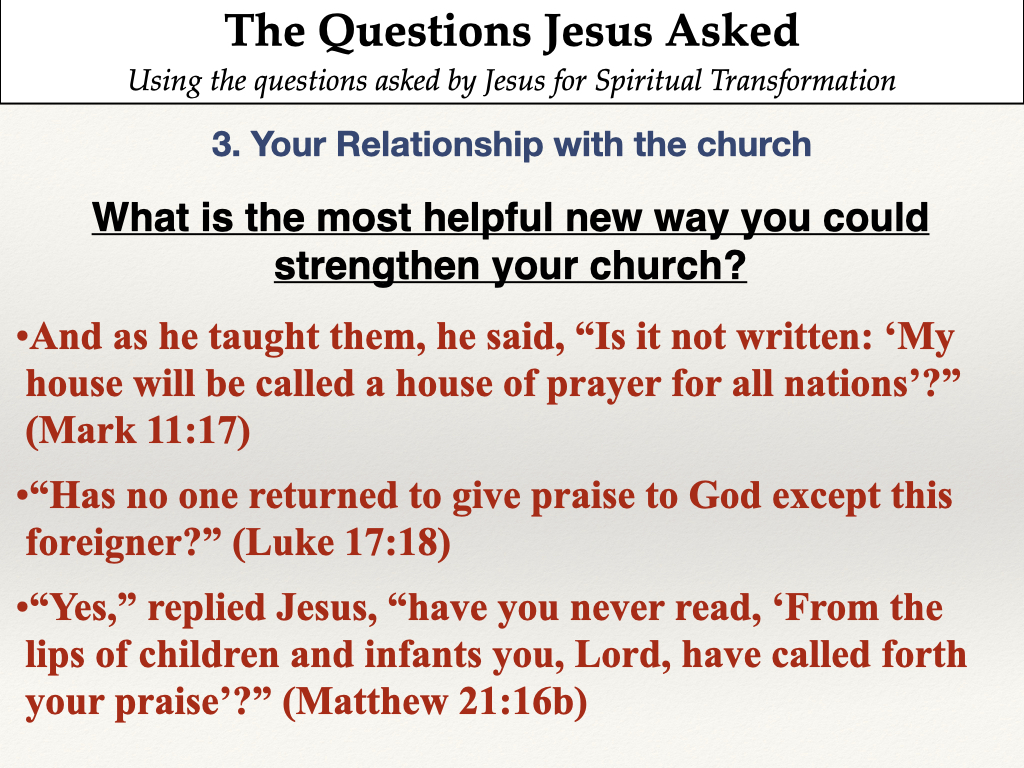
The third category, the relationship you have with your Church: What is the most helpful new way you could strengthen your church? The church is filled with sinful people, and if you are around it long enough, you will get some dents and dings. Yet, the church is the body of Christ in this world, and it is the bride of Christ loved by God. Jesus made the church his witness in this world, his presence among the brokenness of this world. The church is God’s way that God’s grace is manifested and proclaimed. Thus, What is the most helpful new way you could strengthen your church? Here are some of the questions that Jesus asks in this regard:
- And as he taught them, he said, “Is it not written: ‘My house will be called a house of prayer for all nations’?” (Mark 11:17). We are here for a purpose, and that purpose is not to be a social club. We are here to praise the Lord, proclaim the gospel, and make Christ known to this world. We are here to welcome people into a relationship with God. We have a purpose.
- “Has no one returned to give praise to God except this foreigner?” (Luke 17:18). This question gripped me. The church is a place where we gather and meet together to give praise to God. If God has done something extraordinary in your life, how can you not praise him rightly?
- “Yes,” replied Jesus, “have you never read, ‘From the lips of children and infants you, Lord, have called forth your praise’?” (Matthew 21:16b). I read this question and thought, how will children and infants praise the Lord if they are never taught? If you have any concern over our country and culture and what is happening, I do not know of a better way to facilitate change in our world than to raise our children and teach them about Jesus. We need to be faithful now, not just for those present with us, but for those who are yet to come.
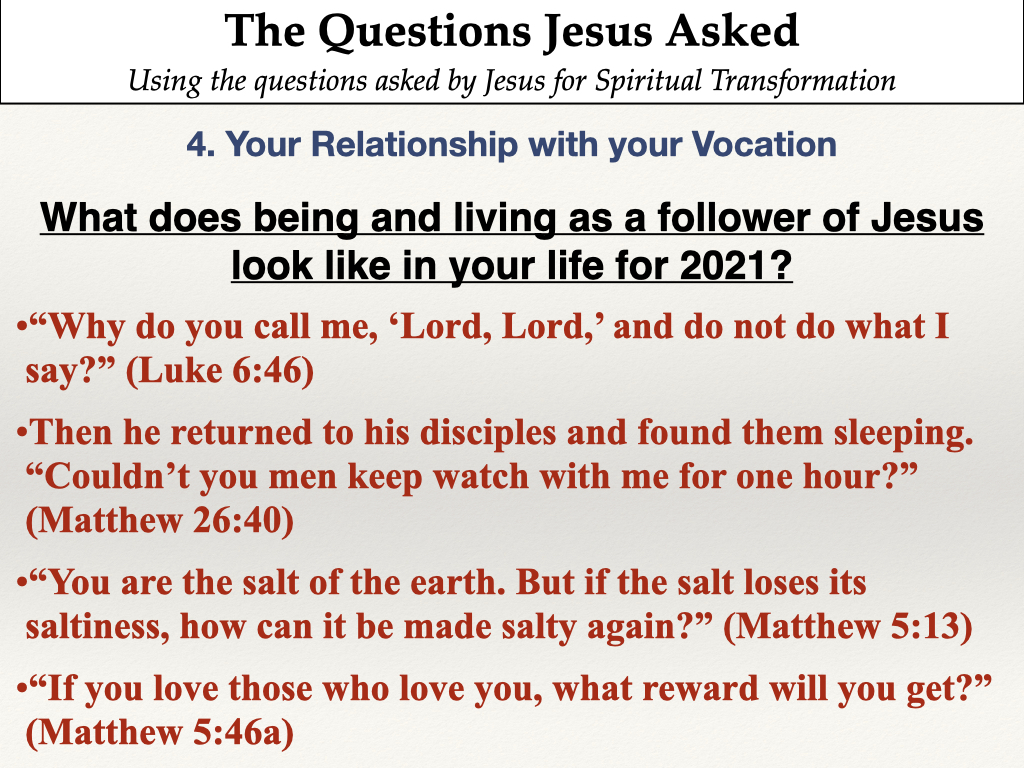
The fourth category, your relationship with your vocation: What does being and living as a follower of Jesus look like in your life for 2021? The word vocation does not mean job. Vocation means calling. Maybe your vocation is your job; maybe it is not. The point is, how are you responding and being faithful to God’s call upon your life? Everyone who is a Christian is called by God regardless of your age or your season in life. I think a person’s calling begins and is discovered in scripture, which is a call to follow Jesus. Here are some questions that Jesus asks in regard to following him.
- “Why do you call me, ‘Lord, Lord,’ and do not do what I say?” (Luke 6:46). That question does not need commentary from me.
- Then he returned to his disciples and found them sleeping. “Couldn’t you men keep watch with me for one hour?” (Matthew 26:40). That question of Jesus always strikes me. It is a question about faithfulness and commitment.
- “You are the salt of the earth. But if the salt loses its saltiness, how can it be made salty again?” (Matthew 5:13). Being salty is about making a difference in this world. A salty person is not anxious when others are fearful, or is patient when others are demanding, or is grateful when others are complaining. But if a person acts just as the world acts, how will the world know God?
- “If you love those who love you, what reward will you get?” (Matthew 5:46a). Our vocation as followers of Jesus is to love. Not just love those who are easy to love but also love those who are not. What does that look like for you?
I ask that you take these questions home and ponder on them. Pray over them, and give an answer to them. Some of the questions may be uncomfortable; I hope so, and that is ok. The purpose of these questions is not to get action out of you or get you to do something. The purpose is to open your heart to God’s work in you. The purpose is to behold the glory of the Lord and be transformed into the same image from one degree of glory to another. Amen
Pastor Trent Eastman – January 3, 2021 – New Baptist Church
 Concerning the Word of Life