The book of 2 Timothy in the Bible is the last letter that Paul writes. He writes it to Timothy, a man he loves and calls his spiritual son. Paul is in prison and knows that death is not far away for him. In this letter, he requests Timothy to come to him before he dies, but we do not know if Timothy arrived in time. I like to think that he did. Since this is Paul’s last letter and possibly his last words to Timothy, what Paul says are things closest to his heart. The words that Paul writes to Timothy are words of encouragement. Paul reminds Timothy of the Holy Spirit’s gift given to Timothy, which I believe was the gift of teaching. He reminds Timothy of the great privilege and responsibility of being entrusted with the Gospel (Good News) of Jesus Christ, and he tells Timothy to endure. In 2 Timothy 2:10, Paul says, “Therefore I endure everything for the sake of the elect, that they also may obtain the salvation that is in Christ Jesus with eternal glory.” In our scripture today (2 Timothy 2:14-26), Paul directs Timothy to one of the most important resources available to him for both strength and instruction; God’s Word.

2 Timothy 2:14-26 – 14 Keep reminding them of these things. Warn them before God against quarreling about words; it is of no value, and only ruins those who listen. 15 Do your best to present yourself to God as one approved, a workman who does not need to be ashamed and who correctly handles the word of truth. 16 Avoid godless chatter, because those who indulge in it will become more and more ungodly. 17 Their teaching will spread like gangrene. Among them are Hymenaeus and Philetus, 18 who have wandered away from the truth. They say that the resurrection has already taken place, and they destroy the faith of some. 19 Nevertheless, God’s solid foundation stands firm, sealed with this inscription: “The Lord knows those who are his,” and, “Everyone who confesses the name of the Lord must turn away from wickedness.” 20 In a large house there are articles not only of gold and silver, but also of wood and clay; some are for noble purposes and some for ignoble. 21 If a man cleanses himself from the latter, he will be an instrument for noble purposes, made holy, useful to the Master and prepared to do any good work. 22 Flee the evil desires of youth, and pursue righteousness, faith, love and peace, along with those who call on the Lord out of a pure heart. 23 Don’t have anything to do with foolish and stupid arguments, because you know they produce quarrels. 24 And the Lord’s servant must not quarrel; instead, he must be kind to everyone, able to teach, not resentful. 25 Those who oppose him he must gently instruct, in the hope that God will grant them repentance leading them to a knowledge of the truth, 26 and that they will come to their senses and escape from the trap of the devil, who has taken them captive to do his will.”
In many ways, this book of 2 Timothy reminds me of the first chapter of Joshua. The book of Joshua begins with the death of Moses and Joshua called by God to lead the people into the promised land. Like Paul does to Timothy, we see the Lord encouraging Joshua. God says to Joshua, “5 No man shall be able to stand before you all the days of your life. Just as I was with Moses, so I will be with you. I will not leave you or forsake you 6 Be strong and courageous, for you shall cause this people to inherit the land that I swore to their fathers to give them. 7 Only be strong and very courageous, (Now notice that the Lord holds up scripture, the Word of God, as being the truth that Joshua is to follow) being careful to do according to all the law that Moses my servant commanded you. Do not turn from it to the right hand or to the left, that you may have good success wherever you go. 8 This Book of the Law shall not depart from your mouth, but you shall meditate on it day and night, so that you may be careful to do according to all that is written in it. For then you will make your way prosperous, and then you will have good success. 9 Have I not commanded you? Be strong and courageous. Do not be frightened, and do not be dismayed, for the LORD your God is with you wherever you go (Joshua 1:5-9).” These instructions from the Lord to Joshua are also a summation of the entire book of 2 Timothy. Paul, knowing that he is departing, encourages Timothy and points him to God’s Word.

WHY? Why is God’s Word, the Bible, so important? The answer is simple; Through the Bible, truth is revealed, God is made known, our lives are defined, and we learn the wisdom of living rightly. And, we can add, there is power in God’s word. Power to convict, power to heal, power to instruct, power to reveal. God’s Word, the Bible, has power. Paul does not say this clearly in our passage today, but he will in Chapter 3 of 2 Timothy when he says, “All Scripture is God-breathed and is useful for teaching, rebuking, correcting and training in righteousness, so that the servant of God may be thoroughly equipped (complete) for every good work (2 Timothy 3:16-17).” People today take this verse to talk about how scripture came into existence. The phrase “God-breathed” in Greek is one word, and it is a noun, not a verb. Paul is not describing HOW scripture came to be, but what IS scripture. The Word of God is God-breathed. This means that the Spirit of God is at work in this book, causing this book to not only be able to teach and correct but (look at vs. 17) to make someone complete and equipped to do good. That is the power of God at work in His Word.
In our passage today, Paul is instructing Timothy to be a person of God’s word. Reading again verse 15, “Do your best to present yourself to God as one approved, a workman who does not need to be ashamed and who correctly handles the word of truth.”
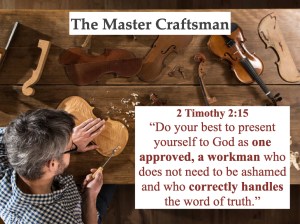
I love the image Paul uses to describe what it looks like to correctly handle the Word of Truth. He is using the image of a master craftsman (the approved workman). A master craftsman is a person who can make something beautiful from very simple tools. Imagine a stonemason who has a hammer and a chisel. A stonemason looks at a piece of marble, studies its lines, and after a few simple taps, that slab of marble opens wide, clean, and straight. I have seen it done before; it is remarkable. If you were to give me the hammer and chisel and set me to work on the piece of marble, the result would be rubble. A master craftsman has the skill to make something beautiful. (Note: Paul was a master craftsman called a tentmaker. He is using this skill as an illustration of how rightly handle the scriptures).
This is the image that Paul is using in his instruction to Timothy. Be a master craftsman regarding God’s Word. Be skilled in how you use it. Our scripture today defines what a master craftsman of God’s Word looks like and what one does not look like. Let’s begin first with what a Master Craftsman DOES NOT look like. Here are the passages in our scripture today that describe what a Master Craftsman of God’s Word does not look like.
- (Verse 14) quarreling about words.
- (Verse 16) godless chatter.
- (Verse 22) evil desires of youth (quick to be angry and argumentative).
- (Verse 23) foolish and stupid arguments.
These descriptions of what an unskilled workman of God’s Word looks like are descriptions of Paul before he met Jesus. Paul, as a Pharisee, was more zealous for the law than anyone else, and he used scripture as a means to show himself to be righteous. He took God’s word and used it as a means to place people into bondage and not into freedom. And, after he met Jesus, many legalists misused God’s word to persecute him. Paul knew well how the Word of God is misused. When Jesus overturned tables in the temple, I think his anger was not only about the misuse of God’s house but also the misuse of God’s Word. The religious leaders used scripture to hurt people, shame people, separate people, and even kill people. Jesus was crucified because the Sanhedrin misused God’s Word.
The same is true today. There are many leaders, pastors, politicians, and others who mishandle the Word of God. They use the Bible as a means to justify their righteousness, to shame others, to manipulate and control people, and to glorify themselves. Some examples of the misuse of scripture today would include,
- Using scripture to support Christian Nationalism.
- Using scripture to allow sin or abuse to continue.
- Using scripture to control others.
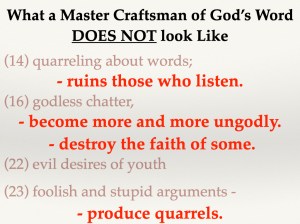
In our passage today, Paul gives us an example of people who are wrongly using God’s Word. Verse 17, “Among them, are Hymenaeus and Philetus, 18 who have swerved from the truth, saying that the resurrection has already happened. They are upsetting the faith of some.” I think (and this is conjecture on my part) that what Hymenaeus and Philetus are preaching is what we call today “the prosperity gospel.” The prosperity Gospel is this, “that right now you are saved, a member of heaven and all of heaven’s benefits are yours now for the asking, you just got to ask and believe. What are heaven’s benefits? Well, we are told in Revelation 21:4 that there will be no more tears, death, or pain. And, going to verse 21, there are streets of gold. Thus, according to the prosperity gospel, if you are saved, you can call upon these heavenly benefits of health and wealth now.” Now I do believe that in heaven, as it reads in Revelation 21:4, “He will wipe away every tear from their eyes, and death shall be no more, neither shall there be mourning, nor crying, nor pain anymore, for the former things have passed away.” But that description of heaven takes place in heaven, on the other side of the resurrection, not on this side. But Hymenaeus and Philetus are saying that the resurrection has already happened; thus, those benefits are available now, in this age, at this time. This is what I understand Paul means when he says, “saying that the resurrection has already happened.” They are misusing God’s Word, and there are consequences to the wrong handling of scripture. Paul names the consequences of those who wrongly handle God’s Word. Those who wrongly handle God’s word;
- (Verse 14) ruins those who listen.
- (Verse 16) become more and more ungodly.
- (Verse 18) destroy the faith of some.
- (Verse 23) produce quarrels.
Therefore it is so important for Timothy to be a workman approved (master craftsman) of God’s Word. In our passage today, Paul says three things about the master craftsman of God’s Word. He tells Timothy
- How to become one.
- What a master craftsman does
- And Why (the goal) of the master craftsman.
How to become a master Craftsman of God’s Word (19-21). “19 But God’s firm foundation stands, bearing this seal: “The Lord knows those who are his…” In verse 19, Paul is quoting Numbers 16, and it is very interesting. In Numbers 16, a group of Israelites, mostly priests, led by a Levite named Korah, come to Moses and Aaron and say to them, “we want your job; we are holy just like you.” Moses responds to them, “you are an idiot; the Lord knows those who are his.” Paul is quoting the story of Korah’s Rebellion because it is about a group of people who think and say they are qualified, skilled at the things of God, and therefore expect to speak with authority and be given responsibility. And God says to this group of people, “NO.”
The same thing is happening today. Nearly every person thinks to themselves (and I am talking Christian and non-Christian), “I have as much ability and authority to read, interpret and apply scripture as the next person.” One of my great annoyances is when I am listening to someone on the radio or tv who says something like this, “while, when I was a child I went to Sunday School, and the Bible says that you are not supposed to judge other people” or something like that. And that speaker usually goes on to describe how Christians are not following the Bible, and they base their theological skill or authority on going to Sunday School when they were seven years old. That is not how one becomes a master craftsman. You cannot just pick it up and expect to know how to use God’s word rightly.
So does this mean that to become a master craftsman of God’s word, a person needs to go to seminary, read through the Bible 20 times, and have half of it memorized? NO! That is not how one becomes a master craftsman of God’s word. To become a master craftsman of God’s Word, something must happen IN you. Paul describes what must take place in a person to learn the right handling of God’s word. He says in verses 19-21, “Let everyone who names the name of the Lord depart from iniquity. 20 Now in a great house there are not only vessels of gold and silver but also of wood and clay, some for honorable use, some for dishonorable. 21 Therefore, if anyone cleanses himself from what is dishonorable, he will be a vessel for honorable use, set apart as holy, useful to the master of the house, ready for every good work (2 Timothy 2:19-21).”
To be a Master Craftsman of God’s Word requires you to flee from sin. You are not able to rightly use God’s word if God’s word has not been rightly used on you. If your life has not been shaped by scripture, how can you expect to use it to shape others? And, when Paul talks about the vessels of the house that we are to cleanse ourselves from, I think he is talking about the motivations of the heart. Things like wanting to have power, wanting to be in control, issues of pride and ego, and selfishness. When people with these types of heart motivators pick up the Bible, they use the Bible as a means to get power, gain or keep control, and massage their own egos. Paul says, “NO, if you want to be skilled at handling the Word of God, you cannot use it as a means to glorify yourself, but rather God’s Word is to be used as a way to love others, according to God’s purposes.” God at work in your life is how one becomes a Master Craftsman of God’s Word.

We also read in verse 22 what the Master Craftsman of God’s word does. In verse 22, we read, “pursue righteousness, faith, love, and peace, along with those who call on the Lord from a pure heart.” A master craftsman handles God’s Word with Love. This includes practicing what they are preaching (righteousness) and trusting God’s Word (faith). There is integrity with who they are and with God’s Word. I think the overarching motivator here is love. I think when Paul talks about faith and love and peace, I think he has in his mind in 1 Corinthians 13:1-2, where he says, “1 If I speak in the tongues of men and of angels, but have not love, I am a noisy gong or a clanging cymbal. 2 And if I have prophetic powers, and understand all mysteries and all knowledge, and if I have all faith, so as to remove mountains, but have not love, I am nothing.” A Master Craftsman handles God’s Word with Love.
Reading on, we see what it looks like to love when handling God’s Word. Verses 23 – 25, “23 Don’t have anything to do with foolish and stupid arguments, because you know they produce quarrels. 24 And the Lord’s servant must not quarrel;” A master craftsman does not just take the hammer and chisel and hit the stone, but instead, he loves. Here is love, “instead, he must be kind to everyone, able to teach, not resentful. 25 Those who oppose him he must gently instruct.” This is how the power of God’s Word is to be administered. Kindness, not being resentful, gently, able to teach.
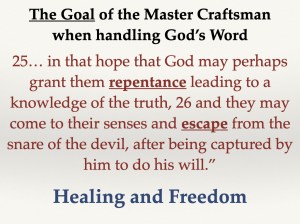
Finally, we come to the goal – the beautiful object that the master craftsman of God’s Word produces. Here is the goal, verses 25 and 26. “That God may perhaps grant them repentance leading to a knowledge of the truth, 26 and they may come to their senses and escape from the snare of the devil, after being captured by him to do his will.” Notice what the goal is not. The goal of the workman approved is not to win an argument. It is not to justify yourself. It is not to shame, manipulate, or control, but the goal is to bring healing and freedom. The master craftsman of God’s Word handles the Word in such a way as to lead others into healing and freedom.
- The word repentance is a word of healing. Repentance means turning around, changing direction, thinking, and living in a new way. Repentance is not simply acknowledging that one has done wrong (that is not the summation of the goal), but rather repentance is recognizing the wrong (many times in grief) and then genuinely deciding “I want to be well, I want to be whole, I want to know the truth, follow the truth, and be a person of truth. I want to be a person of God’s will over and above my will.” That is repentance. And it is in this repentance that the healing of the soul begins, causing the heart and the eyes and the ears to open and see the truth. Repentance is how a life begins to be healed and is one of the goals of the Master Craftsman. This healing leads to the next part of the goal that we should have in the right handling of the Word.
- Freedom. Verse 26 again, “and they may come to their senses (there is the healing that comes from repentance) and escape from the snare of the devil, after being captured by him to do his will.” In a previous letter to the church of Ephesus (note, Timothy is the pastor of the church in Ephesus), Paul tells them that “For we do not wrestle against flesh and blood, but against the rulers, against the authorities, against the cosmic powers over this present darkness, against the spiritual forces of evil in the heavenly places (Ephesians 6:12).” There is a Spiritual battle that we are in. And since we are in a spiritual battle, we are to use the tools God has given to us. We are to be people who rightly handle the Word of God so that others may be led out of bondage into real freedom, no longer enslaved to the spiritual forces of this world (Galatians 4:3). The word freedom is thrown around a lot in today’s discourses. Most understand that word to mean to do whatever one wants. A more biblical understanding of freedom is to do as one ought, live according to God’s purpose, and be a part of His work. That is freedom. Freedom is to grow in virtue, to gain wisdom, to do what is right and good. This freedom and healing is the goal of people who are skilled master craftsmen of God’s Word. Therefore, vs. 15 again, “Do your best to present yourself to God as one approved, a worker who has no need to be ashamed, rightly handling the word of truth.” (Amen)

Sermon was preached by Pastor Trent Eastman on September 12th, 2021 at New Baptist Church of Huntington West Virginia.
 Concerning the Word of Life