In all of Paul’s letter, except for this letter to the Galatians, immediately after his salutation he always greets the recipients of the letter, giving thanks for them and blessing them. For example, to the church of Roman he says “First, I thank my God through Jesus Christ for all of you, because your faith is proclaimed in all the world (Romans 1:8).” Likewise, to the church of Corinth he says, “I give thanks to my God always for you because of the grace of God that was given you in Christ Jesus… (1 Corinthians 1:1–10).” This is not how Paul begins his letter to the churches of Galatia.
Paul is fighting for the gospel and he is so eager to begin that he jumps right into the ring like an eager fighter at the start of the bell. Immediately after his salutation we read, “I am astonished that you are so quickly deserting him who called you in the grace of Christ and are turning to a different gospel— not that there is another one, but there are some who trouble you and want to distort the gospel of Christ. But even if we or an angel from heaven should preach to you a gospel contrary to the one we preached to you, let him be accursed. As we have said before, so now I say again: If anyone is preaching to you a gospel contrary to the one you received, let him be accursed (Galatians 1:6-9).”
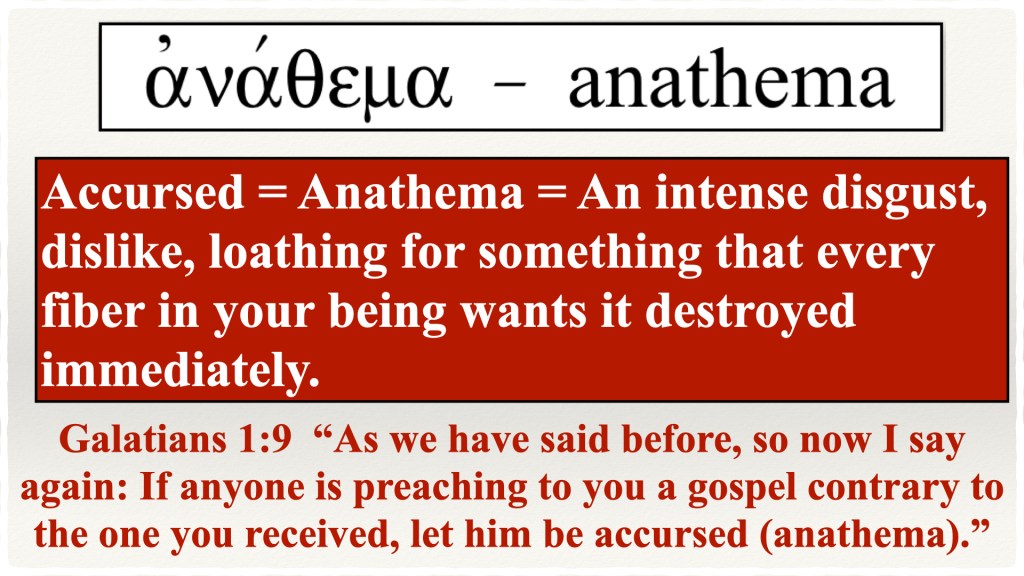
I need to pause here and define this word translated above as “accursed.” In Greek, the word that Paul is suing is “Anathema.” It is the strongest, most potent word that Paul knows. In fact, there is no word in our common English usage that comes close to what it means. Anathema means – Having such an intense disgust, dislike, loathing for something that every fiber in your being wants it destroyed immediately. There is no patience or tolerance towards that thing – whatever it may be. It is so disgusting that it must be destroyed. For example, to many people snakes are an anathema. If a snake entered their house the people inside would have such a high level of disgust and loathing for that snake that it would need to either leave or be destroyed. There would be no tolerance or sharing of space. That is Anathema. You may feel this same way towards snakes, spiders, mice, or bats. Many years ago – I was in a large room full of big burly football players. Towards evening time a bat flew it that resulted in all of these big men screaming and shouting – and the entire energy of the room was focused on one thing – destroy that bat. Which, it ultimately was done by a pizza box. WHY – because that bat was an anathema – it was loathed, disliked, disgusting to the point that it had to be destroyed. This is the language that Paul is using for people who are distorting the gospel and thus destroying the church. “As we have said before, so now I say again: If anyone is preaching to you a gospel contrary to the one you received, let him be anathema / accursed (1:9).”
The word “anathema” is not a word that Paul uses. Normally, in most of his letters he deals with all kinds of theological and relational problems. He writes about people speaking in tongues, and people being remarried, and beliefs about the end times, and baptism, and coming together for communion, instructions for worship and the various roles of elders and deacons and so forth. Paul gives a lot of instruction, and in all of it he does it with great patience and kindness. I love his wisdom and instruction to Timothy when he advises him about those that who oppose Timothy wrongly , he says, “And the Lord’s servant must not be quarrelsome but kind to everyone, able to teach, patiently enduring evil, correcting his opponents with gentleness. God may perhaps grant them repentance leading to a knowledge of the truth (2 Timothy 2:24–25 ESV).” This is how we are instructed to care for people who are wrong, or are in sin, or that we disagree with – with gentleness, and patience, able to teach. But not in regard to the truth of the gospel. When the Gospel is being preached and taught wrongly – Paul gives no quarter. There may be many things in the Christian faith that you and I can have a difference of opinion on, can disagree on – but the gospel is not one of them. For if the gospel becomes obscured, watered downed, distorted, or perverted it ceases to be the means of salvation and it destroys the church.
A distorted gospel that is destroying the church is what Paul says in vs 7, “there are some who trouble you.” That word for “trouble” can mean to destroy. There are some who are destroying you by a false gospel. That is why he is fighting. Going back to vs 6 we read “I am astonished that you are so quickly deserting him who called you in the grace of Christ.” Walking in a false gospel is a desertion, a rejection, of Jesus Christ. A desertion of the one who loves you, who gave himself for you. That is why Paul is fighting – why he is coming out swinging, fighting for the gospel.
- A false gospel destroys churches and lives.
- A false gospel is desertion of Jesus.
Distorting the Gospel: The issue is very clear. People have come in behind Paul and have spread a false Gospel. In vs 7 we are given a very strong hint as to what is this false gospel. The word that Paul uses in vs 7 to describe what these false teachers are doing to the gospel is very revealing, very helpful to us in understanding the problem.
- In the ESV the word used is distort. “and want to distort the gospel of Christ.”
- In the KJV and the NIV word is pervert. “And would pervert the gospel of Christ.”
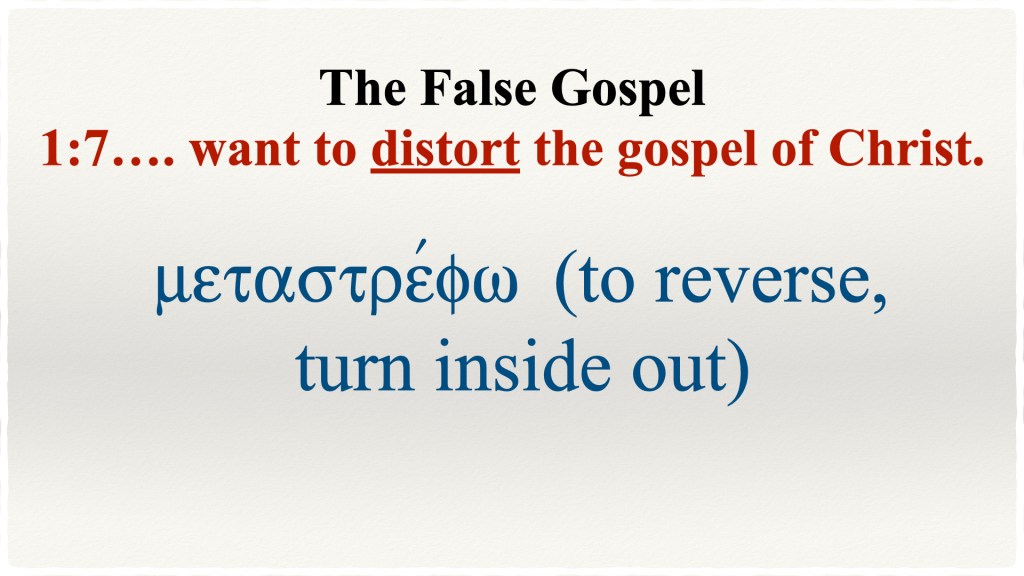
These are not wrong or bad translations, but they lack a certain descriptive quality that I believe describes what is happening. The Greek word is – μεταστρέφω (metastropeho). Means a reversal, a turning inside out. A changing of order. This is what the false teachers are doing to the gospel.
Let us first remind ourselves of the gospel. Last week, looking at Paul’s salutation to the Galatians I highlighted two words that can be used to describe the good news. These words are Grace and Peace.
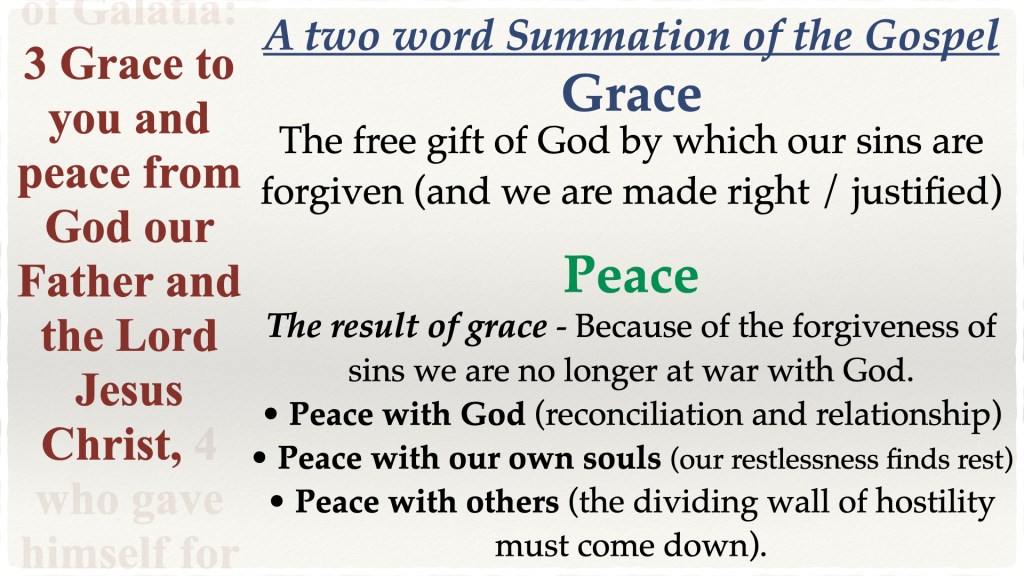
- Grace is the free gift of God by which our sins are forgiven. Vs 4 tells us what this gift is – Jesus Christ,who gave himself for our sins.
- Peace is the result of this free gift of grace given to us. Which can be defined by being – deliver us from the present evil age (1:4) Because of God’s grace – we have peace with God (we are brought into a relationship with him), we have peace with ourselves (there is healing in us, a wholeness and holiness), and peace with others as seen in the church.
Those are the words I focused on last week. BUT – we can equally use two other words to describe the gospel. Justification and Sanctification.
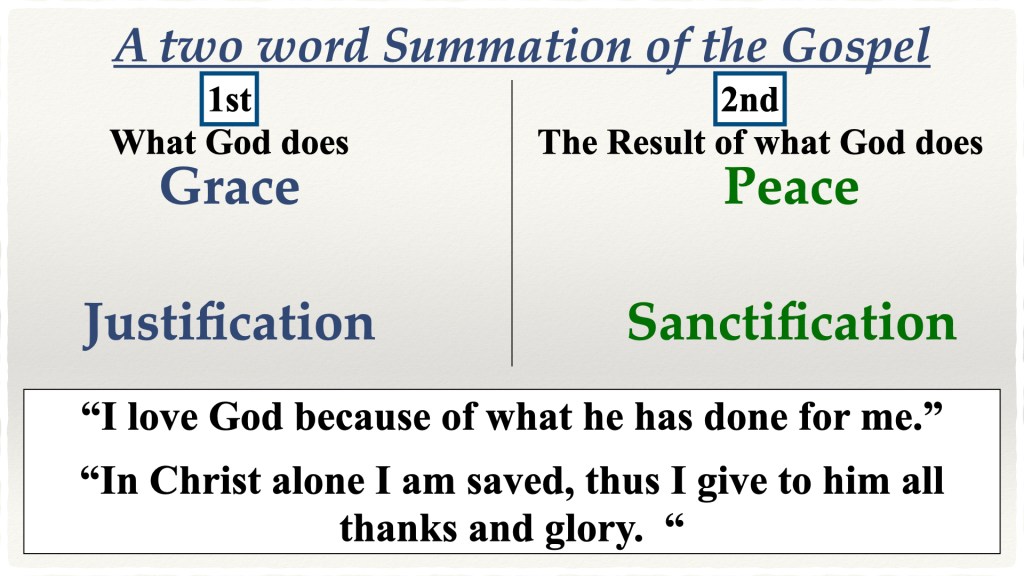
- Justification is the work of Christ (his atonement on the cross) to declare me right before God. It is the forgiveness of sins. It is what God does – thus we put this in the grace category.
- And Sanctification is the work that God does after justification. It is the work of holiness being done in me. Sanctification is the transformation in me because of the gospel, it is the peace I have in Christ, it is the new life I live. Sanctification is grouped in the peace category.
In every day talk we don’t normally go around using the words justification and sanctification. Instead (in everyday talk) we tend to say things like – “I love God because of what he has done for me.” Or, “Because of what he has done (grace, justification), there is this change in me (peace, sanctification).” Or “Through Christ I am saved, thus I give to him all thanks and glory.” Again, notice, the change in us and what we do is a result of what God has done. Got it, that is the right order, that is the gospel. God has done something in history (The cross of Christ) that has changed us today.
Now μεταστρέφω, the perversion of the gospel, is the reversal of this order.
- In stead of grace being first – peace is comes first.
- Instead of justification being first, sanctification is first.
- Instead of our life today rooted in what God has done, it is turn around, making what God does is rooted in what we do. Our salvation (Our justification) is based upon our sanctification (how good we are). This is a false, distorted, and perfected gospel (and it is not the gospel).
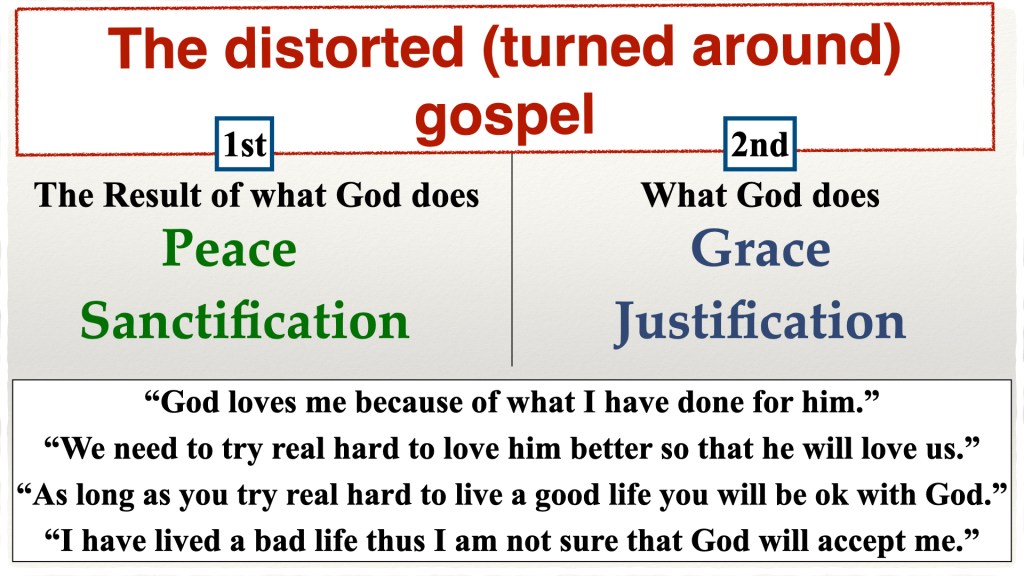
And this – μεταστρέφω – distortion of the gospel is evident when people say or think things like – “God loves me because of what I have done for him.” Or “We need to try real hard and love him better so that he will love us.” Or “As long as you try really hard and live a good life, you will be ok with God.” Or “I need to clean my life up or get right with God before I go to church.” Or “I have lived a bad life I am not sure that God will accept me. “
When people think or say things like this it is coming from a distorted understanding of the gospel. Do you hear what is wrong? Do you hear the perversion? In all of these statements, the action and grace of what God does is dependent upon (it comes after) what a person does. Even that statement that appears to be humble – “I have lived a bad life I am not sure God will want me…” it is locating the Grace (the work of God) based upon how good or how bad is a person. Let me ask you – Does God love you therefore as a result you love him and lead a good life? Or do you come to God and give yourself in love so that as a result he may love you? Which is it? Do you love to get love, or do you love because you are loved? Does God owe you or do you owe God? If you answer that you love God in order to be loved by him then you have a distorted gospel. If you answer that you try to be as good as you can so that God will accept you then you have a distorted gospel. If you think that your works – sanctification – is necessary to receive the blessing of God, which is his grace, then you have a distorted gospel.
A Week ago – Barna Research began to release reports from his “American Worldview Inventory 2020.” A national survey about the worldview of Americans – and thus far what he has released shows that although seven out of ten consider themselves to be Christian, just 6% actually possess a biblical worldview as defined by traditional Biblical views of God, Jesus, the Bible and the Gospel. Other results in of his survey report that only one-fifth of those attending evangelical Protestant churches (21%) have a biblical worldview, which is a 50% decline in the last 25 years. Looking at the age group between 18 to 29 those having a biblical world view is only 2%. He has not yet released the 2020 result for people’s understanding of the gospel – but going back to his report in 2009 he reports that 47% of Evangelicals believe that salvation is earned through their deeds. Which means that nearly 50% of people who claim to be “born again” have a distorted gospel. Today number may be as high as 60 to 70% following the other trends. There are more people in our churches today that have a distorted understanding of the gospel than ever before. Thus, we too need to fight for the gospel. WHY? Paul tells us why. Whenever the gospel of Christ is reversed – sanctification before justification – peace before grace – holiness before acceptance – it is a desertion of Jesus and the church is being destroyed.
The Gospel Proclaimed: Paul calls those who are distorting the gospel “anathema.” Remember the meaning? Anathema is something that is so disgusting, repulsive, shameful, distasteful that it must be spit out, that it must be destroyed. When Paul does this (call these teachers of a false gospel “Anathema”) it feels like Paul is being angry, emotional, and reactionary. I do not think this is true. I am sure he is very angry (he is fighting for the gospel) but I think there is a reason he is saying what he is saying. Sin is an anathema to God. God’s holiness is such that all sin is loathed, it disgusts him, he rejects it all and every fiber of the divine being seeks sin’s complete destruction. This is a large part of what it means to be under the curse of sin which is that because of sin in our own lives we are an anathema to God. This is why the curse of sin is carried out in terms death and separation from him.
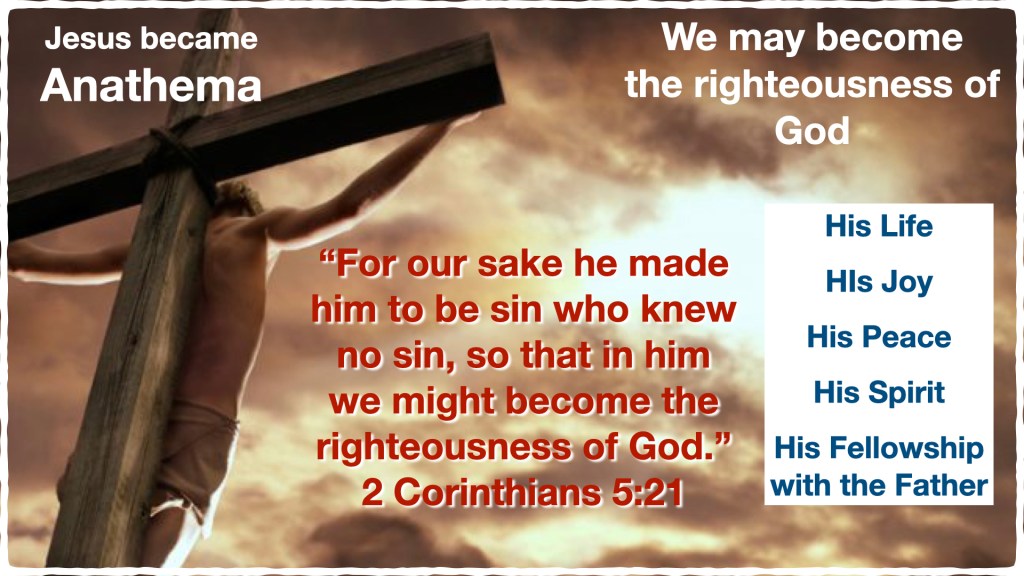
But because of God’s love for us, he does something. This something is the gospel. Paul says in 2 Corinthians 5:21 “For our sake he made him to be sin who knew no sin, so that in him we might become the righteousness of God.” When the Bible says “For our sake he made him to be sin who knew no sin” it means that Jesus became ANTHEMA. That He, the Lord, God the Son was loathed, disgusted, and rejected to the point that every fiber of the divine being brought destruction upon him. He was an anathema. That is what it means when scripture says “For our sake he made him to be sin who knew no sin.” He substituted himself for us. He took our curse; he took our anathema. But when he took our curse, he gave to us his righteousness (“So that in him we might become the righteousness of God.”) Which means that everything that is Jesus’ –
- His fellowship with the father
- His life of abundance
- His Joy
- His peace
- His Spirit
He gave these to us in exchange for our curse, the anathema. This is the gospel that Paul is proclaiming. Jesus substituting atoning death where he himself becomes the anathema to the father so that we may be the righteousness of God. This is God’s gift of grace to you.
Preached by Pastor Trent Eastman
April 26, 2020 – New Baptist Church
 Concerning the Word of Life
It’s definitely essential that God blesses us because He chooses to do so, that He freely saves us, though He owes us nothing and we owe Him everything – that He loved us while we were enemies to Him, and that we love because He loved us first. With this, I wholly agree!
That said, I think sanctification is the work of God. I think justification and sanctification cannot be separated; neither precedes the other – if God forgives you, you are forgiven. If God declares you just, then you are just. The word of God is truth. Just as when God said “Let there be Light!” the light shone in the darkness, so when God speaks, the light of Christ shines in our hearts, and this light in holiness and life.
LikeLike
Thank you for your comment and I greatly appreciate your words. I think this is an area that needs a lot of thoughtfulness. Clearly sanctification is done under and in the Lord’s strength. I can not do it alone. And – if there is a problem in my sanctification (meaning that there is not a growing spiritual maturity) it probably has to do with a problem in my justification (meaning I am still trying to add to what Jesus has done for me). Justification and Sanctification are linked but I do hold that sanctification does come after justification and that there is a difference. As you said – justification is God’s declaration – “You are just.” It is done. Sanctification is now the doing. Or to say this in a different way. I have been forgiven of my sins. But God is not done with me. His work in me does not end with me being saved (justified), but is on going as He draws me near to Him (sanctification). Again, thank you for you post and thoughts!
LikeLiked by 1 person